My hot air balloon safari adventure in remote Tanzania

Teresa Levonian-Cole went on a hot balloon safari adventure through remote Tanzania. It was a brilliant new way to experience those great beasts
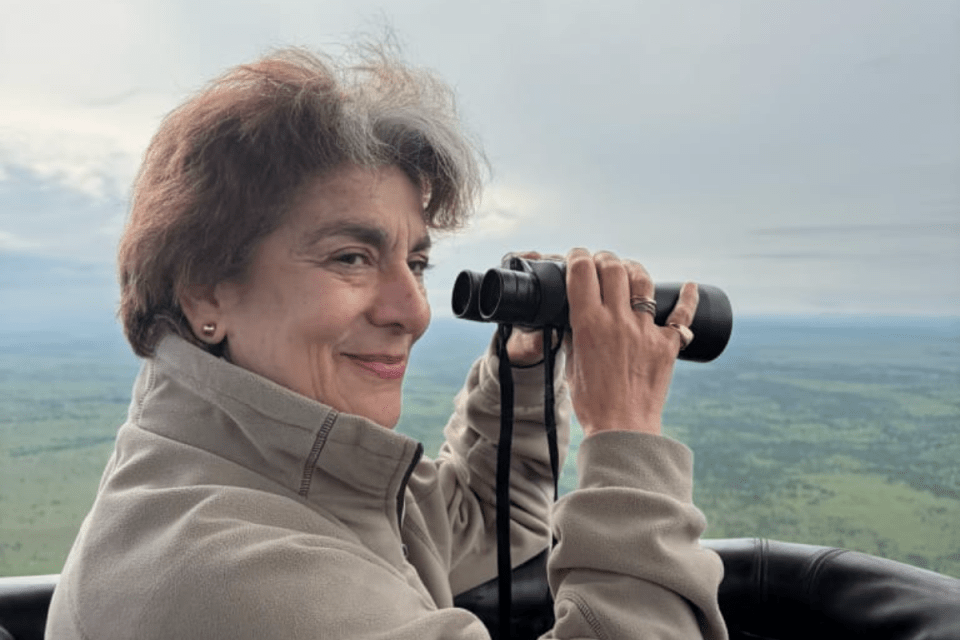
It is remarkable what you can see – both real and imagined – from a height of 1,500 feet. The vast expanse of the Serengeti, a UNESCO World Heritage Site the size of Belgium, spreads out beneath us, a world of emerald and sage greens traversed by veins of sludge brown river.
We are the only airborne balloon in this part of the National Park and our pilot, Amanda Brodbeck, two-time US Women’s National Ballooning Champion, expertly steers it, pointing out the wildlife below.
We float down for a closer look at a dazzle of zebras, each with its unique psychedelic stripes, and at a tower of giraffes picking leaves from thorny acacia trees with their prehensile lips. In the silence, a fish-eagle squeals.
A sounder of warthogs minces along, tails aloft like the umbrellas of Japanese tour guides, and a troop of African buffalo – the most deadly of the Big Five for hunters, Amanda tells us – form a landing strip for ox peckers.
A safari in remote Tanzania
We spot a parade of elephants in the distance, adults with their babies in an orderly line, led to goodness-knows-where by the family’s matriarch, and head towards it, hissing hot air into the balloon to make it rise higher, so as not to spook them.
And, what’s that… a rhino? “No” laughs Amanda, “that’s a rock, otherwise known as an ALT – an Animal-like Thing. There are plenty of those around!”.
We are lucky that the thunderstorms and rains of the last few days have cleared to reveal azure skies and picturesque, fluffy cloudscapes as the backdrop to those iconic umbrella trees.
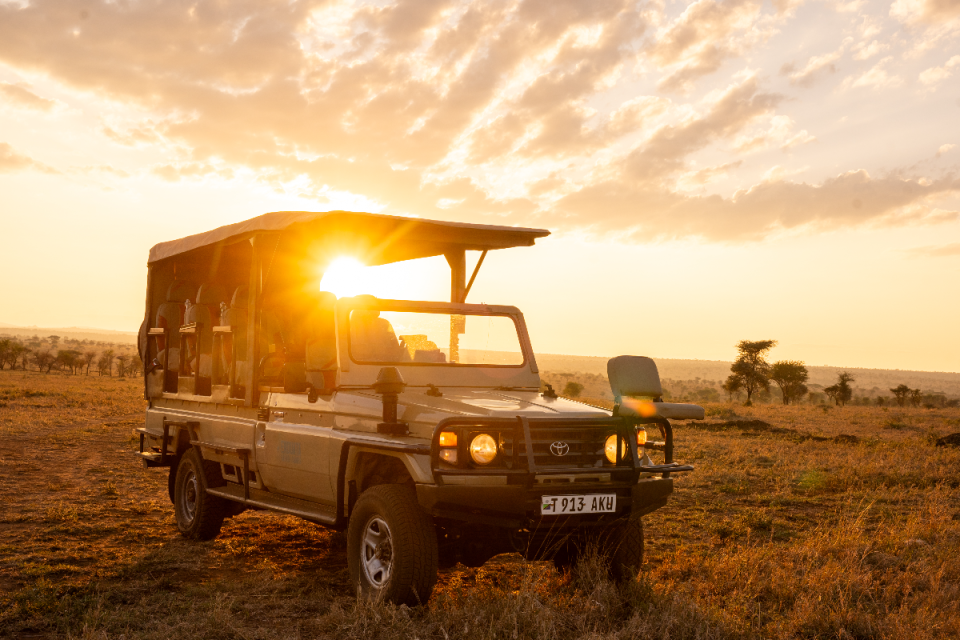
But back on terra firma, the ground remains boggy, which makes for interesting game drives, and some nifty manoeuvering by our driver, Shady (as in Shadrach). Stuck in mud, we have ample opportunity to study lion prints alongside our tyres, and a puff adder, apparently drowned in a puddle.
Reaching the Serengeti is an adventure in itself. From London I flew with Qatar to Tanzania’s Kilimanjaro International Airport with a layover in Doha.
From the Tanzanian city of Arusha, Miracle Air – which has the most delightful African-themed private lounge, brimming with coffee-table books – flew us in a twin-propeller over 140 miles of savanna and the impressive volcano of Ol Doinyo Lengai (“the mountain of God”) to land on a muddy air strip at Seronera, on which hyenas had recently left their mark.
Far from a shiny five-star safari
This is back-packer central – the Piccadilly Circus of the Serengeti – but bumping along in the safari jeep, we turned off in the direction of heavily-guarded gold mines, leaving the crowds behind.
My temporary home some 30 kilometres to the south-west is a brand new camp in the Central Serengeti, known as Wild Wakati – co-founded by Matt Wilkey and Tanzanian guide, Michael Kisiri.
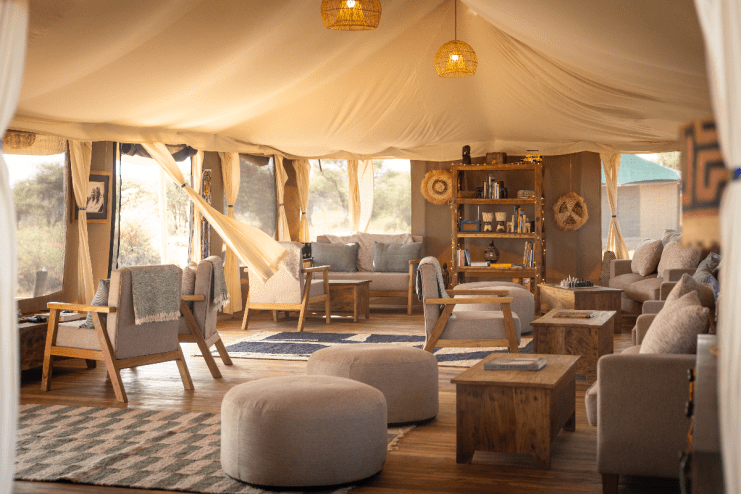
We arrive at a remote spot with a crescent of ten green tents, spread round two central tents that serve as bar, sitting and dining areas. And we are greeted by a three-line whip of staff, beaming from ear to ear, who treat us to an impromptu celebration of song and dance.
Wild Wakati is far from one of those shiny five-star hotel chain camps. Understated and sensitive to the environment (avoiding disturbing any migration routes), this semi-permanent camp nevertheless provides every creature comfort, thanks largely to the staff, for whom nothing is too much trouble.
“We deliberately chose to buy local tents,” says Matt, “rather than the South African tents that so many camps use, because we wanted to benefit the local economy and give back to the community.”
Lie awake listening to the distant roar of lions
As much as possible is locally sourced. “Our staff are all local people – 40% of whom have never worked in hospitality before, and were trained by us. Many of them were orphans, and had no prospects at all.”
Inside, decoration is simple: Maasai textiles, African beaded necklaces, wicker lampshades, squashy sofas, and cotton blankets made by a social enterprise that gives employment to disabled Tanzanians.
Bedrooms, too, are simple, but equipped with everything you need, including an ensuite ‘bathroom’ with proper loos and bucket showers (plumbed modern versions are being installed).
Most importantly, beds – huge and comfortable – are insulated by wonderfully effective mosquito nets, enabling you to lie awake at night, listening to the distant roar of lions and the sinister laugh of hyenas, untroubled by dive-bombing insects.
With three chefs, including a pastry specialist, Wakati shines on the culinary front. We enjoy a lavish barbecue one a starry night, while a three-course dinner might include pumpkin and ginger soup with herb gremolata, followed by stuffed chicken breast with mustard sauce, pumpkin purée, mash potato, and seasonal vegetables accompanied by liberal quantities of good South African wines.
The air trilling with birdsong
This is more Parisian bistro than wilderness nosh. Equally impressive are barlady Diana’s killer spicy Margaritas, which are perfect while watching the sun set from a ridge overlooking the distant Makoma Hills around 25 kilometres east of the camp.
Twice daily, we venture on safari, the air trilling with birdsong and feathery flashes of colour. We spot a crocodile dragging what’s left of a zebra, and a lioness eyeing us eyeing her as she guards her kill, concealed in a bush.
We watch wallowing hippos, one of which eventually rewards us with its wide honky-tonk piano yawn. Not to mention those cute rodent-like rock hiraxes that squat on granite kopjes. They are, bizarrely, the closest relative of the elephant.
Leopards and cheetahs elude us on this trip. There are just 300 in the Serengeti, according to Dennis Minja of the Cheetah Conservation Initiative.
But one of our number, who stayed for a few days longer, made us all jealous by sending photos of her sightings: not only of a statuesque cheetah with Charlotte Rampling eyes; but of a leopard, lounging in a tree, feasting on an impala. Nature – in all her glory – red in tooth and claw.
Visit Tanzania for a hot air balloon safari
Enduata Camps offers full board and game packages for 2026 with prices per person based on sharing or single occupancy, ranging from £381 – £471. For more information go to enduatacamps.com. Return flights with Qatar Airways to Kilimanjaro International in Tanzania via Doha start from around £738. Internal charter flights with Miracle Air are around £300.
Read more: A modern type of safari with Sri Lanka’s leopards and elephants
Read more: This must-book Kenya safari goes way beyond The Big Five