Labour ministers, please stop begging us to celebrate your tiny wins

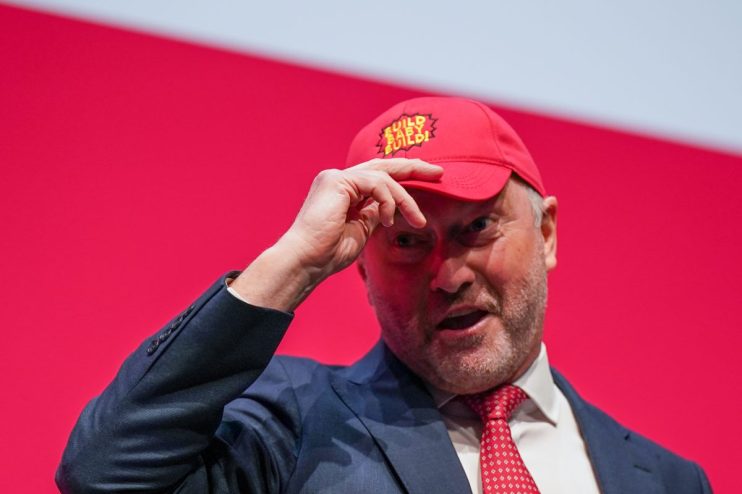
The housing secretary has decried newspapers for burying good news, but Labour’s tiny upticks in tiny numbers are hardly worth celebration, writes Emma Revell
“POV: trying to find good news in UK newspapers…”
Aren’t we all. But last week, Steve Reed made a particularly determined effort. The Labour housing secretary decided to post a video of him doing just that – bemoaning the fact that as he flicked through the papers, all he found was bad news. On he went, turning pages past the horoscopes and the crossword before announcing that, on page 42, he’d found the headline “IMF updates UK growth to third among G7 states”.
“That means the economy is growing,” Reed was delighted to tell us. “Third of the biggest seven economies in the world.”
And that is true.
The IMF did recently change its estimate for UK growth in 2025 to 1.4 per cent, up from 1.3 per cent previously, which puts us behind only the US and Canada in the G7. But that’s not the full story. Spain is estimated to have grown by 2.9 per cent in 2025, Poland 3.3 per cent.
Suddenly we begin to understand why a 0.1 per cent increase in our growth rate may have only made it to page 42.
Another story Reed highlighted was about a recent 18 per cent increase in new housing starts, something his own department is clearly delighted about. Again, unfortunately for him, behind the headline figures lurked a more depressing picture.
There’s a reason we’re not celebrating…
My colleagues at the Centre for Policy Studies (CPS) recently published new analysis showing that in 2024/25, every region in England started fewer homes than in the previous financial year. This slowdown was especially dramatic in London, which saw only 4,170 new homes starting construction last financial year, a 72 per cent fall over the previous year.
Even if there has been a recent uptick, the fact we are starting from such a low base – with a shortfall of 6.5m homes compared to our European neighbours – should not be cause for celebration.
Such is the dire state of growth in Britain in recent decades that Labour ministers are reduced to posting videos begging us to cheer even the most minor of improvements. A bit like when my secondary school made a big deal about getting an award for being one of the most improved in the region but neglected to mention that we were on the edge of special measures. While improvement was welcome, personally I wouldn’t have been preparing the party poppers.
What Britain needs is prosperity. Full-throated, all-out growth, not rounding errors on an IMF spreadsheet.
That is why when it came to choosing the theme for this year’s Margaret Thatcher Conference, that is what the CPS decided on. Our annual flagship half-day conference, held this year on April 27, will bring together over 400 business leaders, policymakers, activists and campaigners to discuss how we can turn the ship around.
Not to crow about gains within the margin of error, but to bring about a sustained period of significant growth that benefits Britain.
Discussions will be broad and I have no doubt City AM readers will have plenty of ideas about where we can start. To that end, I hope to see many of you in April.
After all, business leaders with decades of experience, including experience working across global markets, who can bring in lessons from other countries will be just as valuable as a start-up small business owner struggling to navigate red tape from a co-working space or their spare bedroom.
Our aim is to have both sides reflected on stage at the conference because fixing the problems holding our growth back means listening to ideas from a wide range of voices.
Finding and retaining growth will be difficult but the need to do so is paramount. Our research back in 2023 showed that to keep pace with the rising cost of the welfare state in an ageing society, the UK will need annual growth of 2.9 per cent per cent over the next 50 years – a rate it has hit just twice in the last two decades, excluding the post-pandemic rebound. When you also factor in the cost of working-age welfare spending, not least the surge in working-age economic inactivity, that figure is almost certainly higher today.
To fund the future, it is paramount we turn the country towards growth now.
Emma Revell is external affairs director at the Centre for Policy Studies