JD Vance’s Armenia trip will boost US economy. Why isn’t the UK there?

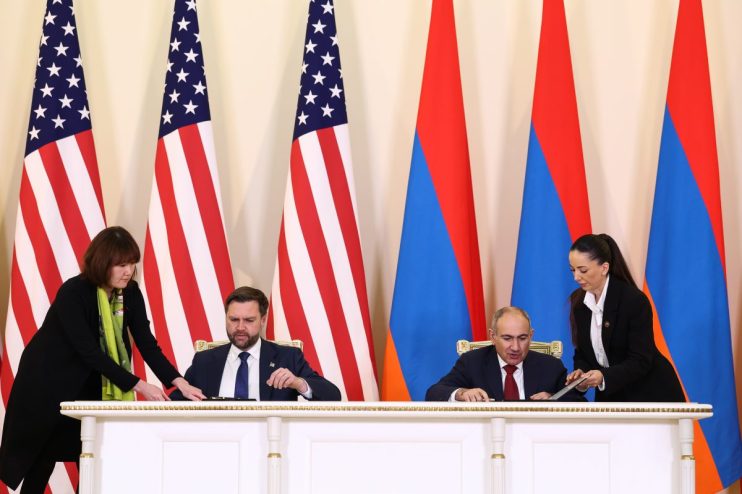
JD Vance is in Armenia to secure US economic interests, the UK should be there too, writes Armenian ambassador to the UK Varuzhan Nersesyan
When JD Vance stepped onto Armenian soil this week, it marked more than an historic first visit by a sitting US vice president: it signalled a decisive moment in Armenia’s future orientation.
In a single visit, the relationship between Washington and Yerevan has moved from symbolism to substance, with the signing of a civil nuclear cooperation agreement unlocking up to $9bn in US investment in next-generation energy and small modular reactors; the deepening of security ties through reconnaissance drone sales; and access to advanced US high-performance computing technologies.
Alongside this, the US has reaffirmed its support for Armenia’s peace track with Azerbaijan and for economic connectivity initiatives like ‘TRIPP’ – the Trump Route for International Peace and Prosperity: a 43-kilometre, multimodal route across southern Armenia linking Azerbaijan to its exclave Nakhchivan and onward to Türkiye. This positions Armenia not as a peripheral state defined by conflict, but as a sovereign, technologically capable and economically connected partner at the crossroads of Europe and Asia.
In short, the visit marked a clear inflection point in the geopolitics of the South Caucasus, signalling the consolidation of a new regional order after decades of closed borders and unresolved conflict.
Last August, under the auspices of President Trump in Washington, Armenia and Azerbaijan agreed to move beyond a legacy of hostility by initialling a long-awaited Peace Agreement. For a region long shaped by confrontation rather than cooperation, this was an historic breakthrough. Yet, while the political significance of the agreement is profound, its economic and strategic consequences may prove more far-reaching.
The peace process was accompanied by the announcement of the TRIPP route. It is much more than just a regional transport project, it is a strategic intervention in global trade architecture with the potential to reshape how goods, energy and investment flow between Europe and Asia. VP Vance’s visit shows that this US underpinning of peace is real.
For Armenia, it is transformative. TRIPP makes Armenia a critical transit hub, rather than a geopolitical cul-de-sac. By unlocking economic potential, the initiative promises growth, investment and stability, key prerequisites for a durable peace.
And TRIPP’s impact extends well beyond Armenia. The route will integrate the South Caucasus into broader Eurasian trade networks by enabling transit from the Caspian Sea through Armenia to Türkiye and onward to Europe. In doing so, it circumvents long-standing, problematic transit dependencies, an important priority for Western states aiming to diversify their supply chains.
Importantly, the TRIPP route remains Armenian sovereign territory, reinforcing the principle that connectivity cannot come at the expense of sovereignty; and US leadership in the development and management of the route reflects a broader strategic calculation: that long-term peace is best secured not through military presence alone, but through economic interdependence and shared prosperity.
UK must foster Armenia relations too
Crucially, London has a stake. The UK has strong commercial interests in Central Asia, the Caucasus and wider Indo-Pacific region – geographies connected by a ‘Middle Corridor’ increasingly seen as the most credible alternative to East–West routes through Russia and Iran. British businesses can benefit from improved access, while policymakers gain from diversified trade routes that reinforce a rules-based international system.
TRIPP also offers the City of London an opportunity to do what it does best: turn geopolitical intent into economic reality. It is not simply a regional transport link, it is an investable platform. The City’s strengths – deep pools of institutional capital, world-leading expertise in infrastructure finance, political-risk underwriting – are precisely what’s needed to crowd in investment and mitigate the risks that otherwise deter participation.
By helping to structure TRIPP as a credible, investable platform, the City can unlock long-term capital while setting a global benchmark for financing “connectivity for peace”. Embracing TRIPP is not charity or diplomacy dressed up as finance; it is a commercially disciplined opportunity to back a route that converts stability into trade, and trade into stability.
TRIPP redefines the South Caucasus as a bridge rather than a fault line, and positions Armenia at the centre of the global trade revolution. For the UK, engaging with this shift is not only in its own interests, it would be an investment in a more connected, resilient and prosperous international order.
As global trade patterns evolve and competition intensifies, trade routes that combine stability and openness will become increasingly valuable. As a collaborative effort between Armenia and the United States, TRIPP is set to transform global trade; and London’s financial and commercial expertise can help contribute to its success.
Varuzhan Nersesyan is Armenian ambassador to the UK