Farage unveils Reform UK’s new economic policies

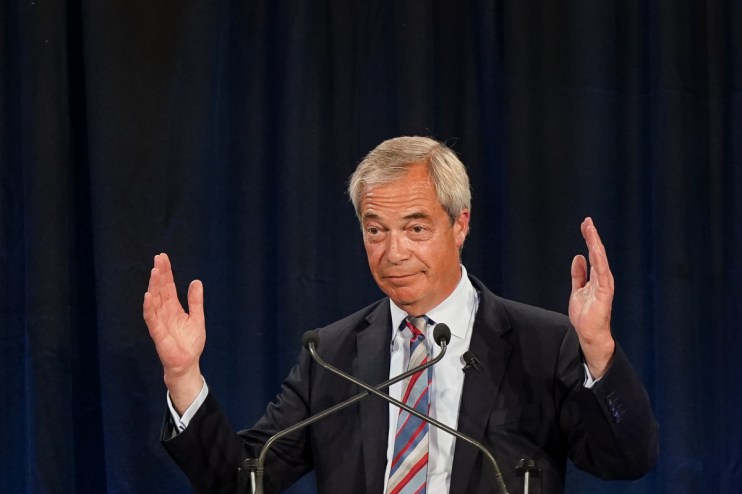
Reform UK leader Nigel Farage has unveiled a tranche of policies aimed at increasing birth rates in the UK, cutting down on government spending, and reinstating welfare policies as he seeks to capitalise on the party’s popularity.
The new policies are part of a wider push from the party to present themselves as “the party of workers, and also the party of entrepreneurs,” which Farage states is not a contradiction as “the two can’t survive and exist and succeed without each other.”
Natalist policies
Farage announced “a transferable tax allowance between married people” in order to “encourage people to have children.”
In 2023, the UK saw the lowest number of births since 1977.
In service of this aim, Farage has also promised to scrap the two-child limit on benefits.
Farage pointed out that removing the two-child limit on benefits is “not because we support a benefits culture,” but in order to make having children easier for “lower paid workers,” – though he admits this is “not a silver bullet.”
The Reform leader claimed that he will introduce this change despite it being unpopular across the country, though Farage is not the only politician pushing for it; Starmer is expected to jettison the two-child benefit cap within the next few weeks.
Farage specified these policies are “not aimed at those that come into the country and suddenly decide to have a lot of children” but at “British families.”
He argued that children who grow up in married families “have the best chance of success in life.”
The Reform UK leader is taking cues from across the pond, where President Donald Trump promised to be “the fertilization president.” The US government is also considering a $5,000 “baby bonus” to be awarded after every birth.
Right-wing welfare state?
Farage vowed to fully reinstate the universal winter fuel payment scheme, though Prime Minister Keir Starmer has already committed to re-visiting winter fuel payment cuts.
He reiterated Reform’s manifesto promise to lift the income tax threshold to £20,000 a year, in order “to “encourage people to get off benefits and to go back to work.”
Farage also committed to scrapping inheritance tax and corporation taxes for small and medium sized companies.
Deputy Director of the Institute of Fiscal Studies, Helen Miller called Farage’s plan “very large tax cuts to be paid for with very large spending cuts.”
“Three high profile giveaways – scrapping the two-child limit on benefit payments, reinstating the winter fuel allowance in full, and introducing a more generous transferable marriage tax allowance – are dwarfed in size by the manifesto pledge to increase the income tax personal allowance to £20,000 a year, a substantial increase on its current value of £12,570.
“Without more detail it’s not possible to put a precise number on the cost of this promise, but it could easily be in the range of £50 to £80 billion a year,” Miller added.
UK DOGE
Farage referred to the US Department of Government Efficiency, set up under President Donald Trump and run by Elon Musk, which has de-funded programmes across the US.
“Our DOGE unit has now been set up,” Farage said, aimed at tackling “excessive waste of money in local government.”
According to the Reform UK leader, Reform’s councillors will prove to the electorate the party’s ability to save money.
“If we win the next election we will scrap net zero,” Farage said, which costs government “£40bn plus every year.”
Farage said he also wants to “scrap the DEI agenda,” which he claimed “is costing the taxpayer up to £7bn a year throughout the public sector,” as well as make cuts to quangos.