Cognac: The storied history of France’s luxury spirit

Whisky Business: City AM’s monthly look at the world of whisky. This week, a look at the world of Cognac.
Cognac is one of the world’s most storied spirits. Created around 500 years ago, more out of necessity than anything else, Cognac is today associated with luxury, high-end quality and refined craftsmanship.
The story of its growth is one of globalisation, immigration, money, quality and above all, time.
Burnt wine
In the 16th Century, Dutch merchants importing wine from the Charente vineyards faced a problem.
The wine often spoiled during the long journeys from the Atlantic coast of France to their destination, so they turned to distillation to try and extend the life of the product by increasing the alcohol content.
The distillation process produced a drink called randewijn or burnt wine, a form of brandy. This burnt wine was then redistilled to create a refined eau-de-vie, which, when aged, created Cognac.
Over the next 200 years, English and Dutch traders refined and developed the method of creating this eau-de-vie while opening up new markets.
By the 17th century, the drink was highly popular among English aristocrats, with a strong following in and around London. This footprint in the capital of Great Britain’s growing maritime empire at a time of rapid expansion helped drive international demand for Cognac.
To meet the growing demand, a handful of major so-called Cognac houses emerged, such as Martell (established in 1715) and Rémy Martin (1724).
Many were founded by traders and entrepreneurs who had travelled to the region to try their fortune in this young market, such as the Irishman Richard Hennessy, who set up his eponymous brand in 1765.
Cognac: Built on trade
The industry’s growth was undoubtedly aided by the town of Cognac’s position on the Charente River and its trading history.
From the Middle Ages until the 16th century, the town was a major hub for the salt trade, infrastructure that was repurposed to support the growth of Cognac exports. Barges laden with barrels of Cognac would travel down the estuary to La Rochelle, where they would be loaded onto ships for export around the world.
Throughout the 17th and 18th centuries, producers in the Cognac region refined their distillation processes and began ageing the drink in oak barrels, creating a smoother spirit than standard brandy.
Then in 1909, the French government decreed that only brandies made in this specific area of France could be called Cognac and in 1936, Cognac was officially granted Appellation d’Origine Contrôlée (AOC) status.
Under the AOC rules for a spirit to be legally called Cognac, it must be produced in the Cognac region of France using specific white grape varieties, double-distilled in copper stills and aged for a minimum of two years in French oak barrels.
Grande Champagne
Three towns sit at the heart of the six grape growing zones that make up Western France’s Cognac region: Cognac, Jarnac and Segonzac. The grape zones, or crus, are based on soil quality and the quality of the fruit.
Those crus closest to the centre, Grande Champagne and Petite Champagne, are chalky and considered to produce the best-quality fruit. (‘Champagne’ is derived from the Latin term for field, ‘campus’, and not the wine region in the North-Eastern France).
The wine produced from the grapes must be distilled by 31 March. It’s then put into oak barrels to age and is graded as ‘Compte 0’. One year later, on 1 April, the spirit graduates from ‘Compte 0’ to ‘Compte 1’, indicating it has aged for one year.
Cognac requires a minimum of two years in the barrel (‘Compte 2’) before it can be sold to the market, at which point it can be sold under the VS or Very Special label.
There are four levels of Cognac maturation:
- VS (Very Special) – the youngest spirit in the blend was barrel aged for at least two years
- VSOP (Very Superior Old Pale) – the youngest spirit in the blend was barrel aged for at least four years
- XO (Extra Old) – the youngest spirit in the blend was barrel aged for at least 10 years
- XXO (Extra Extra Old) – the youngest spirit in the blend was barrel aged for at least 14 years
Paradise Cellar
What really makes the Cognac sector unique is its history. The best barrels are decades old and have been filled, emptied and refilled multiple times.
Some have been in use since Cognac achieved its unique status – more than a century in some cases. The oldest Cognacs make the oldest whiskies look like children.
All houses have a place where the oldest and most precious Cognacs are stored, called the Paradis or Paradise Cellar. When removed from the barrel and stored in glass jars away from light, Cognac can last for centuries.
The oldest confirmed Cognac is a 1696 Jules Robin Cognac, which belongs to Dutch collector Lars Janssen.
And when stored, this drink leaves a unique mark. Driving through the region you’ll notice building after building stained with thick black marks. This is, in fact, a fungus that thrives on ethanol vapours escaping from ageing barrels (the Angel’s Share).
It frequently coats buildings, trees, and fences near distilleries and warehouses. Historically, it was used by tax collectors to identify where Cognac was being stored.
A regional tour of Cognac
With its rich history, the Cognac region is worth a visit for both fans of the drink and newcomers to this world.
The region is dotted with historic Cognac houses, many of which are open to the public, such as the Chateau Royal de Cognac, the 10th-century castle that became one of the world’s first Cognac houses.
For a really special experience, visitors can choose to stay in the Hôtel Chais Monnet & Spa, a luxurious five-star retreat that has been transformed from a 19th-century trading house.
Part-owned by Javad Marandi, the proprietor of Soho Farmhouse, the site’s history dates back to 1838 when Pierre Antoine de Salignac founded a cooperative society for stocking eau-de-vie.
It later passed to the Monnet family, with Jean Monnet, a founding father of the European Union, heading the firm between the wars. Today, the hotel offers 92 rooms and suites spread across four buildings, which used to house the old Cognac warehouses.
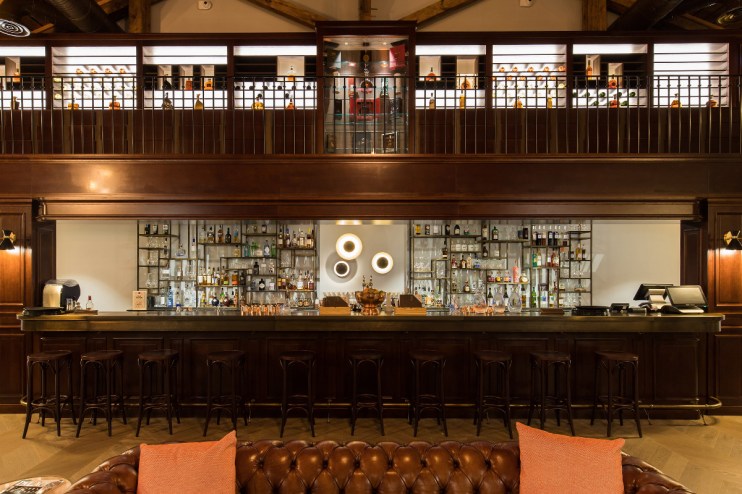
Guests can enjoy exceptional dining at the Michelin-starred Les Foudres restaurant, housed in the old blending room, while the Bar & Rooftop 1838 boasts over 330 Cognac brands – a unique location from which to base a tour of the Cognac region.
Coming up this weekend is The Whisky Exchange’s annual Cognac Show. A celebration of French spirit in the heart of London, the great of Cognac descend on the capital to showcase their products, with cameos from Calvados and Armagnac producers too.
City AM readers can get £5 off tickets to Cognac Show using code COGNACCITY at checkout via Design My Night.