Arm’s AI ambitions hit supply chain reality despite record revenues

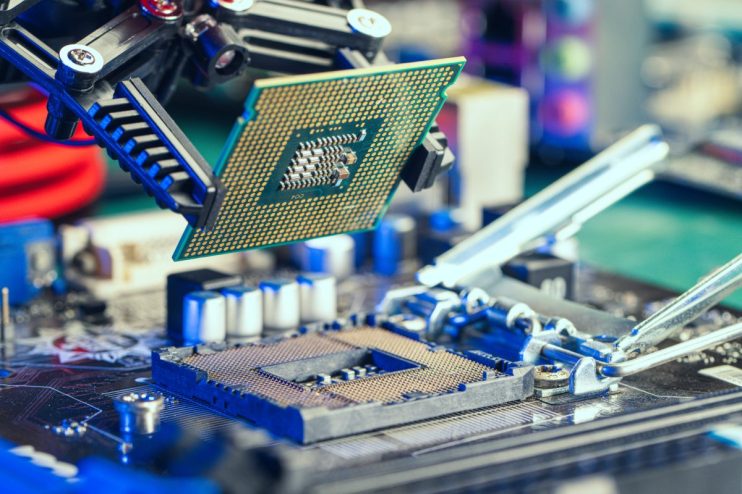
Computing giant Arm has spent the last twelve months posing as one of the AI boom’s biggest beneficiaries, but the British chip maker’s latest results exposed that the semiconductor supply chain is lagging behind demand.
The Cambridge-born company posted record quarterly revenues of $1.49bn (£1.09bn) and annual revenues of $4.92bn on Wednesday, marking its third consecutive yearly growth above 20 per cent since its return to public markets.
Licensing income rose, datacentre revenue more than doubled, and Arm told markets that demand for its new AI chips has already passed the $2bn mark across the next two financial years.
But despite the positive set of results, shares tumbled after executives admitted they had not bagged enough manufacturing capacity to meet demand for the firm’s new CPU products – processors purpose-built for new AI datacentres and AI agents.
The market reaction falls as investors begin to scrutinise whether companies can actually deliver enough hardware to satisfy hyperscalers racing to build out infrastructure.
“It wasn’t the numbers that spooked investors, but concerns about sourcing manufacturing capacity for its next-gen AI processors”, said Darren Nathan, head of equity research at Hargreaves Lansdown.
“That can be read as yet another signal of white-hot demand for computing power”.
The numbers also pointed to the shift in Arm’s own strategy, from decades of operating as a licensing powerhouse and supplier to heavyweights such as Apple, Nvidia and Apple, to pushing the firm into far more ambitious AI territory.
From chip blueprints to AI infrastructure heavyweight
Chief executive Rene Haas used the earnings to update the position Arm increasingly as a direct participant in the AI infrastructure race itself.
Its new CPU, launched earlier this year and partnered with Meta, was the company’s first push into production silicon, made specifically for data centres.
The chips are designed for agentic AI systems, where autonomous tools rely on this software to execute tasks without human involvement.
The company says Arm-based compute now represents roughly half of CPU market share among top hyperscalers, with Amazon, Google, Microsoft and Nvidia all deploying Arm-based systems inside next-generation AI infrastructure.
Google recently announced it would replace its processors with Arm-based Axion chips in future TPU systems, while Nvidia’s new CPU platform is also built on Arm architecture.
Meanwhile, AWS said its Arm-based chip business is now generating over $20bn annually.
But, unlike licensing intellectual property, selling actual chips leaves Arm more exposed to manufacturing constraints, particularly through foundry partner TSMC.
Executives acknowledged that memory shortages and supply limitations are already constraining how quickly it can fulfil demand for its AI products.
And, while AI spending remains ferocious, cracks are beginning to emerge elsewhere. Arm warned that weakness in lower-end smartphones and rising memory costs had weighed on royalty revenues, reflecting broader softness across global handset markets.
At the same time, revenue flowing through Arm China has been surging as Chinese firms appear to front-load licensing agreements amid fears future export restrictions could limit access to Western semiconductor tech.
Financially, the business still appears remarkably strong. Once the distortions of IPO-era stock compensation are stripped out, Arm’s profitability has remained consistently robust, with roughly 40 per cent of revenues converting into adjusted profit across recent years.