Angela Rayner: People in tax-dodge houses shouldn’t throw stones

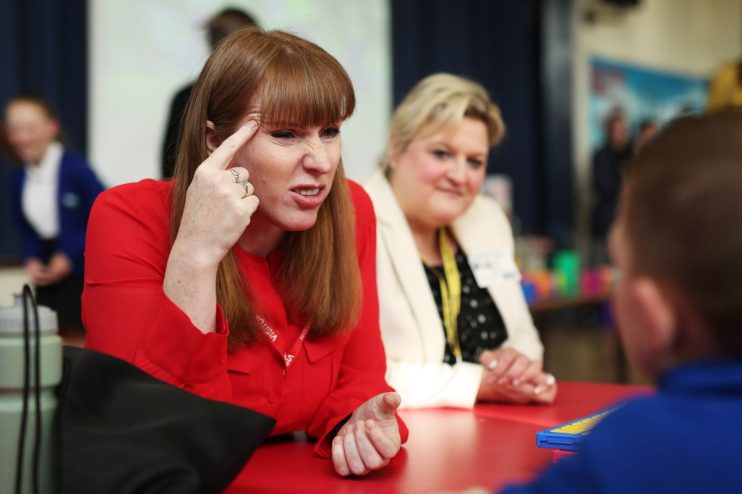
Deputy prime minister Angela Rayner will be lucky to survive this latest tax-dodging property scandal, writes James Ford
If you are a government minister there are always a number of key warnings that your frontbench career is on the brink. The first stage of your fall from grace is when your fellow ministers end up having to defend your actions during a media round when they were supposed to be talking about the government’s latest policy wheeze. In stage two, the Prime Minister has to say he stands by you at PMQs. In the third stage, you find yourself stating emphatically that you are going nowhere. It is at this point that you should probably start drafting your resignation letter. The scandal over the deputy prime minister’s property tax payments has just reached stage two. Angela Rayner should be worried, very worried.
Until those fateful pictures of her quaffing rosé on Hove beach emerged, it would be reasonable to think that Angela Rayner was having a very good summer. According to Labourlist, she was the second highest rated member of the Cabinet amongst Labour voters and the second most popular choice amongst Labour members to succeed Keir Starmer as party leader. (In both surveys she was the highest rated woman). Her position seemed unassailable and the stealth with which she seemed to have put herself into poll position for the Labour leadership spoke of a level of political dexterity that she rarely gets the credit for. (As she told The Times earlier this year, “Whatever I achieve, people still say I’m thick.”)
The centrepiece of Rayner’s cunning plan is arguably the Devolution Bill, one of the most blatantly political pieces of legislation currently making its way through Parliament. As well as eradicating the nation’s hitherto Tory controlled county councils and foisting a form or proportional representation on mayoral elections across the country, the Devolution Bill will also introduce new rules to prevent serving mayors from also sitting as MPs at the same time.
Ruthless
This may sound innocuous but there is a ruthless political calculation behind it. This rule will prevent popular, high-profile Labour mayors like Andy Burnham and Sadiq Khan from entering Parliament before their current terms of office are up (in 2028) and standing as candidates in any leadership contest to replace Keir Starmer before the next election (something that is being considered and discussed with increasing frequency in Labour circles). That same poll that ranked Rayner as Labour member’s second choice to be the next party leader has Andy Burnham ranked in first place (with 57 per cent of the vote) and Sadiq Khan in eighth place. Speculation is growing that Burnham is seriously contemplating a return to Westminster in a matter of months rather than years. The Devolution Bill changes are clearly intended to stop that.
However, whilst Rayner was undoubtedly outmanoeuvring her Labour rivals for the leadership, she was also creating large potential problems that will create headaches for future Labour leaders (whomever they might be): by-elections. Like the Conservatives, Labour strategist are rightly terrified of the prospect of by-elections this Parliament because the political landscape is so volatile and because parties like Reform and the Greens are surging in the polls. There is a much higher risk than normal that any by-election will result in a loss for the party that currently holds a seat. Whilst Labour’s massive majority means they need not fear becoming a minority administration, it is never a good look to lose seats (as they did in Runcorn and Helsby earlier this year).
However, the biggest risk that derives from the rule change on the Devolution Bill is not an increase in parliamentary by-elections, but possible mayoral by-elections. If an ambitious mayor is really determined to swap City Hall for Parliament, they could just stand down from their post before the end of their term of office. In London, if this happens less than six months before a mayoral election is due to take place, then London’s Statutory Deputy Mayor (Joanne McCartney) simply takes over. But, any more than six months before May 2028, and a full, London-wide special election is required and every Londoner troops to the polls. If you think losing a constituency of 75,000 voters looks bad, imagine the political fallout of losing control of a city of 6m voters.
But for all the stealth and ruthlessness of Rayner’s ascent, that she now finds herself on the brink from yet another furore over her property portfolio and tax arrangements speaks to a greater political sin: a failure to learn from past mistakes
Even her purchase of that flat in Hove is rumoured to be part of her plan to become the next Prime Minister as it paves the way for her to potentially move to be MP for a safer seat. Rayner currently has a majority of 6,791 over Reform UK in her Ashton-Under-Lyne constituency but is thought to be at risk whilst Peter Kyle’s seat of Hove and Portslade has a super-safe Labour majority of 19,881 over the Greens.
But for all the stealth and ruthlessness of Rayner’s ascent, that she now finds herself on the brink from yet another furore over her property portfolio and tax arrangements speaks to a greater political sin: a failure to learn from past mistakes. Afterall, isn’t this scandal exactly like the one that engulfed her last year regarding capital gains tax on her constituency home? To paraphrase Lady Bracknell in The Importance of Being Earnest: to become embroiled in one scandal about dodging tax on a home purchase may be regarded as a misfortune; to become embroiled in two looks like carelessness. And, whilst voters may be persuaded to forgive many things, carelessness is not a welcome quality in an aspiring Prime Minister.
James Ford is a public affairs consultant and a former adviser to Mayor of London Boris Johnson