A Requiem for the Boris Bus

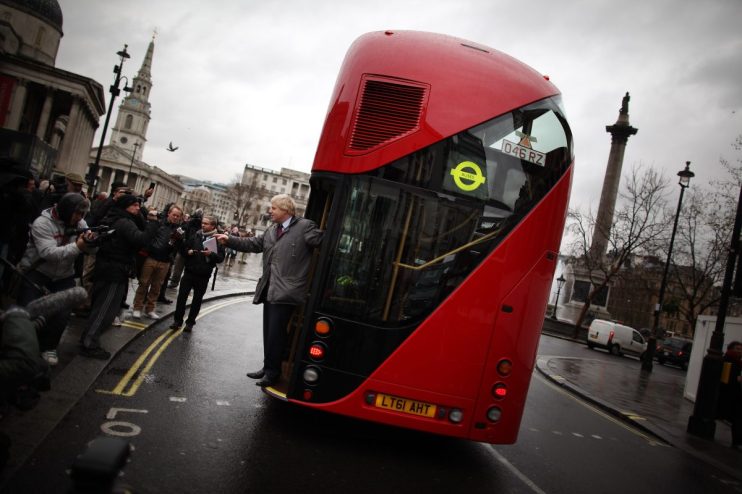
Sadiq Khan’s decision to scrap the iconic ‘New Bus for London’ is about politics not practicalities, writes James Ford
London’s fleet of red buses are iconic. Like black taxis, Beefeaters and red post boxes they are a globally recognised visual shorthand for the capital. And, for better or worse, Mayors of London come to be defined as much by their flagship bus initiatives as for any other policy or project.
I say ‘for better or worse’ because, sadly, whilst Mayoral bus policies are usually well-intentioned, they are as likely to end in ignominious failure as they are in glorious triumph.
Take, for example, Ken Livingstone’s entry in this niche field: the introduction of the bendy bus in 2002. The bendy buses were long, articulated buses deployed because of their greater passenger capacity and speedier, multi-door loading. Sounds reasonable, right? Unfortunately, their length often made it harder for pedestrians to cross the road, they lacked seats and they gave fare-evaders free rein. They were also – and I cannot overstate the significance of this enough – prone to spontaneous combustion. And you do not have to be a transport expert to know that a propensity to burst into flames is a highly undesirable quality in a bus. Boris Johnson branded them “jack-knifing, traffic-blocking, self-combusting cyclist-crushers” and made scrapping the bendy bus a key plank of his successful election campaign in 2008.
This brings us to Boris’s entry in the saga of City Hall-led bus innovation: the Boris Bus. Designed via a public competition and intended to be a spiritual successor to the much-loved Routemaster, the ‘New Bus for London’ (as it was officially named) was built in the UK and, at its launch, was proclaimed as the “the cleanest, greenest bus on the streets of London by miles.” The Boris Bus, naturally, had its flaws: initially the windows on the top deck did not open (causing the buses to get very hot in warm weather) and, designed to operate as a hybrid, there were problems with the battery technology. Despite these problems, the Boris bus had its strident fans. Writing recently in the Evening Standard, Melanie McDonagh ranked the Boris Bus as the best thing to come out of Boris Johnson’s entire political career.
But now Sadiq Khan is phasing out the Boris Bus. Is this because there is a ‘Sadiq Bus’ in development? No. Can we expect a Routemaster 3.0 to quicken the pulses of London’s travelling public any time soon? Of course not. You wait ages for an ‘Even Newer Bus for London’…but, rather than two showing up at once as the adage promises, you are just left standing in the rain. Rather than “cleaning up the previous Mayor’s messy legacy” the current Mayor’s decision to kill off the Boris Bus is not about having a better, more ambitious vision for London’s massive bus fleet. It is naked politics.
Despite telling anyone who will listen that he is the son of a bus driver, Sadiq Khan has presided over a marked decline in bus services across London. There were 62m fewer bus journeys between April and December 2025 than there were in the same period in 2024, meaning that passenger numbers remain about 20 per cent lower than pre-pandemic levels whilst the amount of money that City Hall has to spend to subsidise the network has doubled to £1.2bn over the past decade. This means that many routes are being ‘simplified’ and the Mayor has had to admit he will not achieve his target of making the whole bus fleet zero-emission by 2030. Worse still, the bus network is increasingly dogged by crime and violence. Between October and December 2025 there were 1,324 violent incidents against bus drivers in London – a threefold increase on the same period in 2024. Things have gotten so bad for bus users that the London Youth Assembly recently called for ‘bleed kits’ be installed on high-risk bus routes to help passengers that are stabbed. Certainly, Khan’s bus legacy is more ignominious failure than glorious triumph. So, it is hardly surprising that Sadiq Khan would rather talk about Boris buses.
Some Londoners will mourn the passing of the Boris Bus. Some will not. But we should all be sad about what the death of the Boris Bus symbolises. Like the Mayor that spawned it, the Boris Bus was not perfect, but it represented a bold ambition for public transport, a refreshing optimism in the capital’s future and a singular political vision. London’s streets will be a little less vibrant once this icon pulls into a bus depot for the last time. And how often can you say that about a double decker bus?
James Ford is a former Head of the Bus Centre of Excellence. Between 2010 and 2012 he was an adviser to Mayor of London Boris Johnson on transport, environment and technology policy.
James Ford was an advisor to former Mayor of London Boris Johnson