Disinformation wars: The digital mafia weaponising online news


In part two of our investigation into the disinformation barons, Steve Dinneen dives into a world where hostile factions run smear campaigns for cash and victims have nowhere to hide. To catch up on the first part, follow this link
- Pink slime in 2002: The high-calorie paste made from animal offcuts
- Pink slime in the 2010s: Cheap online content created to drive clicks
- Pink slime today: Sophisticated, for-profit disinformation networks
“A fool may ask more questions in an hour than a wise man can answer in seven years.” This is not the response I was expecting when I contacted a website I suspected of being part of an international disinformation network. I wasn’t expecting a response at all. But over a series of emails, I have what might be the first interview with someone running a ‘pink slime’ operation.
Like something out of a spy movie, the man refers to himself as “Anonymous watchman of the freedom of speech, retired”. He’s happy to fill me in on how he runs his business, “gladly” accepting money from “lovely Kazakhs, Ukrainian oligarchs, and crypto gambling crooks from France, Germany or Israel” in exchange for publishing stories. “We believe that money is equally as important as truth,” he says. “And nobody will pursue the latter if it is unpaid.”

The elusive men behind a pink slime network
As a journalist, it is not every day one of your investigations is presented as evidence in a High Court case – but that’s what happened this summer with my report into disinformation networks.
Uzbek financier Ovik Mkrtchyan sued an online newspaper called the London Post and its owner Viktor Tokarev over a story he argued was “salacious, grave and inherently likely to cause harm”. Mkrtchyan was awarded more than £220,000 in damages and costs after the London Post didn’t turn up to defend the case.
I had spent months investigating this network of apparently British local news websites, whose business model seems to consist of accepting cash to run long, detailed hit pieces, uploaded alongside stories about council meetings and supermarket openings.
I went in search of the elusive men behind the network, which operates under the collective name 2Trom, visiting the bleak business parks and grey council estates listed as its places of business. But no matter how hard I looked, this company, which owns at least a dozen websites and continues to churn out hundreds of stories a day, was nowhere to be found. Every street address, every phone number, every email, every social media account of every former employee led to a dead end. It was like these people didn’t exist. I’m still not convinced Tokarev is a real person.
What I referred to as ‘pink slime’, others knew by different names: yellow-press, mushroom sites, junk news, pay-to-display
I did eventually track down a former director, a man who goes by the nom de plume Matthew Martino, who has spent the last 12 months on a never-ending round-the-world private jet tour, documented on his absurd Instagram account @eastghettoybx. Whatever he knew, he wasn’t saying much, and hasn’t replied to me since.
But this strange story wasn’t over. After the article went live, my inbox lit up with people recounting similar experiences: victims, lawyers, publicists and reputation managers, all claiming they or their clients had been smeared by campaigns just like this. What I referred to as ‘pink slime’, others knew by different names: yellow-press, mushroom sites, junk news, pay-to-display. But the result is the same: orchestrated attacks spanning multiple websites and jurisdictions, sometimes resulting in tens of articles about a victim.
What started as a hunt for the owners of one company became a sprawling investigation whose tendrils reached from Kyiv to Leeds, Soho to Islamabad. My search was on for the people running the international pink slime machine.
‘I knew who was behind my three year pink slime ordeal’
The low sun from the first cool morning of autumn streams through the floor-to-ceiling windows at the tastefully minimalist offices of a boutique investment firm in central London. I’m ushered into a smart, fishbowl-style meeting room where I’m introduced to the founder, one of a vanishingly small number of people who have ever spoken to a journalist about being the victim of a pink slime campaign.
Giles – I’ll call him Giles – looks exactly how you would imagine the founder of a boutique investment firm would look: tall, handsome, impeccably well put together in a dusty-blue suit and slicked-back hair. Were he to be cast as a financier in a movie, it would be too on the nose.
“I could talk about this for hours,” he laughs before methodically describing his three-year ordeal. The campaign against him began with a story in a major British newspaper (since removed), ostensibly about a company in which his firm held a minority stake but featuring a long, personal attack on Giles himself.
Then tweets began to appear, posted by a cluster of newly-minted accounts on the social media platform X, all insinuating that Giles was a supporter of Russia and an enemy of the Ukrainian people. Next came a wave of emails sent directly to his investors, pointing to the newspaper article and warning them to reconsider working with his “foul” company.
We haven’t broken any sanctions. I’m certainly not a ‘Putin lover’ – I was donating to the cause in Ukraine at the time!
This was only the beginning: within a month, Giles’ name appeared in more than 20 articles, many published in countries he had never even visited. He was the victim of a pink slime campaign. “At first I was confused,” he says. “We’re a tiny firm, we haven’t broken any sanctions. I’m certainly not a ‘Putin lover’ – I was donating to the cause in Ukraine at the time! But once something is written in a newspaper that people trust, it becomes fact, right? That’s what people believe.”
He says he knew almost immediately who was behind the campaign. “We were involved in a court case against people who had defrauded us out of tens of millions of dollars,” he says, leaning forward in his seat. “The purpose was to put me off being a witness.”
It didn’t work: Giles went to court and won. But the campaign continued, sometimes seeming to fade away before another flurry of articles would appear. The latest wave went live last month; a steady drip, drip of stories implying Giles is involved in something nefarious.
“I was naive,” he says. “I’d never even heard of ‘offensive PR’. I didn’t consider there might be serious firms, sitting in big offices, engaging in this kind of campaign with no moral or ethical boundaries. Our reputation has been tarnished. It’s cost us time and money. But the real damage is with potential future clients. In the best case scenario, they come to me and say ‘I found these articles about you’ and I can explain. But it’s the ones that stop picking up the phone…”
Does he regret sticking to his guns and appearing in court?
“No,” he says. “It was the right thing to do. But I have more grey hairs than I used to, that’s for sure.”
How pink slime became a powerful tool for the private sector
The World Economic Forum this year ranked dis- and misinformation as the second biggest threat to the world order, behind only geo-economic confrontation, and ahead of extreme weather events, state-based armed conflict and cyber insecurity.
The week this article went to print, Prime Minister Andy Burnham announced a new National Centre for Information Defence, aimed at stemming the “poisonous tide” of disinformation, of which pink slime is an element.
Named after the calorifically dense but nutritionally worthless sludge made from animal offcuts, pink slime journalism began to appear in the early- to mid-2010s, sometimes as state-backed propaganda (foreign powers buying or cloning or copying local news websites in an attempt to subtly sow unrest) but more often as a cheap way to drive ad revenue through clicks.
What starts as a one-off payment can become a subscription service to keep your name clean. A protection racket, in effect
Today it has become a powerful tool for the private sector. And, like any marketplace, there are different products depending on your budget. One site might charge thousands to place a story, another only a hundred quid. Someone I spoke to saw an exchange where a buyer and a website haggled over $20.
There’s also another, more lucrative strand to the pink slime business: expanding the pay-to-display model to include ‘pay-to-delete’. Once you have taken your fee and created a pink slime campaign, you then ask your victim to pay a fee – often couched as an administrative cost – to take it down. Only this time, you add a zero to the bill. Most people I spoke to told me they wouldn’t advise coughing up: what starts as a one-off payment can become a subscription service to keep your name clean. A protection racket, in effect.
One source did explore this option, forwarding me an email chain in which the US-based website Grit Daily – an otherwise apparently legitimate operation focused on start-up culture – attempted to charge him several thousand dollars to remove an article, despite his insistence the story was part of a smear campaign. Grit Daily did not respond to multiple requests for comment.
The Junk News Team’s stand against disinformation
My next stop is the riverside offices of the Junk News Team. Given the name, I was hoping for a rag-tag band of renegade truth seekers, somewhere between the A-Team and the X-Files’ Lone Gunmen. But the Junk News Team is in fact a collection of immaculately-presented Schillings lawyers.
I arrive early for the meeting but a man in an impossibly sharp suit is already outside waiting for me. He greets me by name and ushers me through security to a plush ninth floor meeting room painted a tasteful shade of mauve. It’s quite a welcome for a law firm that hasn’t traditionally rolled out the red carpet for journalists, rather faced them from the other side of the courtroom.
Here I meet the de facto spokesperson of the Junk News Team, Schillings partner Juliet Young, who introduces herself in an accent as sharp and expensive as a crystal decanter. After some small talk, during which everyone wonders how City AM’s Life&Style editor ended up embroiled in the world of international disinformation – a good question – we get down to brass tacks.
It’s a strategic project for us – we’re not directly paid to do it, we work it around the rest of our job
As things stand, 10 of Schillings’ finest work on the Junk News Team, which was founded three years ago to keep tabs on the growing number of disinformation websites. “It’s a strategic project for us – we’re not directly paid to do it, we work it around the rest of our job,” says Young, who specialises in investigations for litigation and reputational crises. “We’re doing it because we think it’s interesting. We started seeing clients coming to us with the same names and we’d think, ‘Hang on a minute, I’ve seen that site…’ So it made sense to knit it all together.”
The Junk News Team breaks down pink slime operations into three broad archetypes: so-called anti-corruption sites; financial news sites; and local, regional or trade sites. Their database now numbers more than 350 and is growing every week, although everyone I speak to assumes the real number is far higher. Between 2023 and 2024, the number of junk news websites Schillings logged increased by 355 per cent. They believe this spike coincided with the mass adoption of AI, which trivialises producing the amount of content required to power a pink slime operation.
The purpose of a pink slime attack is broad, Young says, but it often comes down to making life financially difficult for victims. “The end-game for a lot of these information operations is to create problems with banking and compliance. There was one case we were looking at where the article was stuffed with red flag terms like ‘Russia’, ‘Putin’ and ‘sanctions’, so it would deliberately be picked up in due diligence assessments.”
So how are the Junk News Team fighting back against this wave of disinformation?
You are dealing with sites that are pursuing certain agendas, and those agendas are often pushed through by various corporate or state-sponsored enemies
“We used to recommend clients keep a low profile but our advice has definitely shifted in the last couple of years – it’s often best to be proactive about owning the content about you and making sure there’s a balanced set of results with accurate information.”
So why are victims so reluctant to speak to me on the record? If it were me, I say, I’d be screaming from the rooftops: This stuff isn’t true! It’s a pink slime campaign!
“The fact is, you’re not dealing with rational actors,” says Hind Habib, another member of the Junk News Team. “You are dealing with sites that are pursuing certain agendas, and those agendas are often pushed through by various corporate or state-sponsored enemies. These sites don’t want to be tarnished by a victim and people are worried about retaliation.”
There is also a fear that speaking out could amplify the problem, something often referred to as the Streisand Effect. In 2003, the singer Barbra Streisand sued a photographer over a picture he had posted of her Malibu mansion. Before the lawsuit, the file had been downloaded six times, two of them by Streisand’s own lawyers. After the case, that number was 420,000.
I’m mulling this over as I walk past the expensive-looking paintings on my way back to the lift. I’ve seen all three of the Junk News Team’s pink slime archetypes over the course of my investigation but it’s the third, local news, that keeps surprising me. The London Post fell into this category… And so does my latest obsession: Leeds TV.
How a Leeds student TV channel became a mouthpiece for ‘lovely Kazakhs, Ukrainian oligarchs and crypto gambling crooks’
Leeds TV, which also goes by LSTV and, for some reason, Leeds STV and LST, was a legitimate local news source until 2022. Looking through the Wayback Machine internet archive, I find a wonderfully nostalgic website dating back as far as 2005, when it was the homepage of the Leeds Student TV channel. If you’re the same age as me – mid-forties – you will vividly remember websites like this. It features a bubbly, rainbow-coloured logo with a drop-shadow over a black background, a little more sophisticated than a Geocities website, perhaps, but not by much.
I’m happily reminiscing when I spot a name I recognise: Alice Levine. Surely that’s not the Alice Levine? The one who shot to fame as host of the hit podcast My Dad Wrote a Porno? The former Radio 1 presenter? A quick google reveals that Alice Levine was indeed a student at Leeds University in 2005, and that she did contribute to the Leeds Student TV channel. In a strange coincidence, I interviewed her a few years ago, so I drop her an email, hoping she might tell me some tales about her time there. She doesn’t reply.

Today Leeds TV does not have a bubbly, rainbow-coloured logo with a drop-shadow. It’s a dull, functional-looking local news site bearing the white rose of Yorkshire on its masthead. The design is almost identical to that of the London Post, to the extent I initially assume it’s part of the same network.
The AI-generated About Us page describes its purpose thusly: “In the vibrant city of Leeds, with its cultural diversity and lively atmosphere, it is more important than ever to stay informed about local and national news. That’s where Leeds STV (LSTV) comes in, providing a valuable platform for the community to connect and stay up to date with the latest events, stories and developments.”
Scroll the website and you’ll find thousands of equally AI-generated local-interest stories, such as a recent piece on the fight to save a historic watermill. But you’ll also notice a fixation with the super-rich residents of the former Soviet states; detailed articles on international geopolitics include a recent hit piece on a Russian billionaire property developer. How this fits with Leeds TV’s mission statement is not immediately clear.
There are a handful of staff listed, including “chief editor” Brian O’Neill, “economist and corporate lawyer” Danny Mills, “sociologist” Linda Pantry and two people claiming to be University of Glasgow PhD students, Mary Johnson and P Spence. It’s unusual for a journalist to have bylines at only one outlet: none of the Leeds TV editorial staff have written for anyone else, and I can’t find evidence of Johnson or Spence ever enrolling on a PhD course at my alma mater.

So I email the address at the bottom of the website, a Protonmail account, known for its end-to-end encryption. A few hours later, just after midnight, I receive a strange, rambling response from “Anonymous watchman of the freedom of speech, retired”, who I will henceforth refer to as “Watchman”. Like a budget Bond villain, he lays out how his network operates, taking money from those “Kazakhs, Ukrainian oligarchs, and crypto gambling crooks” in exchange for publishing stories. I recognise some of the colourful characters featured in Leeds TV’s incongruous hit pieces from my previous investigation.
But Watchman also claims to have a moral compass: he says he would never accept money from “Putin’s confidants”, telling me “to take money for Putin’s bloody bastards is a disgrace”. He also denies the stories he publishes are “fakes”, claiming his investigations and fact-checking are “comprehensive”. He doesn’t respond when I point out that every article published on Leeds TV appears to have been written by ChatGPT.
Why the obsession with the former Soviet states? “Here is the darkest secret for you,” he says. “The co-owner of the LST, as well as a dozen minor media outlets from Wales, Yorkshire, Lancashire and Scotland, came from Ukraine.”
‘Come to your senses and start digging up the facts yourselves, rather than waiting for your interviewees to do it for you!’
I can practically hear his exasperation through the screen when I ask if he is affiliated with 2Trom or Viktor Tokarev: “Come to your senses and start digging up the facts yourselves, rather than waiting for your interviewees to do it for you! The London Post network of sites is OFFICIALLY tied to Moscow – something they’ve never made a secret of. London Post openly makes money by placing articles for £100-£500 a pop. London Post runs adverts for casinos… any old copy so long as someone pays for it… We’re hardly likely to collaborate with the Moscow-based London Post, even after the war.”
In fairness, this was covered in my original story: 2Trom is part-owned by the Kremlin-linked Moscow Media Group. Still, it’s the first time I’ve heard someone describe not a monolithic propaganda machine, but a series of hostile factions; a marketplace of disinformation catering to the political leanings of customers.
When I suggest the editorial staff at Leeds TV don’t exist, Watchman is unperturbed: “If you were doing investigative journalism in the gambling sector, illegal high‑risk processing, or even the shadow fleet [unregistered tankers smuggling oil and other goods out of sanctioned countries], you’d try to keep your name out of the spotlight,” he says.
After months of being stonewalled by organisations that thrive in the shadows, someone working at a former student TV channel based in Leeds just laid bare his operation
Much of our conversation centres around accusations City AM is somehow in the pocket of Ovik Mkrtchyan (we are not; I have tried unsuccessfully to contact him) and that we accept money for publishing partisan stories that we pass off as news (we do not). Watchman signs off with a thinly veiled threat: “Please keep in mind: ‘A little knowledge is a dangerous thing’.”
It’s an astonishing exchange. After months of being stonewalled by organisations that thrive in the shadows, someone working at a former student TV channel based in Leeds just laid bare his operation. Yes, we accept money for stories. Yes, it’s politically motivated.
And while Watchman may scoff at the two-bit operation they are running at 2Trom, Leeds TV itself is relatively small fry, at least compared to some of the players in its owner’s home country of Ukraine…
How a wartorn Ukraine became a pink slime hotspot
In 2021, Facebook’s parent company Meta blocked more than 50 accounts, pages and groups linked to a Ukrainian NGO going by the name Anti-Corruption Blockpost, which it suspected of running targeted campaigns against political figures and state agencies. Part of a broader crackdown that also targeted networks in Kyrgyzstan, Kazakhstan, Brazil, Argentina, Pakistan, Indonesia and Morocco, the material bore the signs of a classic disinformation op, straight out of the Junk News Team’s first pillar of pink slime: so-called anti-corruption websites.
This form of disinformation – claiming to expose corruption while actually helping to facilitate it – has become big business in Ukraine, especially since the onset of war. More than one person tells me the campaigns against them or their clients originated there.
Unsure where to start looking, I contact a collective of journalists who run the fake.net.ua database. Fake exists to call out exactly the kind of content I have been investigating, saying it wants to “Free the Ukrainian segment of the internet from fake sites that cause not only personal harm to individuals but also to the entire information field of Ukraine.”
I realise there’s an irony in contacting an anti-corruption website in order to report on fake anti-corruption websites, but sometimes you have to roll the dice. Fake, founded in 2021, says it is run by a team of “editors of official media outlets [and] members of the National Union of Journalists of Ukraine”. Each of them, they say, has been “a victim of slander or disinformation”.
“Journalists in Ukraine are currently experiencing numerous information attacks and persecution by the authorities and law enforcement officers… so we cannot tell you [our] real names.”
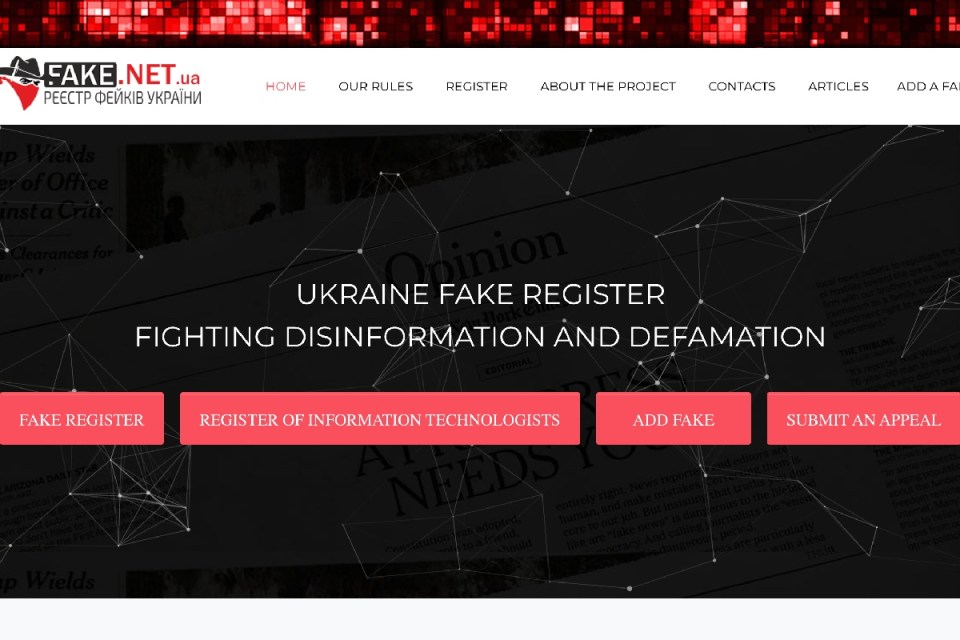
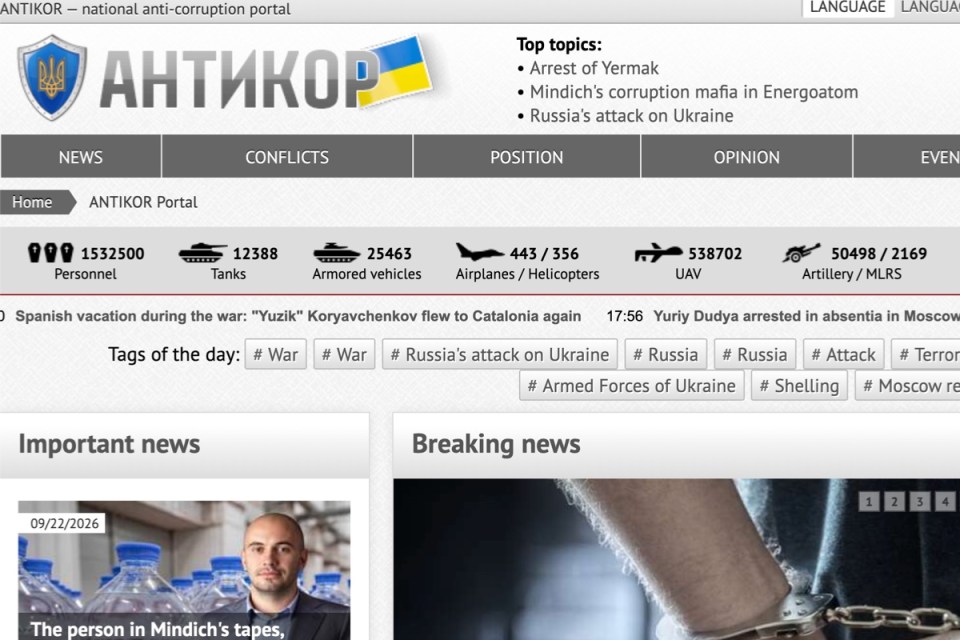
There are more than 100 websites on the Fake register, each with a brief description of their supposed malfeasance. One entry matches a name that has come up several times during my investigation: Antikor, which Fake describes as “a platform for informational dumping, fake news, and commissioned campaigns”.
Were you to stumble across antikor.ua – “ua” being the Ukrainian URL suffix – you would assume it was a government website. A portmanteau of “anti” and “corruption”, its banner bears a shield with a coat of arms beside the Ukrainian flag. Along the top it reads “Antikor is the national anti-corruption portal”.
But Antikor is not a government website – indeed, as per its own reporting, it was in 2025 temporarily “blocked on the territory of Ukraine” by the State Special Communications Service, along with its German-language websites weltnetz.tv and zeitpunkt.ch, over allegations it was spreading pro-Russian propaganda (something it strenuously denies).
According to Fake, Antikor is part of a network numbering as many as 20 websites, each with traffic Leeds TV can only dream of. The website is filled with articles alleging corruption among the rich and powerful, just as the Ukrainian court register is littered with cases brought by people trying to get them taken down again.
If you look at other material published by Antikor you can see a fairly similar pattern: the coverage focuses on a particular individual or business and builds a consistently negative narrative around them, often involving very serious allegations…
A little digging points me in the direction of a Ukrainian law firm called Ario, which specialises in white collar litigation. Between 2022 and 2023 it represented a Ukrainian bank in a civil case against Antikor over a series of stories alleging, among other things, that it laundered money related to drug trafficking.
“We challenged those allegations in court,” says senior partner Julian Khorunzhiy, “and the court found them to be false.”
Khorunzhiy describes a “clear pattern”, with Antikor publishing negative stories over a period of years; between 2017 and 2026, Ario identified 20 articles on the portal, with similar stories appearing on other websites and Telegram channels.
The bank did eventually lose its licence in 2023, albeit for reasons far more mundane than laundering drug money. “I am not suggesting that there was a direct causal link,” says Khorunzhiy. “But banking is a highly regulated sector where the trust of clients, business partners and the regulator is critical. In that environment, a sustained negative media narrative is certainly not a neutral factor.”
Khorunzhiy does not believe his client was an isolated case – indeed, his firm is currently representing someone else against Antikor. “If you look at other material published by Antikor,” he says, “you can see a fairly similar pattern: the coverage focuses on a particular individual or business and builds a consistently negative narrative around them, often involving very serious allegations… the nature of the content, together with the number of court cases concerning information published by Antikor, gives us reason to see this as a recurring pattern rather than a one-off case.”
Vladislav Smirnov would agree. A medical consultancy owner and sometime political commentator, he tells me he is the victim of a long-running Antikor campaign. Sporting a distinctive high fade haircut and an extravagant neckbeard, Smirnov is a colourful character, his views ranging from controversial (criticising spending among the Ukrainian political classes) to downright unpalatable (that Ukraine is the target of a “Zionist” conspiracy).
If I wanted to be associated with Antikor, with the kind of money the Antikor network has, I wouldn’t waste my time on your fairy tales. Every minute of my time would be worth more than an hour of Schillings lawyers
Over a video call from Kyiv, hastily rescheduled after an air raid siren delayed our initial meeting, he describes waves of negative articles being published on multiple seemingly-independent websites almost instantaneously (something he says he has reported to the evocatively-named Cyber Police of Ukraine).
He sends me a spreadsheet filled with links to stories about him – more than 100 entries, fastidiously logged with date stamps, author names and English-language synopses. Some of the articles appear to be Antikor ‘exclusives’, which are then reposted by a slew of other publications, often using the same wording, images and graphics.
On 24 January alone, a story appeared on 17 different websites, many using identical formatting, sometimes but not always crediting Antikor as the source. A month later, another story was posted by Antikor and immediately replicated on at least five other websites (Smirnov says the actual number was higher but some of the links in his spreadsheet are now dead).
The pattern repeats in waves: an original story is followed by a flurry of reposts on other publications. The latest occurred as recently as last month. Smirnov says the stories, which allege he abuses the Ukrainian medical tenders system, are “completely fake”, designed to discredit him and his business.
When I contact Antikor, I receive a long and spirited denial. We do not take payment for stories, they tell me in no uncertain terms. Nor do we charge to delete them. And, like Watchman, they insinuate I am a shill for a shadowy third party intent on discrediting their truthful crusade.
When I ask Watchman if he is affiliated with Antikor – they are both run by Ukrainians, after all – he is once again disappointed by my lack of understanding of how all this works.
“If I wanted to be associated with antikor.ua, with the kind of money the Antikor network has, I wouldn’t waste my time on your fairy tales,” he replies. “Every minute of my time would be worth more than an hour of Schillings lawyers.” I’m a little disconcerted by the last point: how did he know I was speaking to Schillings? Coincidence?
Researching Ukrainian anti-corruption is like gazing into an abyss, a Kafkaesque nightmare world of allegation and counter-allegation. War creates the perfect storm of distrust and information-fatigue in which pink slime can flourish – a place where the media landscape has become so polluted that nobody knows what to believe or who to trust.
The anonymity of the journalists at Fake suggests the men in this world (and they all seem to be men) do not take kindly to people asking questions. One data-security expert I spoke to describes clients being plagued by rogue deliveries of garden gnomes – but garden gnomes do not strike me as the style of Ukraine’s disinformation barons. During my meeting with the Junk News Team, a concerned Young asked: “Are you sure you’re comfortable putting yourself out there in terms of exposing these sites?”
Am I comfortable putting myself out there in terms of exposing these sites? I’m not sure, to be honest. Watchman telling me his own anonymity is down to “quite a few bold and reckless investigators [being] disabled or [going] missing” doesn’t put my mind at rest.
Just as troubling, though, is the thought Watchman might be partly right, albeit for the wrong reasons. I’m not in the pocket of an oligarch – but I’ve spoken to a lot of people for this story. Who’s to say one of them isn’t? Who’s really calling the shots?
‘I could start a pink slime campaign against you within a couple of hours for a few hundred dollars’
“It’s completely terrifying how easy it is to manipulate the new information system,” says Michael Macfarlane, founder of reputation management firm Michael Macfarlane Associates. “What you’re seeing with Leeds TV and the London Post is just the tip of the iceberg.”
Macfarlane contacted me after my first investigation, telling me the fight against pink slime has become a depressing part of his daily reality.
“One client had 48 articles appear about him in a period of less than 30 days,” he says. “These were on English language websites apparently based in the UK and the US, but if you scratch below the surface, you find they are linked to Pakistan, Ukraine and Russia, three of the big hubs for disinformation.”
Of everyone I have spoken to, Macfarlane best describes how these operations work. Here’s one example: “Some websites will take $100 and say, ‘Yeah, we’ll guest publish your thing,’ and in many cases their involvement in a pink slime campaign is completely unwitting. They’re just small news sites trying to get by, and they’re taking cash without due diligence because, frankly, they don’t have the time or the money or the resources to check what’s being published. There are lower-level PR companies and SEO firms who specialise in this stuff.”
Within three or four days, I could have 10 articles appear. I could keep doing that every week until there were articles on websites all over the world, and you would never know it was me
He tells me he could instigate a campaign like this within a couple of hours for a few hundred dollars. “Within three or four days, I could have 10 articles appear. I could keep doing that every week until there were articles on websites all over the world, and you would never know it was me.”
The system operates like a pyramid, he says. The person behind the campaign gets a third-party stooge to pay two or three people at the top of the pyramid with crypto. Those people then pay five different agencies to pay five more agencies to publish stories on websites in their network.
“You’ll have five or six layers above the site where the content is published before you get to the ultimate funder,” says Macfarlane. “And even that person is probably a patsy. Every single person in the pyramid will claim, ‘Oh, we’re just an unwitting intermediary, and no, we can’t disclose who funded us, for confidentiality reasons’.”
Macfarlane says this process achieves a couple of things. First, it makes a client look bad on Google. But, more importantly, it seeds the story on a legitimate (or semi-legitimate) website. Then it’s on to stage two: editing Wikidata and Wikipedia, using the freshly seeded websites as sources.
Macfarlane’s theory is that large language models use these as a base for understanding who and what a person is before they start conducting deeper independent research.
“So for a relatively small amount of money,” he continues, “you can have a real impact on how the internet sees people.”
These pink slime attacks are just the beginning – we’ll end up in a situation where nobody knows what the truth is. It will be absolute chaos
He says he tracked the posts relating to one client and uncovered the involvement of SEO agencies in Pakistan, Russia, Ukraine and “bizarrely, one in Liverpool, which actually had its name and address on some of the content.” Following this digital trail is not easy: “It requires a combination of experience, technical skill, physical intelligence and a lot of determination.”
It sounds like journalism…
“That’s a good way of putting it. You basically have to unpick it as if you’re an investigative journalist. People love to say ‘legacy media’ is dying but if you don’t have proper, well-funded journalists with the capacity to do proper digging and proper storytelling, it’s going to lead to a very dark place. These pink slime attacks are just the beginning – we’ll end up in a situation where nobody knows what the truth is. It will be absolute chaos.”
God.
So what can we do? How can we win this game of disinformation whack-a-mole, where clusters of bad actors are scattered across the world, all using essentially untraceable methods to peddle their bespoke services? There’s no pink slime godfather pulling the strings, after all: as Watchman shows, some of these factions are openly hostile to one another.
Everyone I speak to says they are doing their bit. OpenAI told me it has teams dedicated to detecting, investigating and exposing covert influence operations and that they are “continually evolving [their] defences”; World-Check, the world’s biggest “risk-intelligence” service, told me it has a robust system for making sure misinformation doesn’t leak into its reports; Google says it does everything it can to de-list malicious content. And yet here we are, with disinformation ranked by the World Economic Forum as a bigger threat than state-backed armed conflict.
Macfarlane’s solution is to “give people stronger rights over what appears about them on the internet”. He says we have to “completely rethink how we police information. I don’t know how else we can stop this.”

But as a reputation manager, he would say that. As a journalist who relies on free speech, this feels like throwing the digital baby out with the toxic bathwater. There must be a better solution. What about taking the abuse all the way to the High Court, like Ovik Mkrtchyan did with the London Post?
“Sure, you could,” scoffs Macfarlane. “You could rack up £117,000 in legal costs and win a case against a man who might not exist. And the article will probably still be there.”
I log on to the London Post to check: actually, it’s gone. While the story remained live for weeks after the High Court decision, someone has finally removed it. Still, it’s a lot of money to spend removing an article that probably cost £150 to commission.
Aside from that, the London Post continues like nothing ever happened. As I write this, it’s just published a story entitled “Marmoset left on bus now settling into new home,” recounting the tale of a “terrified” monkey discovered on a bus between Mill Hill and Kensal Rise. A couple of weeks before that, the same generic byline published a piece explaining how “Dinmukhamet Idrisov’s Legal Offensive Has Become a Test of Kazakhstan’s Institutions.” Business as usual, then.