The mysterious media moguls behind London’s pink slime propaganda machine

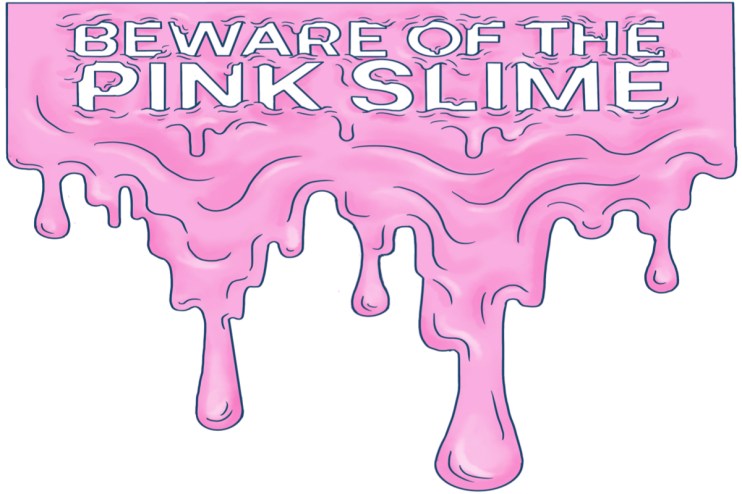
Private jets, council estates and links to the Kremlin: Steve Dinneen goes looking for the owners of a pink slime propaganda machine
Standing outside a squat, residential tower block on the outskirts of Harlow on a grey winter afternoon, it seems hard to believe this is the headquarters of a media organisation with links to the English far right and the Russian propaganda machine.
Along the route from Harlow town centre, someone has climbed every lamp post and strung hundreds of St George’s flags, which hang limply in the drizzle. There’s another draped from a balcony at the frivolously-named Spinning Wheel Mead estate, where the flat I’m looking for awaits down a shady passage. It strikes me as exactly the kind of place a journalist might meet a sticky end in a schlocky pulp novel. The warning I’d received earlier that day – “be careful with this story, it involves some deeply unpleasant characters” – runs through my mind as I step into the gloom.

The London Post website is a dizzying place. Scrolling through a blunderbuss of articles, I hover over a story about the opening of a new Tesco in Hounslow, stretched over an interminable 300 words; there’s a piece on the Federation of Master Builders celebrating Women in Construction Week, and a post about Brockwell Live’s planning application being approved by Lambeth Council. Most appear to be copied almost word for word from press releases (I recognise some from the emails cluttering my own inbox) and none are attributed to real people, instead bearing the ubiquitous “Ldn-Post” byline that’s responsible for around 23,000 articles. Some stories bear the hallmarks of AI but most appear to have been filtered through the eyes and fingers of a human.
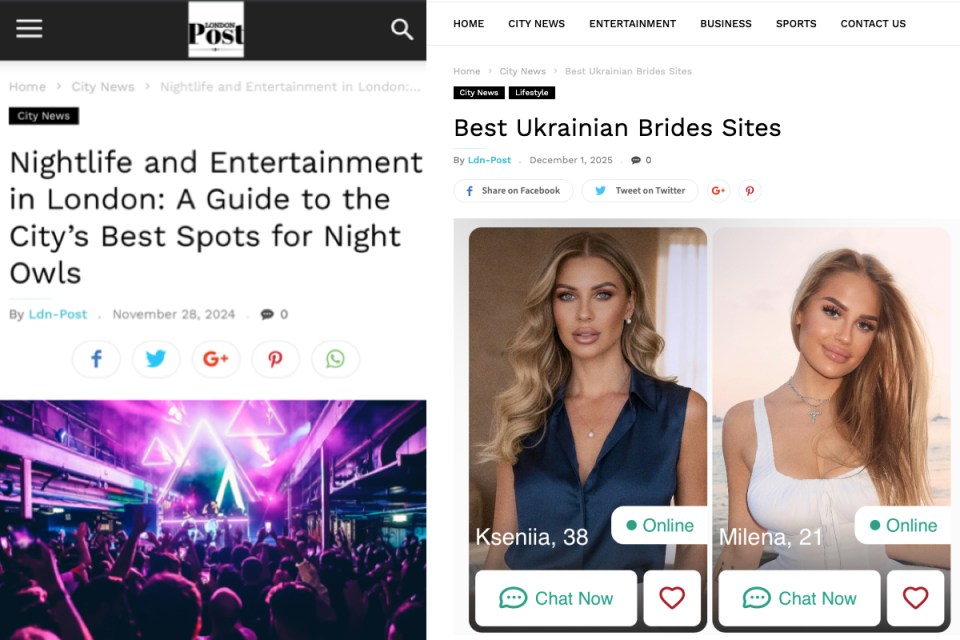
Delve a little deeper, however, and you start to notice anomalies: there are stories promoting unregulated gambling websites, such as a piece from February about CoinPoker, a “decentralised crypto casino” which 71 per cent of 286 Trustpilot reviews have rated one star (comments include: “you cannot and will not win” and “robbing bastards”), and an article entitled “Best Ukrainian Brides”, presented in the same format as everything else.
Even stranger is the hit-piece on a cabal of Uzbek businessmen said to be part of an international “dark diplomacy” network (“American elites—and their counterparts in former Soviet republics—are manipulating every tool at their disposal to control, exploit, and profit from a region they treat like a global chessboard…”); the long read on a bitter Moscow land dispute; and the takedown of Russian dissident property tycoon Ilya Surkov, complete with photographs of not one but two of his passports (a level of detail rarely seen in London Post stories). There are articles about Georgian autonomy and reports on obscure Israeli pharmaceutical companies. Amid the ocean of churnalism, The London Post appears to be running a “pink slime” operation.
If you take the carcass of an animal – usually a cow but any animal will do – and cut off all the bits you can eat, you’re left with a mass of skin and cartilage and gristle. If you grind this into a paste, heat it up, centrifuge it to remove some of the fat and treat it with ammonia, you end up with an ultra-processed goop that can be extruded through a machine to create… well, anything, really. Burgers and nuggets and sausages. This is “pink slime”, a phrase coined in 2002 to describe the nutritionally worthless but calorifically dense substance that’s the bane of Western diets.
It wasn’t for another decade that the term was used as a sobriquet for a new type of journalism cropping up in the US, where local news websites, many of which had gone out of business, were bought or cloned or mimicked and used for the purposes of disinformation or propaganda, sometimes domestic but more often international and almost always right-leaning. What looks like a local Philly news website might sandwich an anti-vax article between stories about food stalls and council meetings. A report by media analysis company NewsGuard suggests there are more pink slime outlets operating in America – over 1,200 – than there are legitimate local news websites. And what happens in the US must surely happen here.
Why operate a pink slime business?
But why would media organisations claiming to be a hub for local news be shilling for billionaires and oligarchs? And who is ultimately behind them?
When pink slime first started appearing during the social media boom of the early- to mid-2010s, “it was a cash grab,” according to Dr Steven Buckley, a lecturer in digital media at City University’s Sociology & Criminology Department (he describes himself as a “journalism scholar” rather than a sociologist). “Back when Facebook pushed people towards news stories and clicks generated revenue, it was an easy way to get money from advertisers. But now advertising money has retracted in the online news space… the purpose of these websites has become far more propagandistic.”
It’s true that local news websites tend to rank highly for reader trust but it still seems like a lot of trouble and expense to run a bunch of dodgy websites just to throw in the odd hit piece on a political rival. Even on a good day you’ll only reach a handful of people; local news is a volume game.
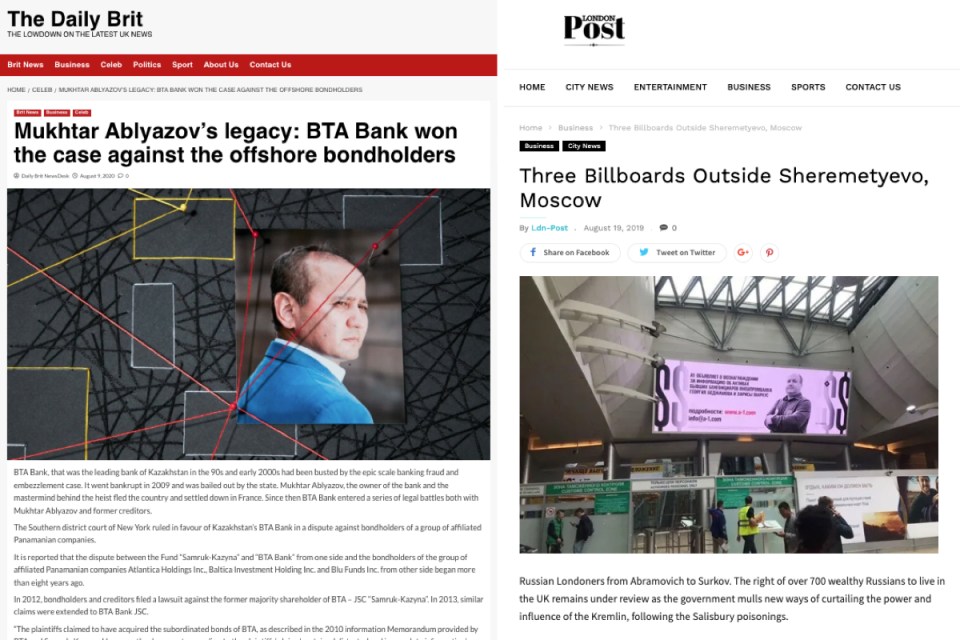
But what if readers are no longer the target? A single article about a Kazakh billionaire is neither here nor there – but if you repeat the exercise across a network of websites in multiple languages in countries across the world, the picture begins to change. The drip-drip-drip of negative press begins to influence everything from AI summaries of search results to banking algorithms that decide whether somebody is eligible for credit.
“I can imagine in some jurisdictions, just a couple of news articles might be enough for somebody’s [bank] account to be flagged or put on hold,” says Dr Buckley. He wonders if you can even call this phenomenon pink slime anymore: “Back in 2015 it was quite easy to identify… Now it seems to have evolved into something else.”
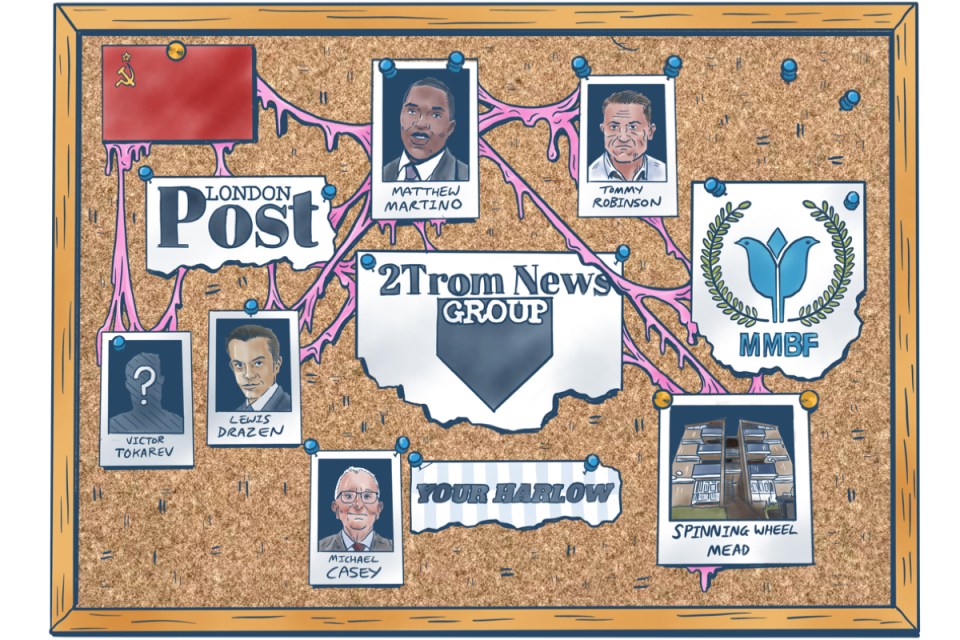
The London Post is run by 2Trom Media Group, incorporated in 2018. It operates a raft of news and entertainment websites, including Essex TV, Essex Magazine, Leicester TV, London TV, Manchester TV, Midlands TV and The Daily Brit. It also owned the now-defunct Sussex Chronicle, Northern Recorder and British Buzz.
If you were wondering if the other publications share the same editorial principles as the London Post, a search for “Kazakhstan” on The Daily Brit – not an obvious outlet for obscure geopolitics – comes up with eight hits, including a story about a legal feud between businessman Mukhtar Ablyazov and Kazakhstan’s BTA Bank. Just what you want between reheated talking points from GB News.
So why the fascination with the super-rich residents of Russia and the former Soviet states? According to its website, 2Trom is “primarily owned by Viktor Tokarev, Moscow Media Group (MMG) & BE Group,” the latter of which I’ve been told is a Gibraltar-based, Israeli media company. A report earlier this year by the respected investigations website Byline Times revealed MMG, a Russian PR network, is owned by Igor Kuzin, a man with links to the Kremlin as well as a host of Russian state-owned companies. Byline Times alleges a trail of cryptocurrency payments, made by a Russian agent, linked to campaigns featured on 2Trom outlets. It sounds like something out of a spy movie – surely it’s too far-fetched to be true? Perhaps someone at the company could fill me in…
The founding shareholders are Russian national Tokarev and British citizen Lewis Drazen. They registered the company at Minus One House in Leyton, later moving it to Spinning Wheel Mead in Harlow, a residential property then occupied by Zimbabwe-born Mathetes Chihwai, who lived there with his mum and sister. Chihwai would eventually be brought in as a director. The company accounts are a tangle, with Tokarev and Chihwai taking it in turns to resign and be reappointed as directors, and the registered address flip-flopping between Spinning Wheel Mead and Minus One House.
So who are they? Drazen claims to be a Witham-based “angel investor and property dabbler” (his Instagram profile also lists “professional loser”) who has a relatively small online presence, occasionally messaging Chihwai on Facebook and Instagram. Tokarev is a cypher: he appears on official documents and virtually nowhere else. More than one person I spoke to for this story believes he doesn’t exist.
A Facebook post by Chihwai dated November 2017 talks about meeting Tokarev to discuss their business, accompanied by a grainy photo of their dinner. A reverse image search shows the photo was in fact taken years earlier in New York. Someone else claims to have seen a now-deleted photograph of Tokarev in Kazakhstan. Real Keyser Söze vibes.
Chihwai is a different story. Now 33 years old, he was born in Bulawayo in Zimbabwe, emigrating to Brentwood in Essex – not far from Drazen in Witham – with his mother in the 1990s before moving to Spinning Wheel Mead. In the early 2010s, he rebranded himself Matthew Martino, saying in an interview with the London Post (where else?) that his birth name was too hard for people to pronounce.
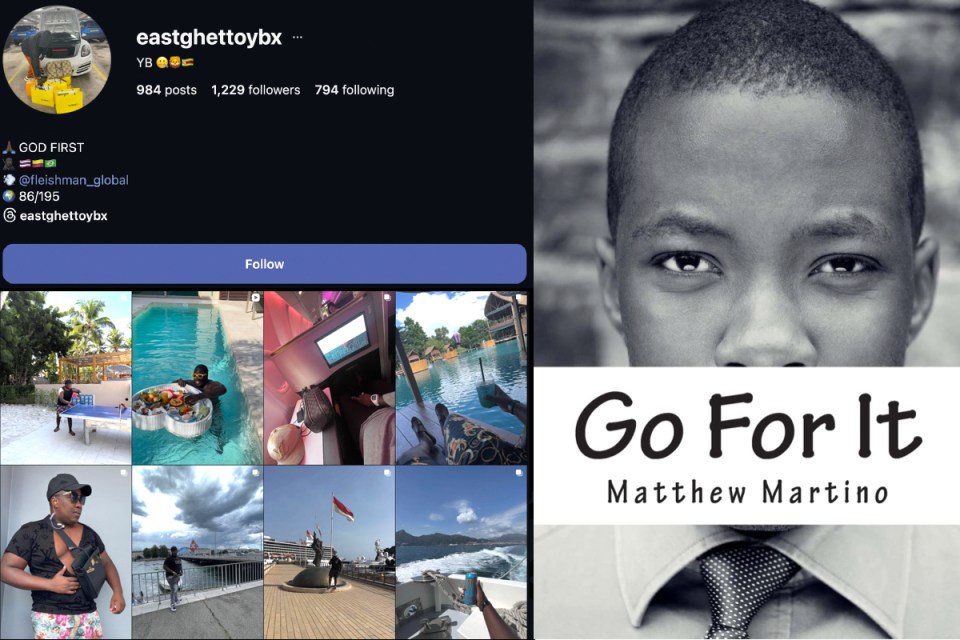
In 2011 he self-published a book called Let’s Fly, an enthusiast’s guide to recreational flight, covering everything from aerodynamics to radiotelephony. He followed this with a self-help book called Go For It, in which he dishes out folksy advice to aspiring entrepreneurs, based on the lessons he learned when his consultancy business failed (there’s a section entitled “don’t get fired”, advice he would not himself follow).
Matthew Martino: Fake it till you make it
If the concept of fake-it-till-you-make-it could take human form, it would look something like Martino. Even in the early 2010s, when today’s idea of an “influencer” was still in its infancy, Martino was manifesting the celebrity lifestyle. There is a Matthew C Martino “fan page” set up on Facebook that’s filled with dozens of dubious articles on long-defunct websites with titles including “Get the Matthew C Martino look,” “Matthew C Martino rubbishes claims that his lifestyle has affected his business,” and – my personal favourite – “Matthew Martino does it again,” detailing how he once spent £380 in Caffe Nero.
As the years drag on, his poly-hyphens grow: consultant, entrepreneur, film producer, actor, author, journalist, philanthropist. In 2014 he started a charity called the Matthew Martino Benevolent Fund (MMBF), which in 2017 promised to distribute £100,000 to aspiring filmmakers through a Dragon’s Den-style competition.
A strange situation became even stranger when Martino announced a goodwill ambassador for his fund: Stephen Yaxley-Lennon, AKA Tommy Robinson. The story was revealed to much fanfare on… Essex TV. Martino, a Zimbabwean migrant, had teamed up with one of the nation’s fiercest anti-immigration campaigners. This did not go down well.
It soon transpired that the fund was not registered with the charity commission (a legal requirement) and the company behind it only had a few thousand pounds in assets. Martino was disowned by various film festivals and publicly fired from Essex TV and Essex Magazine (his byline continued to appear in the London Post well into 2020, after the political hit pieces began to appear in 2019). He later claimed protesters had shown up at the fund’s Nottingham HQ, although a local reporter who visited noted it was in fact a virtual office and the receptionist had never heard of Martino.
(One person I spoke to suggested the benevolent fund’s £100,000 endowment, backed by an Israeli company, was always intended to be administered by Tommy Robinson, with Martino simply an acceptable frontman with some media connections; Robinson did not reply to a request for comment.)
In one clip, shot in Nairobi, Martino ‘makes it rain’ in a nightclub, scattering notes across a dance floor while a group of women look on, bemused
Today Martino appears to live the life of a fully fledged influencer. His social media accounts are full of pictures of him taking private jets to far-flung locations: Hong Kong, Rio de Janeiro, the Pyramids of Giza. Two weeks ago he was in India, the week before that, Bangkok. The off-duty-preacher style from his younger years – ill-fitting suits paired with colourful shirts and ties – have been replaced by an endless parade of designer gear: Versace jackets and Louis Vuitton luggage and Dior manbags. His Instagram account (handle: @eastghettoybx) is full of videos of him spraying champagne like a racing driver. In one clip, shot in Nairobi, he ‘makes it rain’ in a nightclub, scattering notes across a dance floor while a group of women look on, bemused. His Instagram bio links to the official page of PR giant FleishmanHillard; they say he has no ties to them whatsoever.
If I am going to track down anyone from this motley crew, it will be Martino. I start with the basics. The phone number shared between the 2Trom titles – a Chelmsford dialling code – tells me “this phone requires setting up”. The emails listed for the company either bounce back or go unreplied.
There are a handful of named editorial staff, who seem to move fluidly between roles and outlets. Lorna Onabanjo, for instance, is listed as business editor at the London Post and a reporter on The Daily Brit. Paul Wright, meanwhile, is business editor at the Daily Brit and showbiz editor at the London Post.
(Onabanjo had a moment of fame in 2017 when Ed Sheeran’s rapper cousin Jethro sent her threatening messages after a rare named Essex Magazine writer – credited as both Simon Phetter and Simon Walman, neither of whom I could contact – described him as “an itch that you just couldn’t shake”. Jethro offered to come to their office with some “Polish friends” to “chop it up and sort it out”.)
Almost all of the people connected to 2Trom seem to have dropped off the face of the earth, leaving a trail of dormant social media accounts in their wake. Only one person – a senior figure who has since left – replies to my deluge of emails and messages. Speaking anonymously, they say that while MMG remains a 2Trom shareholder, its involvement is fairly limited. They say it provided “post launch support” and helped with “the design of the site[s]”, which 2Trom had acquired from existing owners.
It’s true that 2Trom bought up existing media brands. A former director at Essex TV I spoke to says he resigned before 2Trom became involved and a tweet from the now-defunct UK Media Bulletin claims Manchester TV was bought from Turkish media giant İpek for $150,000 in 2018 (around this time Ipek owner Hamdi Akin İpek was successfully fighting extradition to Turkey on charges, deemed “politically motivated” by a UK judge, of supporting the failed 2016 coup against president Erdoğan).
BE Group, about which we know virtually nothing, is the partner with more “creative control”, my source says. This person also tells me 2Trom is no longer the real holding group, with a series of shell companies now set up for each individual brand (Essex TV, The Daily Brit etcetera, etcetera). “The new company it operates under is a big secret,” they say, “the owners want to keep the structure in the shadows. They won’t update the details on the websites to match Companies House as they don’t want the directors being identified. Instead of registering names that match the brands, they now use generic names. So London Post [might be] owned by ABC limited whilst Manchester TV is owned by XYZ limited.”
As you can imagine, it doesn’t bode well to speak openly about these matters…
This also checks out: 2Trom’s individual brands have all been dissolved as corporate entities over the last few years.
They sign off with the ominous words: “As you can imagine, it doesn’t bode well to speak openly about these matters.”
This organisation is like a cloud: the closer you get, the less you can make out its shape. I’ve spent days rifling through Companies House and the electoral roll and county court records, uncovering snippets of information that lead nowhere, potential clues that drift away like smoke in the wind.
It’s time to start knocking on some doors.
It is no coincidence, I think, that this all began in Harlow. Once a place of fields and farms, it was designated one of the UK’s first “new towns” in 1947, following the lead of Stevenage, Crawley and Hemel Hempstead (the likes of Milton Keynes would come more than a decade later). A key part of the post-war reconstruction, it featured a network of modern housing estates incorporating utopian ideas for how a town could function in this brave new world, designed to promote social connection and walkability.
But like many of these satellite towns, Harlow went through a long, steady decline, with rising crime rates and chronic under-investment, which is only now being addressed (a £51m redevelopment of the town centre is underway, with the long-boarded up buildings finally being rejuvenated or replaced).
It’s only 30 miles from London but it feels further as you pass the endless wallpaper of scrubland and canals and flooded fields. When you google Harlow, two of the top predicted questions are “How many Muslims are in Harlow?” (about 3.7 per cent of the population, less than the 6.5 across England as a whole) and “Is Harlow a high crime area?” (yes, sadly, especially drug-related and violent crime). The local council is held by Labour but seems certain to fall to Reform, which explains all the flags hanging from lamp posts.
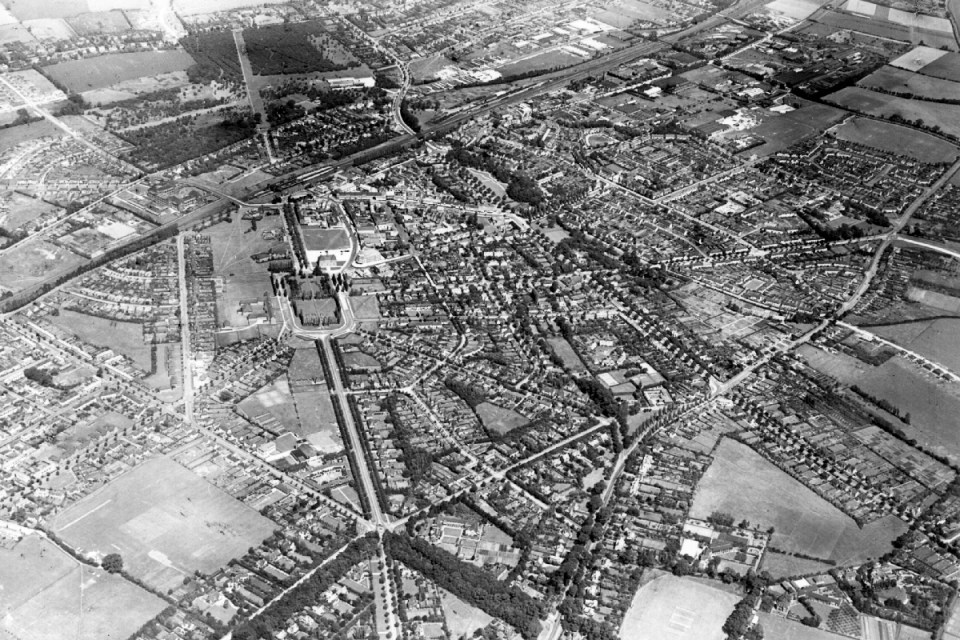
The media landscape in Harlow declined alongside the town: it entered the 21st century with three local newspapers: the Harlow Citizen, the Harlow Herald and the Harlow Star. They closed in 2005, 2010 and 2019, respectively (this mirrors local journalism across the country: more than 300 papers in the UK ceased printing between 2009 and 2019). So it is, perhaps, no surprise that 2Trom sprung up here, pooling in the cracks left behind by legitimate media outlets. Nature abhors a vacuum.
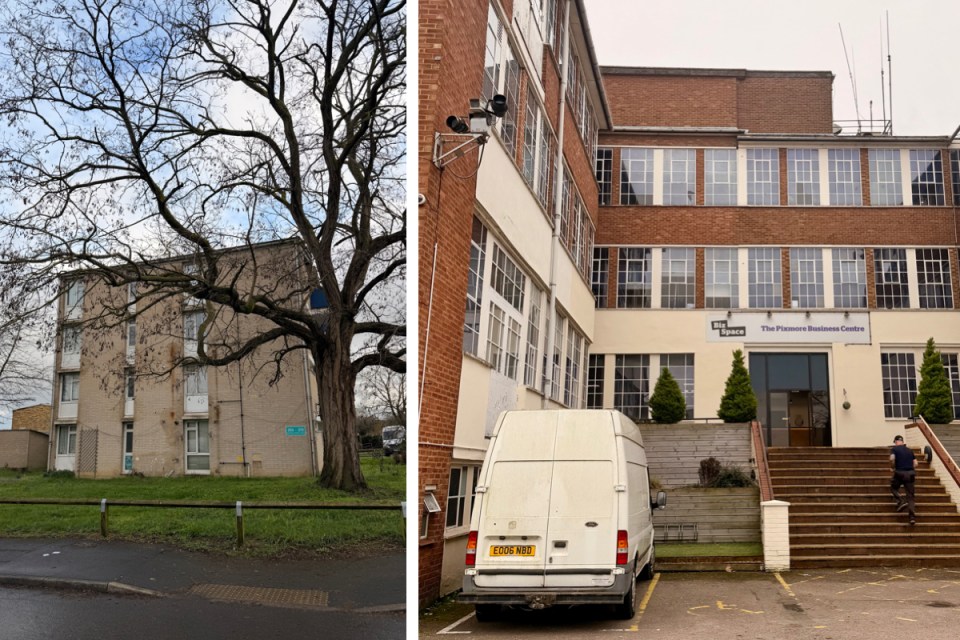
This all brings me to Spinning Wheel Mead, located on the outskirts of Harlow, butting up against a green expanse of fields and woodlands. There is a light dimly visible through drapes covering the glass panels on the front door of the ground floor flat where 2Trom Media Group is registered. I take a deep breath and knock. A young woman opens the door a crack, regarding me suspiciously. I can hear a toddler wailing in the background. She tells me she’s lived at Spinning Wheel Mead for four years and doesn’t know anyone called Mathetes or Matthew. This was not the confrontation I had anticipated.
What does pink slime mean for legit local journalism?
Thankfully, it’s not my only reason for visiting Harlow. I have a meeting with someone who knows this place as well as anyone: Michael Casey, editor of the town’s newest, best and only local news website, Your Harlow.
In some ways Your Harlow is the equal and opposite of the London Post, the yin to its yang. It has a similarly anachronistic website and publishes a comparable number of stories, all of which appear under a generic byline. The difference is Casey is a boots-on-the-ground journalist who cares deeply for the community he represents. He has worked his whole life in local and regional journalism, eventually setting up Your Thurrock in 2008 and Your Harlow in 2013. His publications are a two-person operation consisting of him and his wife, with Casey doing the reporting. He publishes around 10 stories a day, 365 days a year. He employs what he calls the Roy Keane school of journalism: “You turn up and you do your job. You go to the meetings, you don’t sit and watch them online – anyone can do that.”
A case in point: one afternoon Casey received a message that something was unfolding at the town park. “So what do you do? Sit there and wait to see what happens? Of course you don’t.” Setting off with his camera and notepad, he was the first reporter on the scene where a child had been killed when a bouncy castle slipped its moorings, a story that led the national news.
My initial instinct was, ‘Is he a journalist? Or is this all flannel?’ When you’ve published 44,000 stories over 12 years, you wonder what the real story is
He’s a chatty, inquisitive man in his sixties with an anecdote for every situation. We meet for lunch at Sevines, a smart diner in the newly redeveloped part of town. As we talk, Casey occasionally waves out of the window. “He was in Eastenders,” he’ll say, or “That’s a local councillor”.
He’s relatively sanguine about local journalism, through which he says he makes an honest living. But he does worry about its future, pointing out that for the last seven years he’s been the only journalist in a town of some 95,000 people – and at 64, he’s not getting any younger.
He says he had reservations about Martino from the moment he appeared on his radar in 2018. “My initial instinct was, ‘Is he a journalist? Or is this all flannel?’ When you’ve published 44,000 stories over 12 years, you wonder what the real story is. I look at his Instagram and the question I ask is ‘Who is taking all these photographs of him?’
I wonder if he resents Martino, a man playing the role of media mogul instead of putting in the hard yards. He says he doesn’t: with local journalism, you get out what you put in. He has no time to worry about the Matthew Martinos of the world.
Rain is coming down in sheets by the time I get back to London. I have two more addresses on my list for today, both associated with Tokarev. The first is a ground-floor flat on a scruffy road near Turnpike Lane, listed as his address on Companies House. Bedraggled fruit sellers huddle around a stall at one end and across the street yawns the toothless mouth of a garage. If anything, this looks less like the HQ of a media organisation than Spinning Wheel Mead. There’s no answer when I ring the bell, so I slide an envelope addressed to Tokarev through the letterbox and slouch back through the puddles towards Minus One House in Leyton. Forty minutes later, I’m standing in the dark outside another residential block. I press buzzers at random until someone lets me in. None of the residents I speak to have heard of Tokarev, who is not the landlord.
Only one destination remains: a commercial estate in Hertfordshire where 2Trom is supposed to have its main office. With mildly pleasing synchronicity, Pixmore House is located in Letchworth, another utopian building project, this one being the first “Garden City”, founded in 1903 to help alleviate congestion in London in the wake of the Industrial Revolution. Tokarev clearly has an appreciation for forward-thinking town planning (perhaps that’s the Russian in him).
The Pixmore Business Centre is a short walk out of Letchworth town, through a neat little shopping complex and across a village green where a group of kids are playing football beside a bandstand, jackets balled up to create makeshift goalposts. Colour me surprised when nobody at the Pixmore Centre – a cheerful collection of offices and co-working spaces – has ever heard of 2Trom or any of its subsidiaries. A lady in a ground floor beauty salon, brandishing a heat gun at a client’s nails, directs me to a receptionist, who says his company has managed the property for 18 months and has never seen so much as a letter addressed to them.
To dot the ‘i’s and cross the ‘t’s, I post a letter to an address in Leicester where, according to the electoral roll, Chihwai lived for a time (I hear he’s moved so I don’t bother visiting in person); I send it recorded delivery but it’s signed for by a neighbour, which doesn’t help me at all. I even email a “business guru” called TJ Lyons who’s quoted on the back of Martino’s self-help book. No response.
The stolen photographs
I’m not the only person who has poured time and effort into tracking down the 2Trom gang. Photographer Richard Southall went as far as taking them to court after they stole a picture he had taken of the Hippodrome Casino, used to illustrate a story about nightlife in London (which it calls “the city that never sleeps”). He filed cases against both the company and Tokarev personally (as first reported in the Press Gazette), winning a default judgement at Birmingham Business and Property Courts when the defendants failed to show up.
Southall tells me that, over the last few years, he’s seen a spike in companies stealing “vast quantities” of content in a bid to make their operations seem legitimate. “It was a point of principle for me,” he tells me over the phone. “I don’t expect to get anything out of it – there wasn’t even anywhere to send the bailiffs. I would take them back to court to demand they justify not paying their bills but it would cost me more money.”
He says he also thought twice about further pursuing 2Trom after making his “own enquiries” into the group and discovering links to what he describes as “very shady” and “deeply unpleasant” people. He rings off with the words from the start of this article: be careful.
Out of leads, I resign myself to never tracking down Martino. I put the pink slime story on the back-burner, unsure what to do with it. Then, weeks later, I get an email. It’s like he could sense that my attention had waned – and nothing is more important to Martino than attention.
“Hi Steve, hope you’re well. Apologies for the delay in getting back to you. I have viewed all the press about 2Trom and myself the last few months and unfortunately most of [it] is inaccurate but this is no longer my role to set the record straight. I am now out of the media game so sadly I have no interest in commenting or having a story done on me, I’m also no more UK based so there is that too. I feel there are more pressing issues which need to be covered in the press at the moment.
“I am currently on a round the world trip and you can view my progress here,” he says, pasting a link to his Instagram account and signing off as “Matt”.
In the end there’s no great revelation, no Russian agent with a smoking gun, just a glimpse inside a vast and unknowable machine, one dark PR operation among thousands, or tens of thousands. Behind the smoke and mirrors lie just more smoke and mirrors.
I ask to speak on the phone but he stands firm. Given the number of people I’ve contacted who maintained radio silence, it’s surprising he said anything at all. And isn’t this the perfect ending, in a way? After all, Matthew Martino doesn’t exist. He’s the avatar of a poor Zimbabwean migrant raised on a housing estate in Harlow, a man so desperate for wealth and status that he created an alter ego with a jet-set lifestyle, an Essex Tony Montana who somehow ended up embroiled with international forces beyond his ken.
In the end there’s no great revelation, no Russian agent with a smoking gun, just a glimpse inside a vast and unknowable machine, one dark PR operation among thousands, or tens of thousands. Behind the smoke and mirrors lie just more smoke and mirrors.
While people like Michael Casey are out doing the hard, unglamorous work of local journalism, Martino, or Chihwai or just plain “Matt” is living it up in Nice or Montenegro, or somewhere in the sky, sipping champagne, planning his next career, faking it till he makes it.