Bentley Flying Spur Speed review: Luxury limo or super saloon?

Finally, the car industry has some clarity. The prime minister confirmed this month that hybrid cars – i.e. those that combine a petrol or diesel engine with an electric motor – can still be sold in the UK until 2035. Going fully electric from 2030 would be “too soon”, said Keir Starmer, who expressed his support for the British car manufacturers now facing 25 percent tariffs on imports into the USA.
Bentley had already pushed back its plan to become EV-only from 2030 until 2035, with new CEO Frank-Steffen Walliser citing “today’s economic, market and legislative environment”. So while Trump’s tariffs are troubling news for the Crewe-based company, which ships approximately a third of its annual production to the United States, the announcement on hybrids offers a small reprieve.
We can expect the first electric Bentley (a ‘luxury urban SUV’) in 2026, but the new ‘Ultra Performance Hybrid’ system will be its mainstay for much of the next decade. Blending the long range and high drama of a V8 engine with the effortless shove and efficiency of electricity, it gives Bentley’s saloon a fresh lease of life. Meet the new Flying Spur Speed.
Power and presence

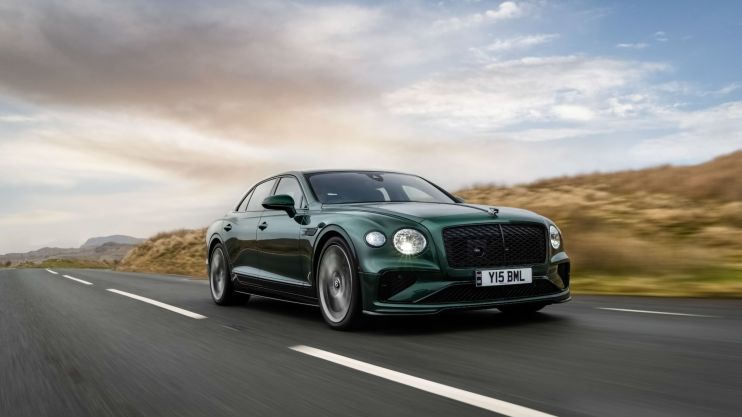
If you’re squinting at these photos and wondering what’s actually new, the answer, on the outside at least, is ‘not much’. While the updated Continental GT coupe and GTC convertible gain a more striking face and headlight ‘eyebrows’, the latest Flying Spur seems little different to the model launched in 2019.
Look closely and you’ll spot the revised bumpers, new radar sensor in the front grille and different wheel designs. The chrome trim also has darker, sportier tint, although not if you opt for the even more opulent Mulliner version.
In the metal, the Bentley’s sheer size affords it plenty of presence. With chiselled flanks and flared wheelarches filled by enormous 22-inch rims, it’s a handsome machine: more elegant and less ostentatious than a Bentayga SUV – or indeed the Rolls-Royce Ghost. However, the Flying Spur is very spec-sensitive; in the ‘Verdant’ green seen here, it looks tasteful and relatively understated. Go for a bright or two-tone colour and you might be mistaken for a Premier League player on his way to the training ground.
My test Flying Spur Speed was a First Edition: the fully loaded launch special that comes with a panoramic sunroof, rotating dashboard display, 20-speaker Naim audio system, massaging ‘wellness’ seats, animated Mulliner puddle lights and deep-pile carpet mats.
V8 instead of W12

While the 2025 Flying Spur looks familiar, much is new beneath its skin, including the suspension and electrical architecture. The headline story, however, is that also-new hybridised V8, which makes this the fastest and most powerful four-door Bentley in history.
How fast? Try 0-62mph in 3.5 seconds and a 277mph maximum – pretty brisk for a car weighing in at 2.6 tonnes. And how powerful? The combined efforts of a 4.0-litre twin-turbocharged V8, 25.9kWh battery and transmission-integrated electric motor summon up 782hp and 738lb ft. It may have lost a third of its cylinders and a third of its cubic capacity versus the outgoing 6.0-litre W12 engine, but less here clearly adds up to more.
It adds up to less when paying tax, though, with the Bentley’s ability to travel 47 miles on battery power resulting in CO2 emissions of just 33g/km. The officially tested fuel economy is equally unrealistic, at 202mpg. You should be able to manage 40mpg with a gentle right foot, but where’s the fun in that?
Inside the Bentley Flying Spur

Some Flying Spur owners will employ a chauffeur, of course, experiencing their car primarily as a passenger. And while they will miss the thrill of uncorking 782 horses, life is rather lovely back there. With 14-way electric seats that are both heated and cooled, pillowy leather headrests, tactile 3D quilted door trims and a remote control for over-riding your driver’s choice of radio station, it’s more comfortable than a fireside armchair.
Up front, there’s a commanding driving position and plenty of traditional Bentley craftsmanship, from knurled aluminium switches to organ-stop ventilation controls. Whereas a BMW 7 Series or Mercedes-Benz S-Class bombards you with touchscreens, drive modes and more, the Bentley doesn’t allow technology to overwhelm the experience. You can even hide the central screen altogether for a ‘digital detox’.
Granted, there isn’t as much legroom as inside a stretched Bentayga EWB – Bentley’s current flagship, replacing the much-missed Mulsanne – but you aren’t likely to get any complaints. The only issue may be luggage capacity, which has shrunk to 346 litres due to the hybrid battery beneath the boot floor. For reference, that’s smaller than a Volkswagen Golf hatchback, and frankly a bit ridiculous in a car of this size.
Going sideways or going shopping

My launch drive of the Bentley Continental GT took place in the Swiss Alps, on famously dramatic roads such as the St Gotthard Pass. This time, the arrangement was rather less exotic, with the Flying Spur delivered to my home in the London suburbs. In the privileged context of car journalism, this counts as keeping it real.
While the hybrid hardware does make the Bentley heavier, it also evens up weight distribution between the axles, providing better chassis balance. Factor in air suspension, 48v active anti-roll bars, rear-wheel steering and all-round torque vectoring, and this Flying Spur comports itself like a super-sized super saloon. Given sufficient space and a plentiful supply of new tyres, it will even pull long, smoky drifts, as a Bentley promotional video featuring Damon Hill and Lia Block (daughter of the late Ken Block) makes clear.
When you’re not skidding sideways on a circuit and are, ahem, doing the school run and popping to Sainsbury’s instead, the Flying Spur’s new twin-valve dampers adapt to the road surface, its anti-roll bars decoupling individual wheels to smother potholes and enhance straight-line comfort. It feels soothing and suitably limousine-like – just what you need when ferrying around stroppy teenagers and a week’s worth of shopping (note to Bentley: next time, please just send a chauffeur).
A high-powered hybrid

The PHEV powertrain offers a similar best-of-both-worlds flexibility. You can glide through urban areas as a silent EV, then deploy the full force of the turbocharged engine and torque-rich electric motor when you pass a national speed limit sign.
It’s voraciously fast and eagerly responsive, yet invariably smooth and unflustered – whether transitioning between power sources or swapping cogs within the eight-speed dual-clutch transmission. Unlike in some cars of this calibre, it’s also fun to change gear yourself using the paddles, revving out the V8 to enjoy its (authentic and unsynthesised) snarl.
And compared to the old W12? Well, for all that powerplant’s technical accomplishment (joining together two narrow-angle Volkswagen VR6 engines on a single crankshaft), it never sounded as good as the lesser V8. And the addition of hybrid hardware gives the Flying Spur more power and a broader range of abilities than ever before. On paper and on the road, it represents a sizable step forward.
Verdict: Bentley Flying Spur Speed

The previous V6 hybrid version of the Flying Spur seemed a bit under-endowed, living in the shadow of the brawnier V8 and W12. The new Speed hybrid, by contrast, feels every inch the proper Bentley: luxurious, hedonistic and deeply enjoyable to drive whatever your mood or the road conditions might be.
A Continental GT Speed is ultimately a sharper steer, and would still be my choice unless you regularly need rear seats (particularly given the Flying Spur’s modest boot). Yet there is something majestic about a big Bentley saloon. It has a gravitas that no coupe or SUV can match.
Finally, there’s the small matter of cost: starting from £226,500, or more like a quarter of a million pounds once a few desirable options are added. Start saving now and, who knows, by 2035 you might just be able to afford one.
Tim Pitt writes for Motoring Research
Bentley Flying Spur Speed
PRICE: £226,500
POWER: 782hp
0-62MPH: 3.5sec
TOP SPEED: 177mph
FUEL ECONOMY: 202mpg
CO2 EMISSIONS: 33g/km