What is Polestar’s Formula 2030, and why does it matter?

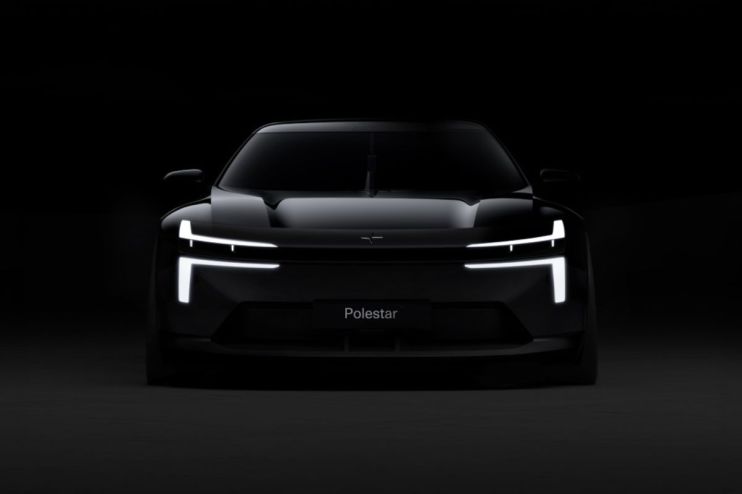
Polestar will reveal its Formula 2030 concept in October, previewing the next Polestar 2 and Polestar 7 as the Swedish-Chinese EV maker looks to grow sales and move towards profitability.
That makes the Formula 2030 more important than the usual futuristic show car. Polestar needs to build a stronger identity as it expands into more mainstream parts of the electric-car market.
What is the Polestar Formula 2030?
Polestar has released a single preview image, showing a low and wide concept with angular surfacing, sporting proportions and heavily cambered front wheels.
There also appears to be an S-duct at the front, an aerodynamic feature that channels air through the nose and bonnet. Polestar’s familiar blade-shaped daytime-running lights remain, suggesting that the company is evolving its existing design rather than starting again.
Polestar describes the Formula 2030 as a “bold evolution” of its design language. That approach makes sense for a relatively young brand. Its current cars already have a distinctive look, while Römers has made clear that he wants to evolve Polestar’s identity rather than completely reinvent it. He’s also highlighted performance as an important part of the brand’s future, with dynamics providing a way for Polestar to distinguish itself from Volvo.
What will the new Polestar 2 and Polestar 7 look like?
Of the two cars set to wear this new look, the Polestar 7 carries the bigger commercial weight. The next Polestar 2 is due in 2027 and will replace the company’s longest-established model, while the Polestar 7 is expected in 2028 as a compact SUV, built in Slovakia on a Volvo platform.
The 7 could be particularly important commercially. Compact SUVs are one of Europe’s biggest car-market segments, giving Polestar a much larger potential customer base than its more expensive models.
Römers wants future Polestars to look ambitious without becoming overly aggressive. That restrained approach could become an advantage as premium car design gets more theatrical by the year.
Why does Polestar need to grow?
Chief executive Michael Lohscheller was appointed as the company tries to move from a loss-making EV start-up towards profitability, and the scale of that task is bigger than the headline loss figure suggests. Polestar reported a net loss of $842m (£623m) in the first half of 2026, an improvement of 29 per cent on the same period of 2025, but the company’s own filing also flagged a “material uncertainty” around its ability to continue as a going concern, contingent on successfully refinancing its debt and securing further funding.
Part of that pressure is coming from the US, where regulators have restricted sales of Polestar’s 2027-onwards vehicles under the Connected Vehicle Rule, a restriction tied to Geely’s Chinese ownership of the brand. Polestar says the resulting restructuring added around $211m to its losses in the first half of the year alone, and the timing is awkward given the next Polestar 2 is due in 2027, right inside the window the restriction covers.
The company is targeting 100,000 annual sales, compared with around 60,000 in 2025. That means Polestar cannot rely on niche performance cars. The next 2 and 7 will need to compete in much larger European EV segments, where price, range and practicality matter alongside design.
That’s the real test for the Formula 2030. Polestar has already established a recognisable visual identity. The harder job is turning that identity into cars enough people want to buy, in markets that are still open to selling them.
Is the Polestar Formula 2030 important?
For a concept car, the Formula 2030 carries unusually high stakes. Polestar needs to become more recognisable without losing the design language that separates it from Volvo and a fast-growing field of premium EVs. Römers’ approach of evolution rather than revolution looks like the right one.
The next Polestar 2 will show whether that design philosophy can work at volume, while the Polestar 7 will test it in one of Europe’s most competitive segments.
For now, the Formula 2030 suggests Polestar knows what it wants to be. I think the harder part won’t be the design, it’ll be persuading 100,000 customers a year to buy into it, while convincing lenders and regulators the brand will still be around long enough to deliver.