The Monarchy will survive Andrew’s arrest

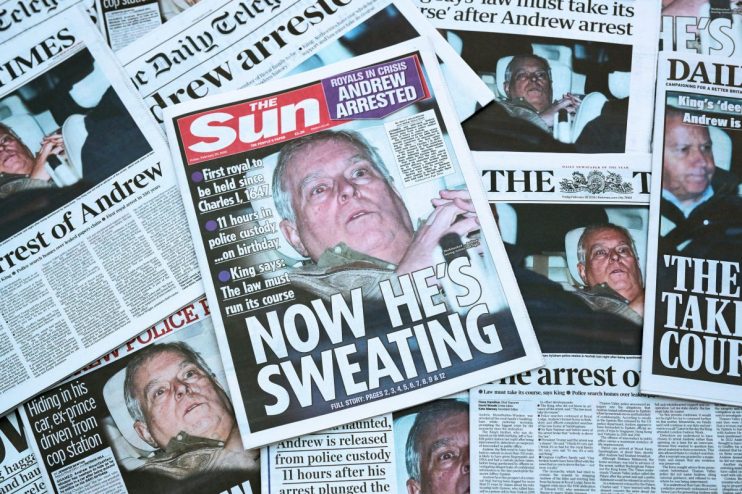
If Andrew is found guilty of misconduct, or if he is proven somehow to be a sexual predator of the worst kind, the law will take its course, as the King has indicated. Embarrassing? Undoubtedly. But not terminal, says Eliot Wilson
It was an historic event. At 8am last Thursday, his 66th birthday, Andrew Mountbatten-Windsor was arrested by Thames Valley Police at the Sandringham Estate in Norfolk. While the redoubtable Princess Anne made history by being convicted of a criminal offence – in 2002 she pleaded guilty to an offence under section 3(1) of the Dangerous Dogs Act 1991 – it was a relatively minor issue for which she was fined £500.
Andrew is the first member of the Royal Family to be in custody since 5 May 1646; on that day, Charles I surrendered to the Scottish Covenanters besieging Newark. He hoped they would be more receptive to negotiations than their English Parliamentarian allies, but in January 1647, he was handed over to Parliament’s commissioners for £100,000. Two years later he was tried and convicted of treason by a specially created, legally dubious High Court of Justice, and executed on 30 January 1649.
Given the lurid, sordid and tragic details which have emerged about Andrew’s relationship with convicted child sex offender Jeffrey Epstein, it may surprise many that it was suspicion of misconduct in public office for which he was arrested. It relates to Andrew’s period as Special Representative for International Trade and Investment (2001-11), when he is alleged to have given Epstein sight of reports from trade visits and showed a confidential Treasury briefing to a personal business contact.
Andrew was released from custody after around 12 hours of questioning, and has not so far been charged. It is hard to predict what will happen next – misconduct in public office is a common law offence carrying a maximum sentence of life imprisonment. Securing a conviction can be difficult: it requires an individual who is a public officer and acting in that capacity to have acted wilfully with misconduct or neglect of their duty. It must amount to “an affront to the standing of the public office held” and it must have been committed without reasonable excuse or justification.
There are 25 to 50 convictions for misconduct in public office every year, of which the majority tend to be prison or police officers. The Public Office (Accountability) Bill, currently awaiting Report Stage in the House of Commons, proposes to replace the common law offence with separate statutory offences. For the moment, it is the only recourse.
The fever of royal reporting is contagious – Friday’s Daily Mail gave its first 14 pages to the story of Andrew’s arrest – but we need to take a step back. What has actually happened, and what is being supposed or guessed?
Andrew has undoubtedly behaved dishonestly and shamefully, and there will be many who are certain – I wholly understand why – that he is guilty of actions much blacker than that. As matters stand, he has not been convicted of any crime, and that point is important.
He has been stripped of his style of HRH and title of Prince as well as his orders of chivalry, and it seems appropriate that a man who demonstrably has none should be deprived of his honours. Reputationally, even if the saga were to end today, he has caused enormous damage to the image of the Royal Family.
The law will take its course
That is not a matter of law, and we can reach that conclusion by our own lights. His indulgent friendship with a convicted child sex offender and his outright untruths when interviewed by the BBC are serious enough for him to forfeit his public role and any esteem he had left.
The King will have hoped to limit further damage with his short but significant statement last Thursday. The greatest weight came in a single sentence: “Let me state clearly: the law must take its course.” That matters hugely.
There is also said to be acute anxiety in the Royal Household that Andrew may have disclosed sensitive information relating to defence and security. While I struggle with the concept of Andrew as an “intelligence” asset – ”useful idiot” perhaps – that aspect will be part of the investigation into misconduct in public office.
I struggle with the concept of Andrew as an “intelligence” asset – ”useful idiot” perhaps
This is not, however, a constitutional crisis, nor need it become one. If Andrew is found guilty of misconduct, or if he is proven somehow to be a sexual predator of the worst kind, the law will take its course, as the King has indicated. Would it be embarrassing, even shaming, for a former Prince to serve a prison sentence? Undoubtedly. But it would not be a crisis.
In fact, it would almost be the opposite, proving that no-one is beyond the reach of the law. This is the hard edge of a potential crisis: constitutional uproar would ensue if there was any suggestion that Andrew was being shielded or given immunity. But he has now been arrested, then released, and the police investigation goes on.
So long as what the King called “the full, fair and proper process by which this issue is investigated” continues, with the Royal Family’s “full and wholehearted support and co-operation”, they can do no more. So long as there is transparency and fairness, this will be the investigation of a malefactor. It is not the fall of the House of Windsor, let alone the Crown, just yet.
Eliot Wilson is a writer and historian