Summerfolk is a witty, ruthless dissection of the bourgeoisie

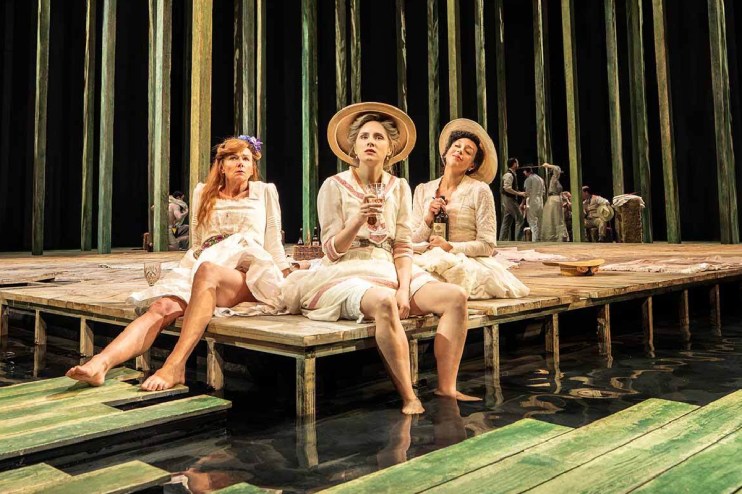
Summerfolk | National Theatre | ★★★★★
Maxim Gorky is a giant of the Russian literary canon, a playwright to be mentioned in the same breath as Gogol and Pushkin and even Chekhov. Yet his work is rarely performed on these shores and I’m a little ashamed to admit I have visited more municipal parks bearing his name (one) than I have seen his work performed on the London stage (zero).
This wonderful, languorous production of Summerfolk at the Olivier, directed by Robert Hastie (Standing at the Sky’s Edge), shows exactly what I’ve been missing. It’s a brilliantly directionless skewering of the petit bourgeoisie, ruthless in its efficiency and brutal in its ultimate condemnation.
We meet a vast ensemble of characters – at least 20 of them – as they migrate to their summer houses (hence “summerfolk”) for a sticky vacation, where the main event is an amateur production of A Midsummer Night’s Dream.
Everyone is either hopelessly in love (with the wrong person, of course) or simply hopeless. They speak interminably about poetry and suicide, making half-hearted attempts at both. This is a group with, as one character puts it, “toothache of the soul”, detached from the land their parents once worked but without the good grace to wear their wealth discreetly (Gorky, a socialist whose work would be thoroughly embraced by the Soviets, was no fan of the nouveau riche).
Varvara Bassova is depressed because her husband Sergei is a boorish drunk. She hopes the reappearance of a great novelist she once fancied might cheer her up but her hopes are dashed when it turns out he’s gone bald. Her brother Vlass (portrayed as a kind of drunk rag-doll by Alex Lawther) is in love with the much older Maria Lvovna, and while she’s in love with him, too, she can’t bear the social embarrassment of following through with the affair. Olga (brilliantly played for laughs by Gwyneth Keyworth) spends her time moaning about how terrible her life is now she has children. Yulia doesn’t even attempt to hide her flirtatious affair with her fellow amateur thespian Nikolai. All of these vignettes – and many more – play out in overlapping waves, the characters segueing in and out of focus in a loose, louche tapestry.
The literary greats are ever-present: Shakespeare is performed, Tolstoy is name-checked and Chekhov is printed right through like the name in a stick of Blackpool rock. It is a paean to the great Russian miserablist, sometimes bordering on love-lorn pastiche. It’s a work about the great conflicts of existence: truth vs lies, action vs apathy, loneliness vs the mundane social niceties of the middle classes. But it wears its themes lightly, considering them as its characters might, with a kind of listless disdain.
A big, ensemble affair like this demands a stage like the Olivier and Hastie’s production does not disappoint. More of this, please.