Starmer’s Chinese takeaway leaves a nasty taste

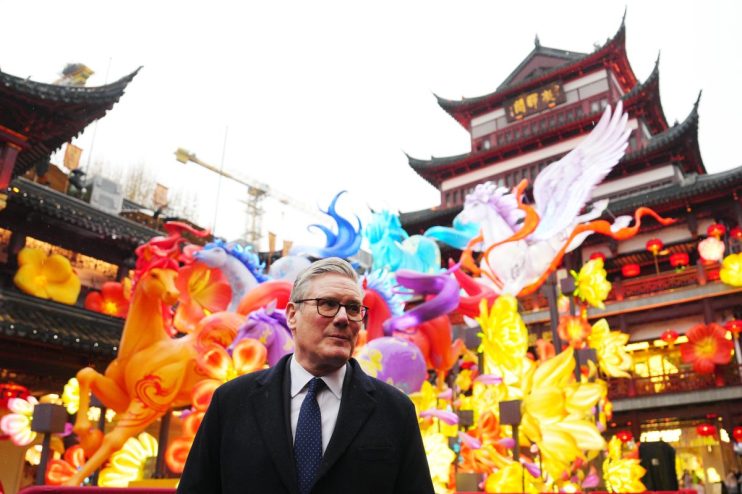
The Prime Minister returns from China a rather diminished figure. His vaunted commitment to human rights and international law rings very false when he kowtows to the regime in Beijing, and even the likely modest economic impact of his visit cannot offset that, says Eliot Wilson
We need to talk about Sir Keir Starmer.
The Prime Minister is having a torrid time of it, with historically low approval ratings and would-be successors circling as they sense blood in the water. He is at best embattled, and, as former Scottish Conservative leader Ruth Davidson said of Rishi Sunak two years ago, “embattled is one away from beleaguered, and once you’re beleaguered, you’re fucked”.
Starmer’s recent visit to Beijing can be seen as part of a desperate attempt to generate growth in the British economy. That is the foundation upon which rests everything else the Labour government wants or needs to do, from improving public services and increasing defence spending to tackling the uncontrollably rocketing welfare bill. Pursuing relations with the People’s Republic of China, however – maximising the economic benefits without compromising national security, moral authority or basic human decency – is an extraordinarily demanding task, if it is possible at all. And Starmer simply is not good enough to achieve it.
Within the past two months, President Xi Jinping has welcomed Emmanuel Macron, President of the French Republic, and Prime Minister of Canada Mark Carney to Beijing, and Starmer completes a triptych which underlines China’s influence and allure on the world stage. There is an air of the visits of Franciscan friar William of Rubruck or the Venetian merchant Marco Polo, eager Westerners on the take, overawed by the wealth of the elaborate courts and powerful rulers of the mysterious East.
Downing Street is already trumpeting the deals concluded with China on this visit, with much talk of “better market access”, “huge growth opportunities” and stimulating “growth, jobs and investments, to the benefit of both countries”. But such engagement with China is not risk-free. Starmer told the media that the UK’s relations with China are in a “good, strong place”, and he has sought to play down any weakness on the UK’s part.
Espionage
Yet China continues to engage in espionage, subversion and territorial expansionism at the expense of the West in general and the UK more specifically. David Lammy’s pre-election threat to “call out” Beijing’s genocide against the Uyghurs in Xinjiang has long since been abandoned; the trial of two British nationals accused of spying for Beijing collapsed recently in part because no-one in Whitehall was prepared to say unequivocally that China is a threat or an adversary; and Hong Kong businessman Jimmy Lai, a British national for 30 years, faces a potential life sentence in jail having been convicted of collusion and sedition in the recent pro-democracy demonstrations in Hong Kong.
As Lai’s son Sebastian has noted, “whether my father is freed or not is the ultimate test, it’s a very visual representation of how China views our relationship”. The most Downing Street can offer is not-exactly-menacing pledge that the Prime Minister will “raise” these issues with President Xi.
This gap between the bravado of Downing Street statements and the actions (and inactions) of ministers illustrates a wider issue. Sir Keir Starmer, alarmingly, seems unable to distinguish between saying something and making it so; and also appears to believe that the incompatible can be reconciled by issuing contradictory statements in isolation from one another.
Magical thinking
The fons et origo of this befuddled and ineffective approach, encapsulated in the results of the government’s China audit presented to Parliament last June, is Labour’s 2024 election manifesto. The 136-page document (in which the word “China” appears only twice) sought to address a difficult diplomatic, strategic and economic rat-king of problems through the magic of positive thinking and the power of mindless assertion.
“Labour will bring a long-term and strategic approach to managing our relations [with China]. We will co-operate where we can, compete where we need to, and challenge where we must… we will always act in our interests and defend our sovereignty and our democratic values. We will stand with and support members of the Hong Kong community who have relocated to the UK.”
Bluntly, not everything in those sentences can be true. The UK is failing to “defend… democratic values” by soft-pedalling on Jimmy Lai’s imprisonment, and it is doing so because it attaches a greater importance to boosting trade and investment from China.
This is of a piece with the government’s rhetoric on defence and relations with the United States. In effect, if you say both the good thing and the bad thing out loud, you transform yourself into a sophisticated statesman who can achieve the latter without being at risk from the former. In fact you have simply ducked or deferred a decision which is too difficult to absorb, ignoring the fact that these issues will collide at some point.
The Prime Minister returns from China a rather diminished figure. His vaunted commitment to human rights and international law rings very false when he kowtows to the regime in Beijing, and even the likely modest economic impact of his visit cannot offset that. Politics can be a dirty affair, and we must always be prepared to look that truth in the eye; the alarming part of this is that Starmer seems to think he is still cleverly and adeptly conducting a multi-track engagement with China.
Find a significant concession made by China to the UK and we can see how the evidence stacks up. Until then, the Prime Minister looks like a man who has been mugged, but whose desperation is somehow allowing him not to recognise it.
Eliot Wilson is a writer and historian; senior fellow for national security at the Coalition for Global Prosperity; contributing editor, Defence on the Brink