Starmer serves up his best and empty platitudes

If today’s relaunch-not-relaunch buys Keir Starmer any additional time in Downing Street, it will only be due to the extraordinary fecklessness of his would-be challengers, none of whom has anything significant to say about change either, says Eliot Wilson
Is Sir Keir Starmer all right?
There is a reason I ask. At last week’s local and devolved parliamentary elections, several factors were simultaneously at work, but a constant theme was that the Labour Party took a savage beating. It lost 1,500 councillors in England and control of 12 of the 21 London boroughs in which had been dominant; the loss of four seats in the Scottish Parliament means it is now only jointly the second biggest party alongside Reform UK, not even within touching distance of the SNP; and in Wales, one of the heartlands of the Labour movement, there are now just nine Labour representatives in the 96-member Senedd.
Two things were wholly predictable and expected: that Labour would perform poorly, and that the poor performance would increase pressure further on the Prime Minister’s leadership, which began to slide towards crisis within weeks of coming to office in 2024. Eyes were fixed on Downing Street almost as soon as the polls closed last Thursday, to see how the beleaguered Starmer would respond.
Only those with Flavor Aid on repeat prescription would claim that Starmer is a deft or highly attuned political operator. This is, after all, a man whose defence against accusations of racist undertones in a speech on immigration was that he hadn’t read it before he spoke it out loud. Even so, his first moves over the past few days have been so bizarre, so tin-eared, so wildly ill-judged that you start to wonder if he’s entirely all right, or at least, as my late father used to say, what colour the sky is on his planet.
The public mood is still one of inchoate, prickly, reflexive unhappiness. Reform UK continues to ride high with its smörgåsbord of disparate grievances and thin, shoot-from-the-hip solutions. But the thread running through everything is a desire for change, almost any change.
Starmer’s instant answer to this sullen, scratchy feeling was the appointment of two 75-year-old advisers: as special envoy on global finance and co-operation, Gordon Brown, who fought and lost one general election as Prime Minister; and as adviser on women and girls, the doggedly self-righteous Baroness Harman, first elected to Parliament in 1982, whose great public legacy is the ham-fisted, intersectionality-written-into-law Equality Act 2010. Politicians often fall for the lure of “getting the band back together”, but most choose a band that was successful.
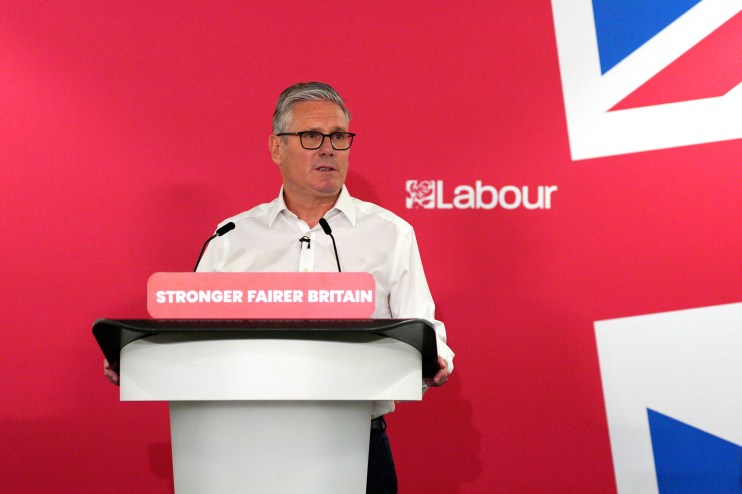
This morning, the Prime Minister gave a speech which was, his aides were categorical, not a reset or a relaunch. It is perhaps as well, since most of us have lost count of Starmer resets. The challenge was clear: if Starmer wants to retain his job – and the indications are that he does – what did he have to do or promise to show both his party and the electorate that he had understood the severity of the defeats, understood where he had been failing and had plans to change where change was needed.
Echoes of Boris Johnson
He could have done that. Instead, having told The Observer over the weekend, with echoes of pre-lapsarian Boris Johnson, that he wanted to be Prime Minister for another 10 years, Starmer literally rolled up his sleeves, and treated the public to his best and emptiest platitudes. The government had “made mistakes”, he admitted without explicitly identifying any, and he understood that “people are frustrated”.
“Incremental change won’t cut it,” Starmer declared, and “change cannot come quickly enough.” So he set out “the direction we need to take”. Are you sitting down? He will pursue closer ties with the European Union, but retains the red lines of Labour’s election manifesto: “no return to the single market, the customs union, or freedom of movement”. He will also nationalise British Steel, which has been under government control since April 2025 through the Steel Industry (Special Measures) Act; as of January, the government had spent more than a third of a billion pounds simply keeping the Scunthorpe Steelworks open.
It is genuinely bewildering that the Prime Minister can begin to imagine this satisfies those who voted for fundamental change. His needy approach to the EU pleases almost nobody, since Brexiteers see him as a sneaky Remainer trying to undo Brexit by stealth, while Europhiles cannot bear his faint-heartedness in ruling out so many policy options like freedom of movement and a customs arrangement. Nationalising British Steel simply looks like trying another switch to see if the domestic steel industry can somehow be made competitive.
We live in strange times. The people have spoken (“the bastards,” as Dick Tuck famously noted after his failed campaign for the California State Senate), and the incumbent Prime Minister has sympathised, as if he had not been in charge for the past 22 months, then agreed change must come quickly without demonstrating anything he will do differently to achieve that. It is almost a less aggressive and more pathetic version of the madman theory.
Politicians often interpret electoral reverses as indications that they have simply not been sufficiently successful in explaining their brilliance to the electorate. This is much stranger and more disconnected. It’s more like asking someone what they want for lunch only for them to explain what their favourite television programme is. If Monday’s relaunch-not-relaunch buys Starmer any additional time in Downing Street, it will only be due to the extraordinary fecklessness of his would-be challengers, none of whom has anything significant to say about change either.
Honestly, though, is he all right?
Eliot Wilson, writer and historian; Senior Fellow for National Security, Coalition for Global Prosperity; Contributing Editor, Defence on the Brink