Oxford Street regeneration a complex undertaking for City Hall

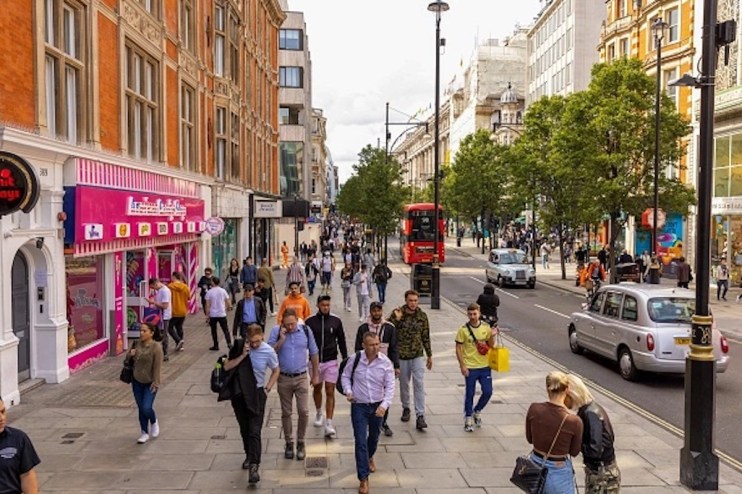
The centrepiece of shopping in the capital is set for a major makeover, after London mayor Sadiq Khan set out his long-mooted plans to pedestrianise Oxford Street on Wednesday.
The plan will transform the makeup of central London and bring huge opportunities for retailers, but the proposal – particularly its computer-generated elements – leave plenty to be ironed out.
Traffic will be removed from the strip between Orchard Street and Great Portland Street by the end of this summer, according to details announced on Wednesday.
The new Oxford Street will feature trees and more seating areas, City Hall said, and the Met Police will use CCTV and street lighting to prioritise the safety of women and girls.
Khan’s decision was widely welcomed by business leaders, though social media users were quick to pour scorn on a widely-shared CGI mock-up of the pedestrianised street, which features brightly-coloured green paving and models of jumping men strung between Oxford Street’s historic buildings.
“No need for migraine-inducing diagonals, greenified asphalt, or sculpted athletes suspended on wires,” Samuel Hughes, fellow at the Centre for Policy Studies wrote on X, sharing another image depicting the street paved with cobblestones.
But it appears the image attracting the ire of X users dates from a previous iteration of the plans and does not represent City Hall’s current ambitions for the project.
Westminster council ‘gazumped’ by Khan
The decision represents a victory for City Hall over Westminster City Council who, despite being Labour led, have long been sceptical of the plans.
In September, the mayor was accused of giving the council only an hour’s notice before announcing a trial car-free day – a claim Sadiq Khan said was “completely untrue”.
Responding to the mayor’s decision to green-light the project, council leader Adam Hug gestured to his council’s long-standing criticism of the plans as “a matter of public record”.
But he committed to engaging with the Greater London Authority to make the new Oxford Street “work for local communities, as well as for London”.
He said: “Over the last eighteen months we have secured a number of key improvements from the Mayor of London’s original plans to ensure that the proposals for Oxford Street are more deliverable and better meet the needs of local residents, businesses, and wider London.”
These concessions include ensuring that Oxford Street East, which is not due to be pedestrianised, retains bus traffic, he said.
“We will continue [to] work pragmatically with the Mayor’s team to ensure a bright future for the nation’s high street as well as for our residential communities and businesses,” Hug said.
James Ford, a former advisor to Boris Johnson during his time as London Mayor, told City AM the decision will offer an opportunity for the two Labour authorities to move on from the difficult politics of the dispute over the plans.
He said: “Westminster [council] is traditionally a Conservative borough that went emphatically [to] Labour in the 2022 local elections, and there are ruffles in the Labour movement about the fact that a Labour mayor is gazumping a flagship Labour Council.”
While the council has now committed to put its weight behind the plans, Ford believes the redevelopment of Oxford Street could meet further opposition among the wealthy inhabitants of surrounding areas like Mayfair and Fitzrovia.
“Many […] will now find the bus coming outside their house, and find the traffic on their street a little slower moving. There will be pollution and air quality issues, and they are not known to keep those things quiet,” he said.
Retailers: plans will boost takings
A number of high-profile retail figures have put their weight behind the plans to pedestrianise the area, which is already among Europe’s biggest shopping streets.
As the mayor set out his plans for the transformation, John Lewis managing director Peter Ruis said the pedestrianisation would create a more “vibrant, green” space while Selfridges executive director Meave Wall said the project will “revitalise” the shopping strip.
Following Khan’s approval of the project, the chief executive of the New West End Company, which represents more than 600 businesses across the district, told City AM the previous pilots prove the plans will be a success.
ReDee Corsi said: “This is Oxford Street’ offered visitors a fresh and dynamic way to experience the nation’s high street, with our data revealing that the one-day pedestrianisation drove large increases in footfall for both Oxford Street and neighbouring streets across the district.”
Sarah Bevan, the director of planning and development at industry body BusinessLDN, welcomed the plans but told City AM the mayor’s office “must” consult businesses to ensure the pedestrianisation does not clash with ongoing plans to regenerate parts of the West End.
Property market also set to gain
Paul Stenson, director of real estate investment management at investor services firm IQ-EQ, told City AM the “reinvention” of Oxford street will bring a wealth of opportunities for real estate investors.
The “patchwork” of land owners in the area – which includes investment trusts, sovereign funds, high-net-worth individuals and owner-occupiers – means Oxford Street is particularly adaptable, Stenson said.
He said: “It’s very hard to think about a patchwork of ownerships that gives you such resilience anywhere else in London, never mind worldwide.”
Questions remain over how the heavy bus traffic – which carries more than 200,000 passengers per day down the thoroughfare – will be redirected without causing knock-on effects for the surrounding road network.
London Travelwatch, the capital’s travel watchdog, said they are “broadly” in favour of the plans but called on Transport for London (TfL) to consult on a wide range of groups to make the pedestrian area “safe and accessible”.