London cable car proves Britain can still get infrastructure right – sometimes

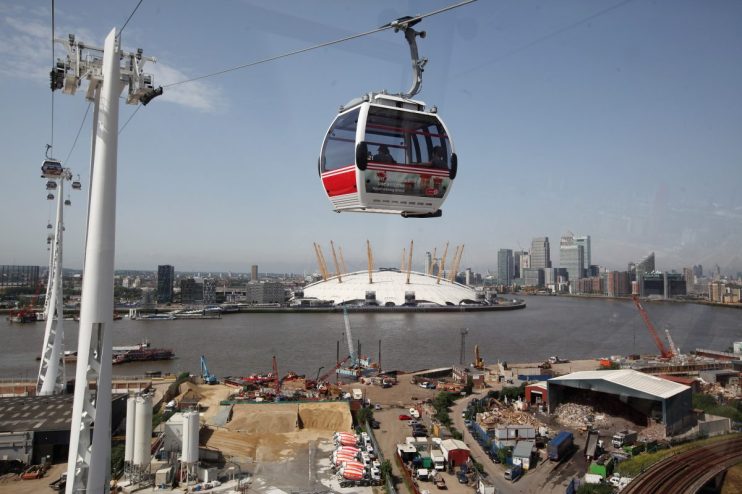
A proposed floating park in the Royal Docks finally proves the value – and vision – of the London Cable Car, argues James Ford
Here is a question you probably rarely ask yourself: what is your favourite bit of transport infrastructure in the capital? Is it the Regent Street Monorail? Maybe you prefer travelling between Westminster and London Bridge on a steam train courtesy of the Thames Viaduct Railway? Or perhaps you enjoy watching planes land at King’s Cross Aerodrome? No, you haven’t been misreading the tube map: none of these transport wonders exist. They were all, at one time or another, real proposals though.
Sadly, the archives are full of grand projects for the capital that never got off the ground. There was Watkin’s Tower (a Wembley rival to the Eiffel Tower), the Barbican Pyramid (which sounds far nicer that the non-pyramid-shaped brutalist edifice that we ultimately got), the Great Victorian Way (a ten-mile, glass covered loop around central London, integrating shops, residences, and railways), Charing Cross Heliport, and several different versions of a Grand Central station.
All of these ideas are interesting. Some are inspired. A few were just unlucky to be conceived at the wrong time. Most, however, are just plain bonkers. So, spare a thought for the poor public officials that must sit in judgement and filter the inspirational from the merely hair brained.
For a brief period during my time at City Hall, I was one such official. Worse still, the ‘visionary’ ideas floating across my desk were not the easily dismissed wacky outpourings of architecture’s latest enfants terribles. They were ideas that had captured the imagination of my boss (indeed, my boss’s boss): the Mayor of London no less. According to design writer and critic Douglas Murphy, Johnson’s legacy in London amounts to “some of the most remarkably odd public works anywhere in the world in recent years.” Some ideas, like an airport in the Thames dubbed Boris Island, were never realised. Others, such as the helter-skelter like ArcelorMIttal Orbit (‘a bauble of questionable taste’), were built but probably shouldn’t have been. However, amongst the deluge of random ill-fated ideas, was the odd, brilliant spark of genius. One such scheme was the London Cable Car (now the IFS Cloud Cable Car but previously the Emirates Air Line) in East London.
Dangleway
Of course, if you’d asked me to put money on it during my City Hall days, the cable car would never have been the scheme that I would have expected to one day grace London’s skyline. An old idea knocking about since the late 1990s, it seemed fanciful. Its planning was torturous: at every meeting we had internally to discuss it, the price seemed to go up by another £5m. Once finished It was dubbed the “dangleway”, derided as a white elephant and dismissed as impractical, expensive and unpopular.
However, I’m delighted to say my scepticism was misplaced. The project’s critics were wrong. I’ve taken a ‘flight’ on the Cable Car and loved every second, making me one of 14m happy passengers during the cable car’s first decade of operation. History has also proven that its conception and construction was a stroke of pure genius. It provides a quick and easy way to get from the new City Hall building in the Royal Docks to the restaurants and bars across the river at the O2 (itself another of those questionable London planning projects that have proved their worth over time). And, even if you don’t think access to Nando’s and Wagamama is important for City Hall bureaucrats, now the cable car’s gondolas are set to be filled with thousands of visiting tourists thanks to the planned construction of a giant floating park in the Royal Docks. Far from the frivolous indulgence that it was dismissed as, the London Cable Car had proven to be farsighted, futuristic and a vital catalyst for the regeneration of Newham (one of the capital’s most deprived boroughs). Yet again, the capital owes Boris a debt of gratitude. I never should have doubted him.
We live in a time where commentators – myself included – find it all too easy to argue that Great Britian’s decline is best symbolised by its ‘can’t build, won’t build’ mentality. Where once we were a nation forged in steel by Brunel or carved from Portland stone by Christopher Wren, now we are a nation whose ambitions are thwarted by crested newts, nesting bats or Treasury myopia. But the London Cable Car proves that when our leaders are brave and our designs are ambitious it can pay dividends. Maybe it is time we dusted off the plans for the Regent Street Monorail or the Charing Cross Heliport…
James Ford is a former adviser on transport policy to Boris Johnson during his time as Mayor of London.