FTSE 100 suffers worst month since Covid as Iran war rages on

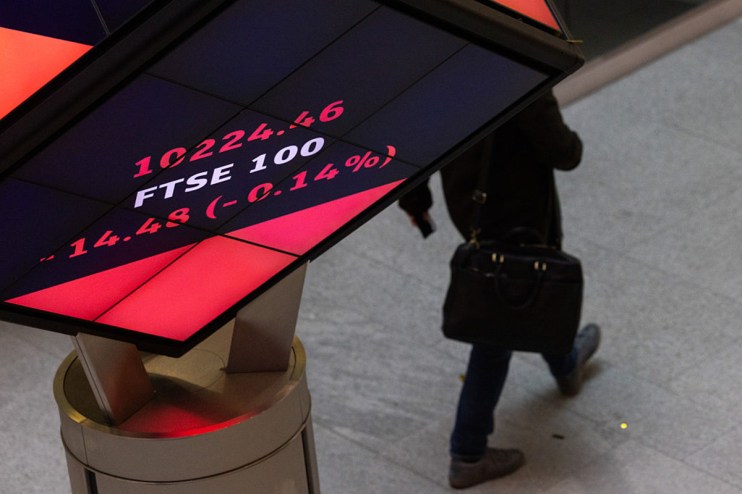
The FTSE 100 suffered its worst month since the coronavirus in March, after the United States’ war in the Middle East sparked a historic market reaction that has seen government borrowing costs sprial and oil prices subjected to their largest single-month jump on record.
Despite a relief rally on Tuesday, London’s blue-chip index fell more than seven per cent over the course of the month when Donald Trump and Israel’s strike on Iran escalated into the Middle East’s gravest regional conflict this century.
Markets have swung violently since the end of February, with speculation mounting on whether the Strait of Hormuz, a vital shipping lane out of the Persian Gulf that normally funnels a quarter of the world’s seaborne oil supplies and a fifth of its natural gas, may be reopened.
The strait’s de facto closure has led to a period of acute stress in energy markets. Brent crude – the international benchmark for oil prices – notched up its largest single-month rise on record, while WTI crude climbed similarly sharply.
Brent, which traded at historic lows for much of 2025, rose more than 50 per cent in March to soar past $100 a barrel for the first time since Russia’s invasion of Ukraine. The commodity ended the month at $107/barrel, meaning its gains for March narrowly outstripped the previous monthly record set in 1990 when Saddam Hussein invaded Kuwait.
Jose Torres, senior economist at Interactive Brokers, said: “President Trump’s attempts to inject calm into markets appear to be losing impact each time.”
The hostilities have also sparked a sharp reappraisal in the path of interest rates, leading the government’s short-term borrowing costs to suffer their worst month since Liz Truss’s fateful mini-Budget. The yield on the 2-year gilt, one of the most commonly issued UK bonds, soared by nearly a full percentage point through March, wiping billions off the Chancellor’s fiscal headroom.
Before the onset of hostilities, traders had expected the Bank of England to cut its central interest rate three times through 2026, amid a rapidly disintegrating labour market and a more temperate inflation outlook. But fearful the spiralling energy prices would drive up prices across the wider economy, investors fully reversed those bets, with markets now pricing in between three and four interest rate hikes before the end of the year.
War extinguishes record FTSE 100 run
Britain’s government bonds suffered the most aggressive swings in the developed world. Analysts have argued transitory price rises are less likely in the UK because of its array of regulated industries and vulnerable energy market. The costly sell-off in shorter dated gilts also spawned a wave of fears over the UK’s fiscal sustainability, leading longer-dated bonds to come under pressure from traders as well. The 10-year gilt yield climbed a shade over five per cent for the first time since the global financial crisis, and 30-year gilts remain at levels not seen this century.
Kathleen Brooks, research director at XTB, branded the bond market moves “astonishing” and argued in a note that the government was in part respsonsible.
“It is unwilling to cut fuel duty or VAT on fuel in this environment. Instead it is blaming price gouging by petrol forecourt owners,” she said. “There is absolutely no evidence of this, and the RAC has reported that forecourt owners only make a slim six per cent profit margin on a litre of fuel. It is the government’s coffers who line their pockets during an energy price shock.”
The month has brought a juddering halt to what had been an impressive run for UK assets, with both equities and government bonds enjoying a strong first quarter in 2026. The FTSE 100 broke the 10,000-point mark for the first time in its history in January, extending a stellar run in 2025 when it was the world’s best performing major index. Buoyed by investors’ demand for exposure to mining and the eye-catching valuations, the index continuing to hit a string of fresh records, coming to within touching distance of 11,000 points shortly before the war.
Government bonds had also rallied into 2026 on hopes of interest rate cuts and several signs suggesting ministers were prioritising getting a grip on the public finances.