Experience the Roman Empire in Bulgaria for history to rival Italy – just without the crowds

What have the Romans ever done for us?” quipped my partner, Ed, as we stood on the main street of Nicopolis ad Istrum, formerly a Roman town in Bulgaria that is now a glorious assemblage of ruins. “All right, but apart from the sanitation, the medicine, education, wine, public order, irrigation, roads, a fresh water system, and public health,” I replied. The archaeologists excavating the site were thankfully out of earshot…
It didn’t take long for proof of the wonder of the Romans to appear before our eyes: we were walking on one of said roads, the sewer system still visible in places underneath; and there were wells, a catchment reservoir, and three aqueducts to supply drinking water, plus public baths, nearby.
Whether your knowledge of Roman history is informed solely by Monty Python’s Life of Brian, or has been enriched by more scholarly sources, it is at places like Nicopolis that hazy, half-remembered ideas of what the Romans were capable of suddenly come into sharp relief.
Bulgaria is laughably untouristic – but has some incredible Roman amphitheatres

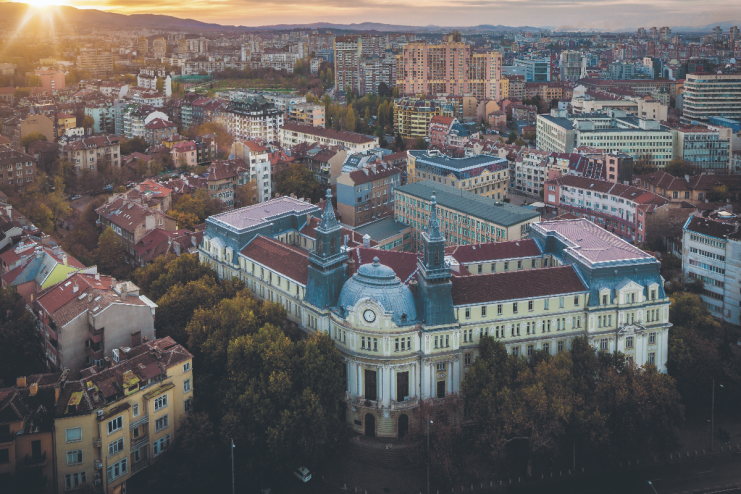
Bulgaria was on the frontier of the Roman Empire, part of the 1,800km-long Danube Limes of forts and fortified cities. Plovdiv is the oldest continually-inhabited city in Europe; and the modern capital of Sofia sits above and around the ruins of ancient Serdica, large parts of which were discovered during excavation work for the metro system.
Scattered elsewhere across Bulgaria are Roman basilicas and temples, theatres and tombs, in addition to fortifications. The best way to see them on your Roman Holiday is on a circular road trip, starting and finishing in Sofia.
Bulgaria joined the EU in 2007 and since then has benefited from ongoing investment in infrastructure, including in its roads. Having flown direct from Heathrow, we picked up a rental car (toprentacar.bg/en dominates the local market) from Sofia Airport and sped east to Veliko Tarnovo, two and a half hours away.
The three hills on which the city is built have been inhabited since the 3rd millennium BC, and it’s the closest modern settlement to Nicopolis, a former Roman city. I’d expected Nicopolis to be busy — and no doubt in the summer months it is — but in October, the only other people there were the archaeologists; there’s still a lot more of this important site to dig.
I was where charioteers raced for glory 1,800 years ago. Close your eyes for a moment and you can almost hear the pounding of ghost-horses’ hooves
The Romans are rightly famed for their baths. The thermae in Varna, on Bulgaria’s Black Sea coast, cover some 7,000 sqm (making them amongst the largest in Europe) and date from the 2nd century. Unlike Nicopolis, but akin to Plovdiv and Sofia, the ruins are in the heart of the modern city. In fact, if you had an apartment on Tsar Kaloyan Street, you could sit on your balcony looking down on the substantial remains of the changing rooms, meeting rooms, and pools.
We’ve all read about hypercausts and how they worked; here, the heating system is almost intact, and so extensive it would have carried hot air as far as the roof. Finds from the baths are in the equally impressive Archaeological Museum of Varna, a 10-minute walk away.
Driving in Bulgaria is easy; there aren’t many cars on the roads and signs are in both Cyrillic and Latin scripts, so we had no difficulty navigating. With your own wheels there’s no need to go straight from A to B, so we meandered between villages and towns, through farmland and scenic gorges. The mostly deciduous forests were turning bronze and gold, and the warm autumn sunshine sparkled on the trout-filled rivers and lakes.
We reached Plovdiv in the late afternoon, left the car at the well-located Emporium Hotel, and struck out on foot to explore.
Plovdiv first came to my attention when it was European Capital of Culture in 2019, but the pandemic seems to have delayed what should rightly have been an ensuing tourism boom.
The lack of tourists is almost laughable: this is a city with Roman history to rival anywhere in Italy, photogenic cobbled streets with painted houses, dozens of museums, and a thriving cafe and bar culture. Oh, and it’s cheap!
Read more: Italy topples Bulgaria to offer Europe’s lowest ski-resort prices
Well-fed street cats stalked the stones of the Roman Forum in the fading light at dusk. We walked, fig and honey ice creams in hand, with a background of bustling bars and street musicians. Half way down the main shopping street, a section of the Ancient Stadium of Philippopolis comes into view, the steeply-tiered spectators’ seats just below the minaret of the Ottoman-era Djumaya Mosque. The balcony of a popular restaurant juts out, suspended above where charioteers would have raced for glory 1,800 years ago.
Close your eyes for a moment and you can almost hear the pounding of ghost-horses’ hooves. In the nearby Roman Theatre — one of the best-preserved in the ancient world — you don’t even have to imagine what it once was like: performances still take place.
Returning to Sofia, I expected to meet modernity with a jolt. But here, too, the city wears its many layers of history — Roman, Bulgarian, Byzantine, Ottoman — and all the cultural complexities of its past, on its sleeve. There’s so much history to take in, it is easy to become overwhelmed. In such scenarios, a beer usually helps, and Tap Local came to the rescue. The craft beers are all by Bulgaria’s Kazan Artizan brewery; the double IPA is a particularly good pick.
Read more: ‘Extraordinary’ Roman Basilica uncovered in heart of the City
Refreshed and rehydrated (which makes all the difference…) I headed to the Serdica II metro station, not to take the train but to stroll a while longer among the monuments. Allegedly, Emperor Constantine declared “Serdica is my Rome!” before naming Byzantium as the new capital of the Roman Empire, and for 300 years Serdica was indeed a hub of culture and commerce.
In total I spent two weeks road tripping around Bulgaria, moving at a leisurely pace and stopping in villages between the major cities. You could comfortably do my itinerary in a week, however, with a night in Veliko Tarnovo and two nights in each of Varna, Plovdiv, and Sofia.
The Romans may have been drawn here by the hot mineral springs, but it is their built legacy — most importantly churches and shrines like St. Sophia’s and the St. George Rotunda in Sofia — which still enchants visitors today.
VISIT BULGARIA
British Airways (BritishAirways.com) flies from London Heathrow to Sofia from £107 return.
Double rooms at Maison Sofia MGallery (from €140) and Emporium Hotel Plovdiv MGallery (from €209) can be booked at mgallery.accor.com and include breakfast. To plan a wider itinerary or find out more about Bulgaria go to visitBulgaria.com.