Covid-19: It’s 1-1 at half-time in the biggest match of our lives

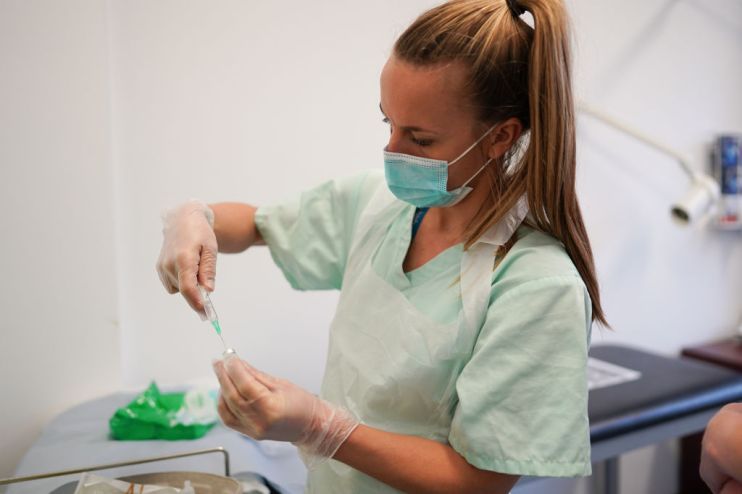
A monumental effort has produced the first vaccines for Covid-19 in a timescale that at the start of the year looked very difficult.
The fact we are now seeing people like Margaret Keenan, the first to receive the vaccine in the UK, given an injection shows the progress made in vaccines over the past 10 years.
Big companies working with small, scientists, charities, sharing information and data for the greater good.
Read more: UK stuck with Tier 4 lockdowns until vaccine rolls out across the country
And it’s that spirit of cooperation that must continue now if we are to truly defeat Covid. Cooperation at a political level on managing this next phase for the benefit of all – and cooperation from the public in taking a vaccine that is so crucial to overcoming the virus.
Do this and we can win.
Because make no mistake, as we’ve seen this week, the match against this deadly virus isn’t over. If it was a football game, we are currently at half-time. It’s 1-1 and as a world we really need to pull together now.
We need to learn which people cope with which vaccine the best, to learn the profile of the vaccines we have developed and the possible side effects they have.
We need to figure out which vaccines are best at preventing the virus, combating its severity, how long they protect us for and which ones are more suitable for different climates.
We also need to produce enough and work out the best way to distribute the various vaccines so that it’s not only the wealthy part of the world that benefits – but the less wealthy part too.
What concerns me most as a vaccine innovator, a microbiologist is the creeping isolationism and populism among some political leaders, totally misunderstanding the need for teamwork. This idea that we are better than others is outdated and means we fail to master infectious diseases.
You’ve seen this malicious ignorance in the United States under the departing President and, sorry to say, to a degree even in some European countries.
“We’re better than you.”
“We’re first.”
We seem to be bringing a kind of disruptive contest into this and it could undermine our efforts against Covid.
Read more: R Rate creeps up to 1.4 in the capital
The ‘mutant’ strain recently identified in the UK population, underpins the notion that it’s prudent to move forward a variety of distinct vaccines following the front runners.
We shouldn’t be arrogant. Take the Chinese vaccine. It’s a very well-developed vaccine candidate with a promising profile. It’s based on classical vaccine technology.
Viruses grown on tissue culture, inactivated, purified and formulated are classical vaccines which are very efficient and proven to be safe – like the one we used against Hepatitis A and Rabies. Classical vaccines which do not need a minus 80 degrees centigrade cold chain for distribution and have a very long shelf life.
We shouldn’t be arrogant and dismiss it because it’s from China or because it doesn’t use the latest technology.
But critically, as well as political goodwill we also need to educate and make the case for vaccines once more among the public.
People living in wealthy or even in ‘upcoming’ countries have enjoyed relative freedom from infectious disease for decades, mostly because of vaccines. As a result many of those diseases have nearly disappeared or their spread has at least been kept under control.
This has led to the gigantic misconception that we don’t need vaccination programmes, but they are essential to protecting society.
So today, some in better off countries are not willing to recognise that taking vaccines is the only way to get out of this dramatic pandemic crisis. If people want to return to normal life, there really is no other way now than a mass vaccination programme.
While I’m not a friend of authoritarian solutions, we have to be honest and admit we may need to introduce a kind of ‘Immunity Passport’ as an incentive, something that allows those willing to take a vaccine to resume normality while being clear that those who don’t pose a risk.
I wouldn’t necessarily enforce a vaccine, but there are many sectors in our economic life, in our social life, where if somebody refuses to be vaccinated, she or he has to accept that this will exclude them from some type of standard, economical and social activity.
As I mentioned. We are only at half-time. We are facing a team of 11 very strong, little red viruses. We have to put all our nerve, strength – and teamwork – into the second half.
If we do we will return to the normal life we crave.
Read more: Wanted: A Minister for Hospitality