Cirque du Soleil OVO, Royal Albert Hall review: Amazing tricks, okay clowns

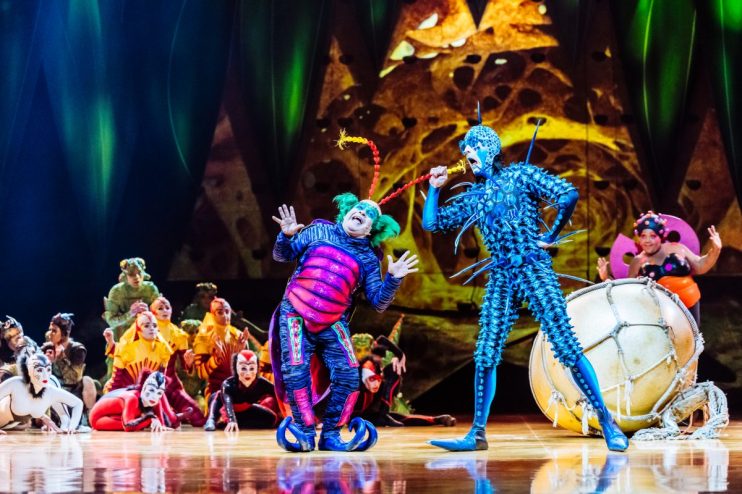
OVO at Cirque du Soleil | Royal Albert Hall | ★★★★☆
Roll up, roll up, the circus is in town! Royal Albert Hall has once again been transformed into the most glamorous of big tops for a two-month residency from French-Canadian troupe Cirque du Soleil.
This time they return with OVO, a show first created in 2009 celebrating the world of insects. Bear with: it may not sound like the most promising of themes, but it works remarkably well.
The show is essentially a series of tricks: foot juggling, slackwire, glow in the dark diablo, a trampoline wall and, of course, aerial acrobatics. Performed by different groups from the insect kingdom – clad in carnivalesque costumes with shell-backs, wings and antennae – it makes for an otherworldly spectacle.
Just like their insect counterparts, the performers, playing spiders, ants, grasshoppers and many other insects I don’t have the entomological knowledge to identify, are both delicate and astonishingly robust, contorting their bodies in ways that can only be described as non-human. Indeed, watching the show, still and straight-backed in the stalls, it’s easy to forget you even belong to the same species as the acrobats before you. When they took their masks off for the bows at the end, and all their non-buglike hair came tumbling out, it was rather a shock.
The theme is a gift for the set design too, in which stage ropes become webs and climbing apparatus is reimagined as great, towering flowers. Paired with an upbeat, ‘Brazilian-inspired’ soundtrack, the show has an infectious vibrancy.
New for this performance – and one of the most impressive parts of the show – is a new aerial cradle routine, performed by the cast’s scarabs (a type of beetle). Featuring three platforms suspended above a net, the acrobats launch themselves through the air in an increasingly precarious manner. With each platform separated by a full six meters, there is a real sense of jeopardy, with audible gasps from the audience when one performer almost didn’t make it before catching one of their peer’s hands just in the nick of time. The last time I saw a Cirque du Soleil I was a child and didn’t really appreciate the stakes; my adult sense of fear made this section particularly enthralling.
Interspersed between the acts is a halfhearted attempt at a narrative, a PG romance between a shy fly and an assertive ladybird. Together with Master Flipo, the colony’s cranky head bug who emerges in the crowd with a giant fly swatter, this trio are the show’s clowns, gabbering on stage in Cirquish (Pingunese to my ears) with slapstick setpieces focused around a mysterious egg (“ovo” is egg in Portuguese), presumably meant to represent life or rebirth or growth or something. It’s not the most affecting of narratives, mostly serving as distraction for set changes, but this is a circus and it will do.

Ultimately, Cirque du Soleil is a show about the human body – how far can we bend, push and contort it until it becomes unrecognisable. It’s a concept that can breed greed – it’s easy to demand more, more, more. There’s sometimes a catch 22 for performers: the more skilled they are, the more effortless the performance and the more hidden their skills become. The key for the audience is to appreciate the humanity (and its accompanying limits) behind it.
OVO is everything you expect from a Cirque du Soleil performance – kaleidoscopic, fun and hugely impressive. It’s little more than that (there are only so many tricks to pull off, and only so far the human body can be pushed) but that’s to be expected. Staged in the plump settings of the Royal Albert Hall, it feels like an especial treat – it’s a show where you can really settle in, switch your brain off and just allow yourself to be amazed.
Cirque du Soleil’s OVO is on at the Royal Albert Hall until 1 March 2026