The Nichols N1A proves there’s still a market for cars that make no sense at all

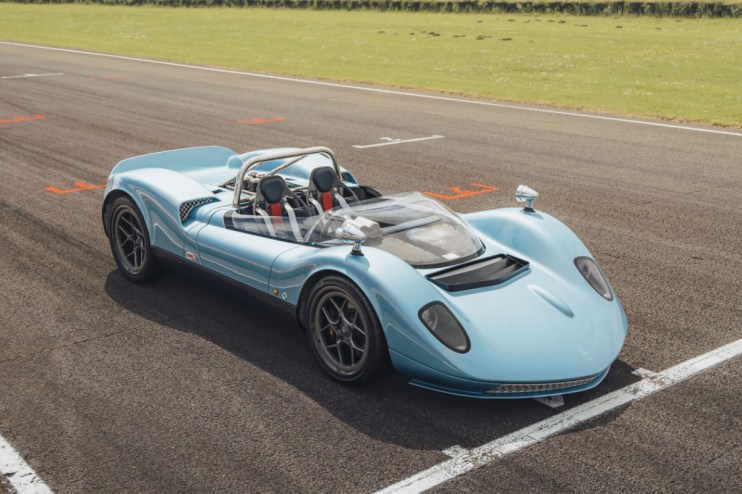
Steve Nichols, the Formula One designer behind McLaren’s legendary MP4/4, has finally put his name on a road car. The result is a £540,000 British supercar that seems determined to ignore almost every automotive trend of the past decade.
The modern supercar is becoming a strangely sensible thing. Even Ferrari is building an electric car, Porsche now talks as much about software as it does about engines, and McLaren’s latest models are engineering marvels increasingly wrapped in layers of technology designed to make extraordinary performance accessible to ordinary millionaires. Which is why the Nichols N1A feels so refreshingly odd.
This is a brand-new British supercar costing £540,000 including VAT, and it has no hybrid assistance, no electric motor, no grand vision for a sustainable future and seemingly very little interest in making life easier for its owner. Instead it channels the spirit of the unrestricted Can-Am racers of the late 1960s, stuffing a naturally aspirated Chevrolet V8 behind the driver and leaving the rest largely up to talent and bravery.
The more interesting story is why a car like this exists at all in 2026. Looked at coldly, it appears to be selling nostalgia at half a million pounds a time. Spend a little longer with the idea and it starts to look like one of the most honest supercars launched in years.
A Formula One legend enters the road car business
The name above the door matters here. Steve Nichols is not another entrepreneur chasing a boutique car company; his CV includes designing the McLaren MP4/4, arguably the most dominant Formula One car ever built. Driven by Ayrton Senna and Alain Prost, it won 15 of its 16 races in 1988 and remains one of motorsport’s great benchmarks. Nichols later worked for Ferrari, Sauber, Jordan and Jaguar, accumulating the sort of experience that lends credibility to almost any engineering project.
The N1A has been a long time coming. It was first shown several years ago and has only now reached production, with the cars assembled in Northamptonshire by engineering specialists RML. That feels fitting, because Britain’s performance car industry has always thrived in corners rather than on motorways. While Germany perfected industrial scale and Italy cultivated glamour, the UK became home to small manufacturers building machines for enthusiasts who cared more about feel than market share. Caterham, Ariel, Radical, Morgan and Noble all emerged from that tradition, and Nichols Cars joins the list, albeit from a rather more expensive starting point.
The analogue luxury boom
The obvious question is who exactly spends £540,000 on a car that appears determined to reject progress, and the answer is increasingly the same sort of person who buys a mechanical watch. Nobody needs a £20,000 Swiss chronograph when a smartphone tells the time more accurately, yet the luxury watch industry thrives because buyers value craftsmanship, heritage and the satisfaction of something mechanical working beautifully. Cars are heading the same way. As mainstream vehicles become quieter, cleaner and more automated, analogue driving experiences are becoming rarer, and scarcity creates value.
The N1A leans into that completely. It weighs around 900kg and can be specified with a 7.0-litre V8 producing up to around 700bhp, sending everything to the rear wheels through a six-speed manual gearbox. Even traction control is optional. Nichols quotes a 0-62mph time of 3.5 seconds, but the more telling figure is the power-to-weight ratio, which edges past a Bugatti Chiron despite the car costing a fraction as much. Not that buyers in this market are comparing spreadsheets. They are buying a feeling.
Looking backwards to move forwards
There is something slightly contradictory about spending vast sums developing a modern car designed to resemble a racing machine from almost 60 years ago, yet that contradiction runs through much of today’s luxury market. Fashion endlessly recycles past eras, vinyl records keep outselling expectations, and luxury hotels charge a premium for authenticity. The N1A taps into the same instinct. Its shape is inspired by the McLaren M1A Can-Am racer, complete with swollen wheelarches, an open cockpit and an exposed roll structure, and even the name nods to that heritage. Modern carbon fibre construction and contemporary engineering make sure it performs properly, but visually it belongs to a period when racing regulations were little more than a polite suggestion.
That era still holds enthusiasts in its grip because it represented freedom. The cars were often dangerous, frequently unreliable and gloriously excessive. Modern motorsport is faster and safer by almost every measure, and a good deal more regulated. The appeal of Can-Am was that nobody seemed particularly interested in limits.
A supercar for the post-digital age
What strikes me most about the N1A is that it feels less like a supercar and more like a reaction. For the best part of a decade the automotive conversation has revolved around electrification, autonomy and connectivity, with most manufacturers asking how technology can improve driving. Nichols Cars has approached the question from the opposite end, asking instead how much technology you can strip away before the experience gets better.
That doesn’t automatically make the N1A right. Plenty of buyers spending this kind of money will prefer the sophistication of a Ferrari 296 or the sheer capability of a modern McLaren, and those cars represent an impressive future. But there is room in the market for machines that celebrate the past without becoming museum pieces. The first 15 examples will be sold as “Icon 88” editions, commemorating the MP4/4’s 1988 season, with the full production run limited to just 150 cars.
For most people the N1A will remain a fantasy, and at more than half a million pounds that is unavoidable. Its significance, though, goes beyond how many are sold. At a moment when much of the industry is racing towards a software-defined future, the Nichols N1A shows there is still a wealthy audience willing to pay handsomely for something unapologetically mechanical, for an experience modern cars increasingly struggle to replicate. In a world fixated on what comes next, there is still money in remembering what made people fall in love with cars in the first place.