‘Dangling perilously off a horse’: can an ordinary bloke play polo?

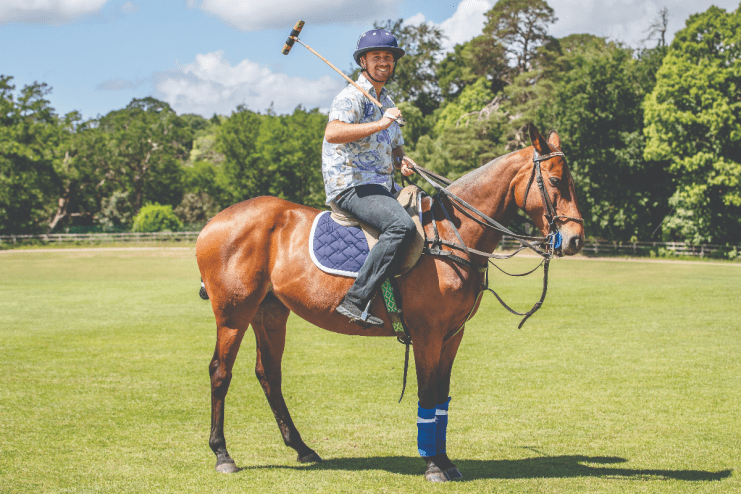
It’s a sport associated with kings and aristocrats. But as Rivals popularises polo, can self-titled ‘normal guy’ Adam Bloodworth get into it? in City AM The Magazine, Summer edition, he saddles up with the England captain to find out
With all of my body weight resting on my right foot, to my horror, I appear to be dangling perilously off a horse.
I feel as if one quick jolt could send me flying. I must look like the world’s worst tightrope walker as I attempt to stay atop the beast by clenching my knees together. In my head we’re filming the epic scene from Ben Hur but in reality I must resemble a quivering Quentin Blake illustration, reins in my left hand, the polo mallet in my right, look of terror on my face.
As the horse walks slowly forward, I let out the occasional yelp, like a dog whose paw has been trodden on. We approach the ball but rather than the firm grip I’ve been taught, I let the mallet wave around like it’s clutched in the tentacle of an octopus. I grunt as I swing at the ball, but miss it for the hundredth time, turning the surely terribly bored horse around for another go.
This is a far cry from the image of polo in the mind’s eye, particularly of princes Harry and William on the field. They had the right gear, and – to borrow the old adage – I had absolutely no idea. Spotting the helipad arrival option at posh country house Coworth Park, where I was invited to have a go at the game, confirms my belief that this sport was not invented for me.
‘Once you stopped panicking, you did well’
But one man is changing the sport’s image. New money entrepreneur Freddie Jones in the TV adaptation of Jilly Cooper’s Rivals. Played by Danny Dyer, Jones speaks in a thick Essex accent, dropping his aitches when he talks about his “‘orses” and suggesting non-aristocrats can play polo, too.
Big-wigs have long claimed the sport is more inclusive than it seems. Silver Leys in Hertfordshire has a membership tier of just £30 a year, and Shrewsbury offers a first season deal for £120. But that doesn’t mean anyone can just hop on a horse and start malletting their way to success…
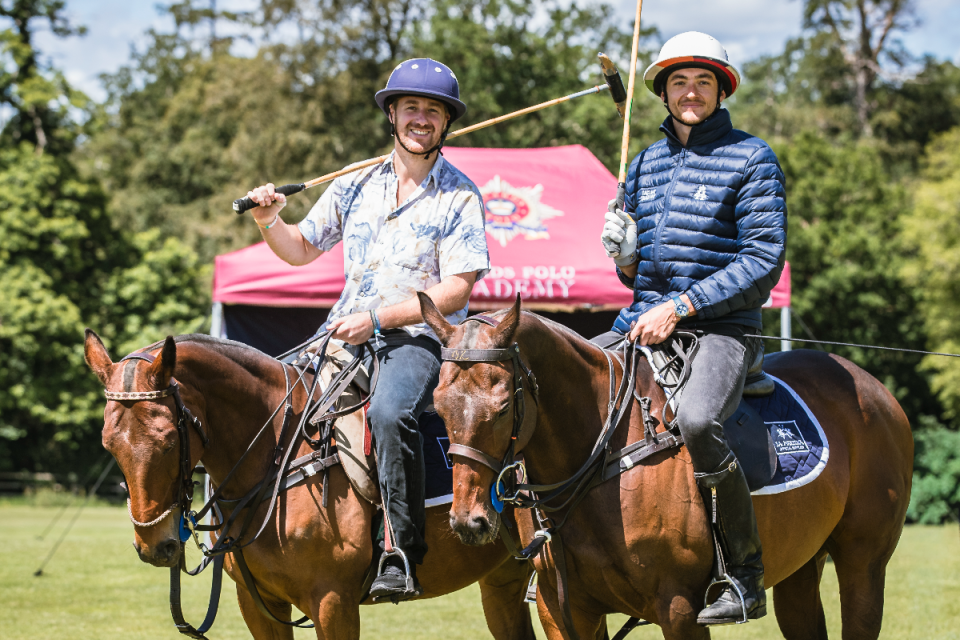
Thankfully I have Tommy Beresford, the England polo captain, teaching me the basics. Conjure an image in your mind of England’s polo captain, and you will visualise Tommy. Impossibly handsome and six foot five inches tall, he was brought into the game through his father, the accomplished player Lord Charles Beresford, and Chilean uncles, one of whom became the country’s greatest player. He mentions his privilege a lot, which makes sense, as he’s here to promote polo’s inclusivity and his lineage hardly screams ‘polo’s a game for the masses!’
With Beresford flanking me, I attempt to hit the ball, inadvertently doing my best impression of someone having a stroke. Half my body is hanging off to the right hand side, drooping down towards the ground. In an attempt to power my mallet my arm has gone weirdly stiff, like a Nazi salute facing the ground. My face is pouting so hard with concentration that it looks like I’m constipated. I miss. Again.
Can Rivals change polo’s image?
My knight in shining gilet, Beresford is patiently placing balls in the exact spots where I have the best chance of hitting one, which strikes me as a little futile, like moving rocks out of the way for salmon to jump upstream. But I need all the help I can get.
He teaches me the smooth pendulum motion to employ with my mallet, and I eventually start to hit the balls, even if getting the timing right is a challenge. A couple even make that satisfying ‘clonk’ noise, the polo equivalent of when a tennis ball hits the sweet spot on the racket.
I spent an hour experiencing intense fear mixed with occasional glimpses of the freedom I’d assumed horse riders had when galloping through fields. Then I’m relieved to disembark my pony, Forestera, to watch the pros. There’s an actual match about to start, so me and Tommy take a seat on the grass.
I ask how he feels about the sport’s royal association and whether it’s a bugbear or not. “It’s great that there is that aspect to it,” he says. “It does give it that prestige, but at the same time it’s not polo’s reality. Most of the time polo is a lot more humble. No grandstands, no sponsors, no flashing lights or commentary, just a very honest, competitive sport. Some people love the glitz and glam and some people love the relaxed countryside aspect.”
‘People are dying to bring newcomers into polo’
This take is slightly undercut by the description of polo on the Coworth Park website: “The sport of kings”. But he’s keen to remind me that spectacles like this one are technically free for observers. “Where we are now, there’s no one at the gate,” he says. “You just need to know where the games are.”
So, how did I do? “Well,” says Beresford with the calm authority of a teacher – one that you kind of fancy – “Once you gained that trust, you were able to focus on hitting the ball rather than panicking about what the horse is going to do…”
He paints a straightforward picture of how to get into polo. “Go on the Hurlingham Polo Association website, just type in ‘polo clubs near me.’ People are dying to get new people into polo. They are very welcoming. You can find good coaches across the country.”
But to state the obvious, being able to ride a horse in the first place is costly, and even if you can afford lessons and memberships, you have to feel like you belong. Like walking past the doormen into Claridge’s and ordering a cocktail, turning up to a polo club requires a certain type of confidence. As for Freddie Jones on Rivals, he may sound like he’s from Essex, but is he really relatable when he’s a multi-millionaire?
I suspect my involvement in polo will be in the stands – until I land on Jones’ sort of money, anyway.
A polo lesson at Coworth Park costs from £250; go to dorchestercollection.com; Rivals is streaming on Disney+