Reasons to be cheerful in an age of extraordinary technological progress

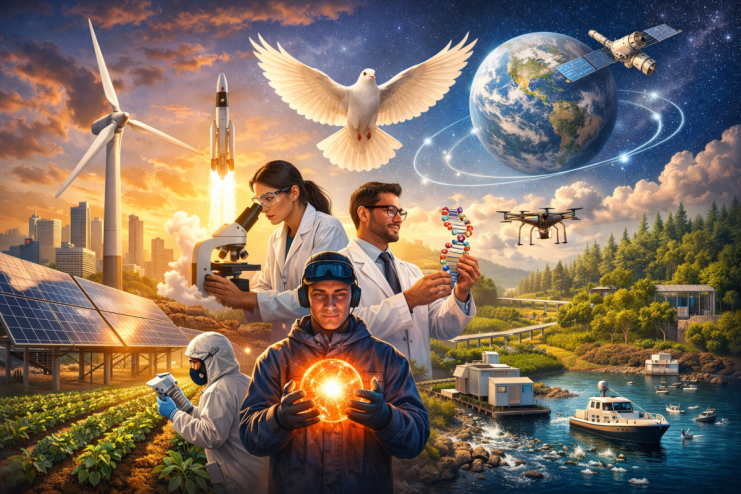
Headlines are dominated by the oncoming AI apocalypse. The 21st century, far from being an age of decay, may prove to be the most creative and constructive period in human history, says Madsen Pirie
We are told that the world is in irreversible decline. Newsfeeds deliver a daily diet of disasters, wars, fires, floods, political turmoil and technological dread. Commentators warn of collapsing ecosystems, runaway artificial intelligence and social disintegration. Fear sells, and pessimism feels intellectually justified.
Yet beneath the noise of crisis, an extraordinary transformation is taking place. The 21st century, far from being an age of decay, may prove to be the most creative and constructive period in human history.
I wrote my latest book, The Optimistic Outlook to restore perspective. It does not deny the gravity of the world’s problems. Global warming, poverty, and the misuse of power remain urgent challenges. But it argues that despair is neither accurate nor useful. Across energy, medicine, biology, agriculture and environmental restoration, evidence points to accelerating improvement, progress not driven by wishful thinking, but by science, ingenuity, and collaboration on a scale unmatched in the past.
Pessimism thrives on short-term memory. It forgets how much progress has already been achieved. A century ago, most people lived without electricity, antibiotics or reliable food supply. Half of all children died before adulthood. Global literacy was below 20 per cent. Today, extreme poverty has fallen to historic lows, child mortality has plunged by more than two-thirds, and access to education, medicine, and information is expanding faster than ever. These improvements were the fruits of human curiosity, technological creativity and a conviction that things could be made better. Now those same impulses are armed with tools of astonishing precision.
Energy, the foundation of civilization
Consider energy, the foundation of civilization. Progress was formerly tied to fossil fuels, bringing prosperity at the cost of pollution and warming. Now that link is being broken. Solar and wind power have become significant sources of electricity. Battery costs have fallen nearly 90 per cent in a decade. Offshore wind turbines turn oceans into power stations. In laboratories from California to France, fusion energy, the process that powers the sun, has crossed the threshold from theory to demonstration, proving that clean, virtually limitless energy is physically possible. These advances are not dreams; they are engineering projects under construction.
Energy is not the only frontier. In medicine, there is a transition from reactive to predictive healthcare. The sequencing of the human genome has led to personalized therapies that match drugs to individual biology. Artificial intelligence is designing molecules via computer simulations, accelerating discovery that once took decades. mRNA technology, proven during the Covid-19 pandemic, is being adapted to cancer and rare diseases. Senolytic drugs and gene-editing tools such as CRISPR hint at treating ageing itself as a medical condition. Far from a future of inevitable decline, medicine is extending both lifespan and healthspan.
The biological sciences are undergoing a similar metamorphosis. Synthetic biology treats DNA as programmable code, allowing cells to produce fuels, materials and foods without the environmental costs of traditional industry. Cultivated meat and precision-fermented dairy promise nutrition without deforestation or cruelty. Engineered microbes are digesting plastics and producing biodegradable alternatives. Genetic rescue and de-extinction projects explore how to restore endangered species and damaged ecosystems. These innovations demonstrate that human creativity can work with nature, not merely exploit it.
Agriculture reinvented
Agriculture is also being reinvented. Genomic breeding and gene editing are producing crops that thrive in drought, heat and salinity, reducing the need for fertilizer and pesticides. Vertical farms use a fraction of the land and water of traditional fields while supplying cities year-round. AI-guided robots and drones are making precision agriculture affordable even for smallholders. Rather than a looming food crisis, we may be entering an era of intelligent abundance.
Water, too, is undergoing a quiet revolution. Membranes built from graphene and nanomaterials are turning seawater and polluted rivers into safe, disease-free drinking water with a fraction of the energy once required. Solar-powered desalination and atmospheric water harvesters are bringing independence to regions once condemned to drought. Cities from Singapore to California are closing the water loop, recycling wastewater into pure supply. For the first time in history, access to clean water need not depend on geography.
Even the planet’s accumulated damage is no longer regarded as irreversible. Air-capture systems are removing carbon dioxide directly from the atmosphere. Autonomous vessels are collecting plastic from oceans and rivers. Microbes are being engineered to digest waste and detoxify soil. Drones and AI-guided reforestation projects are restoring forests and wetlands faster than they are destroyed. The concept of ‘cleaning up’ is evolving from metaphor to measurable industry.
To see these developments only as technical stories would miss their cultural significance. They represent a change in mindset, from resignation to agency. For too long, public debate has oscillated between denial and despair: between those who refuse to acknowledge problems and those who insist they are insoluble. Both stances paralyze action. Constructive optimism, by contrast, accepts reality. It recognizes that progress is cumulative: Each breakthrough enables progress in other fields. Cheap clean power supports desalination, data and medicine. The feedback loops of progress are powerful once they are seen clearly.
Solutions are emerging faster than most people realize, and while a pessimistic worldview looks at what is, the optimistic one understands trajectories. The direction of travel is unmistakable, toward cleaner energy, longer lives, richer biodiversity, and a planet increasingly shaped by intention rather than accident. The future in other words, remains open, and it is brighter than we have been led to believe.
Madsen Pirie is president of the Adam Smith Institute