UK economy barely grows in third quarter

The UK economy grew at a more sluggish pace than expected in the third quarter of the year amid a pervasive sense of gloom across the country ahead of the Budget.
The Office for National Statistics (ONS) said there was 0.1 per cent GDP growth between July and September, triggering fears among City analysts that there was a “looming” recession. Economists pencilled in 0.2 per cent growth for the three-month period.
Statisticians said production output dropped 0.5 per cent while the services sector grew by a marginal 0.2 per cent.
On a monthly basis, there was a 0.1 per cent contraction in the UK economy September.
“Growth slowed further in the third quarter of the year with both services and construction weaker than in the previous period,” Liz McKeown, director of economic statistics at the ONS, said.
“Across the quarter as a whole manufacturing drove the weakness in production.”
McKeown added that the cyber attack on Jaguar Land Rover contributed to a “particularly marked fall in car production” while there was also a fall in the pharmaceutical industry.
The results may give rise to a sense of panic ahead of the Budget, with looming tax rises and fiscal restraint expected to further dampen growth in the coming months.
Reeves: ‘There is more to do’
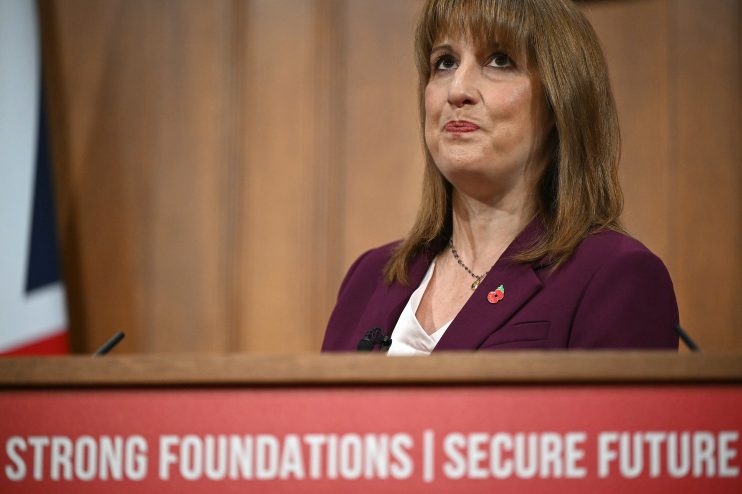
Rachel Reeves said: “We had the fastest-growing economy in the G7 in the first half of the year, but there’s more to do to build an economy that works for working people.
“At my Budget later this month, I will take the fair decisions to build a strong economy that helps us to continue to cut waiting lists, cut the national debt and cut the cost of living.”
Reeves is widely expected to raise more than £30bn in taxes, targeting household income as well as pension pots and gamblers.
Economists have also warned that the Chancellor will have to build a bigger fiscal headroom to gain credibility in the bond markets and help lower borrowing costs.
Reeves has said that growing the UK economy was one of two “principles” set to guide her Budget, alongside introducing “fairness” in policymaking.
She has indicated that a Labour manifesto pledge not to raise income tax would be broken.
Lindsay James, investment strategist at Quilter, said the Budget was “critical” for preventing a further economic downturn.
“Her next move will be critical if she is to recover Labour’s economic growth mission and prevent any whispers of a recession looming,” James said.
Andrew Griffith, shadow business secretary said: “With GDP, investment and manufacturing all down, growth is as absent as the phantom plots the Prime Minister frets about.
Chantal Van Stipriaan, a partner at advisory firm Blick Rothenberg, said: “The Office for National Statistics (ONS) latest report shows that growth is down to just 0.1%, unemployment is up to 5% and the expectation is it that this will not improve. The economy is in a downward spiral; Labour cannot pull the country out of the fiscal black hole with tax rises alone, ultimately, spending needs to come down – and fast.”
UK economy stumbles on
The UK economy enjoyed a surge in growth over the first half of the year, with a one per cent rise in GDP. Economists put down to front-loading in purchases and investors by firms and households ahead of potential tariff announcements by President Trump.
The International Monetary Fund (IMF) said the UK would outperform all G7 countries bar the US in 2025 though a growth in living standards, measured through GDP per capita, would be the lowest out of any of the seven advanced economies over the next two years.
Treasury officials will be eagerly anticipating the Office for Budget Responsibility (OBR)’s final decision on its growth downgrades following its review of productivity trends.
City analysts have said a 0.3 percentage point decrease to productivity trend forecasts could blow a £20bn in public finances alone.
Reeves has blamed a downgrade in growth forecasts on the previous Conservative government.
“The reason why our productivity and our growth has been so poor in these last few years is because governments have always taken the easy option to cut investment in road and rail projects, in energy projects, [and] in digital infrastructure,” she told the BBC this week.
Reeves has also said the government would strive to overcome gloomy economic forecasts.