Why Albania’s Tirana could be the city break of the future

“Tirana is like a cross between Mumbai and Las Vegas,” I was told by a teenage traveller a week before I arrived in Albania’s capital city. “I’ve never been to either place, but at least that’s how I imagine them to be.” I’m not sure if Tirana is really like either of those cities, but I can see the point. It has the feel of an energetic, if slightly chaotic, boom town where things are changing fast.
The city, which was numbered among Europe’s poorest capitals well into the 1990s, is undergoing a construction boom. Until recently, it had no high-rise buildings, but some 30 skyscrapers have been planned, started or completed. Tourism is growing rapidly. In 2025, Albania recorded 12.5 million overnight guests, more than double the 6.1 million who visited just before the pandemic. Two decades ago it was just 3.3 million. It feels as if you could visit again in five years and find a completely different place.
However it may change, Skanderbeg Square is at the heart of Tirana. It’s a pedestrianised square so big that it feels like you can see the curvature of the earth (or maybe there’s just a small hill in the middle). The city’s major cultural hotspots are located in the square, including the opera and the national museum (closed until 2028). Looking out from the square you can see Albania’s skyline and, directly abutting the square, the 31-storey glass Eyes of Tirana, with its layers clumsily stacked atop one another like ill fitted Tetris blocks. A little further away is the 40-storey Downtown One, with a map of Albania cantilevered out of the surface.
The history of Tirana
With the city changing so fast, I chose to spend the weekend trying to understand Albania’s troubled past. Many of the city’s most interesting sites are connected with the communist regime of Enver Hoxha, who presided over one of Europe’s most repressive governments. I noticed on a museum signpost that under Hoxha, the Republic of Albania was closed to “hippie tourists” as well as enemies, spies and other “vagabonds”. The borders had barbers to shave the beards of any foreign tourists wanting to come in, which would have been bad news for me.
The museum of the Secret Police, known as the House of Leaves, is a must-see. The leaves refer to the coverage over the building, preventing people from looking in, but also the pages held by the Sigurimi on suspicious people. It features all of the things that enabled Hoxha to control the population with fairly limited resistance. “Attention! Dear guests, this room is bugged,” reads a sign in one of the rooms.
There’s a great art scene too
Another clear demonstration of the paranoia is Bunk Art, an old communist bunker on the outskirts of the city. Hoxha constructed 173,371 of these bunkers across the country, equal to one for every 11 people. You enter through a long, dark tunnel, slowly saying goodbye to sunlight for the next few hours. The bunkers themselves are vast, with over 100 rooms. While most of these rooms look a lot like the last, the effect is almost hypnotic.
Tirana’s main district for cafes and bars is called Blloku, previously the residential hub for the top brass of the communist regime, but rapidly transitioned to become the most fashionable district for the city’s new elites. We stopped in at Radio Bar, which is decorated with old radios and retro moving posters. It is a chic place to try some raki, Albania’s national spirit.
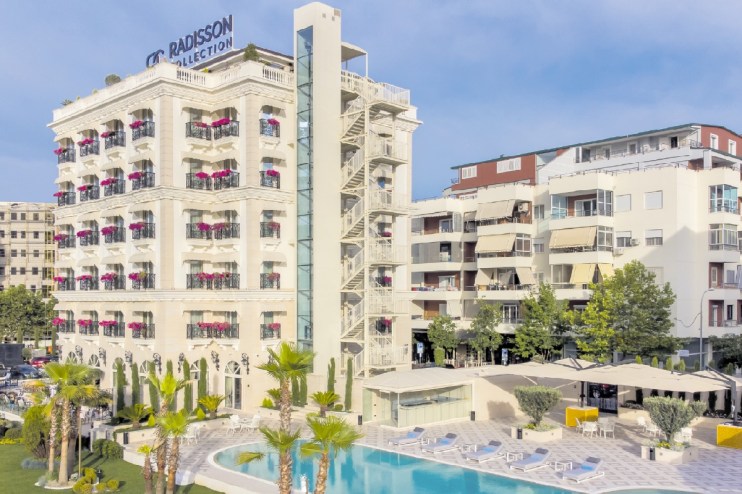
• Chris stayed in Tirana’s Morina Hotel, a Radisson Collection property about a 30-minute walk from the city centre through the Grand Central Park, or a 15-minute bus. With two swimming pools, a spa, and a nice bar overlooking the city’s artificial lake; visit the website here