Manic Monday: How Trump rocked global markets

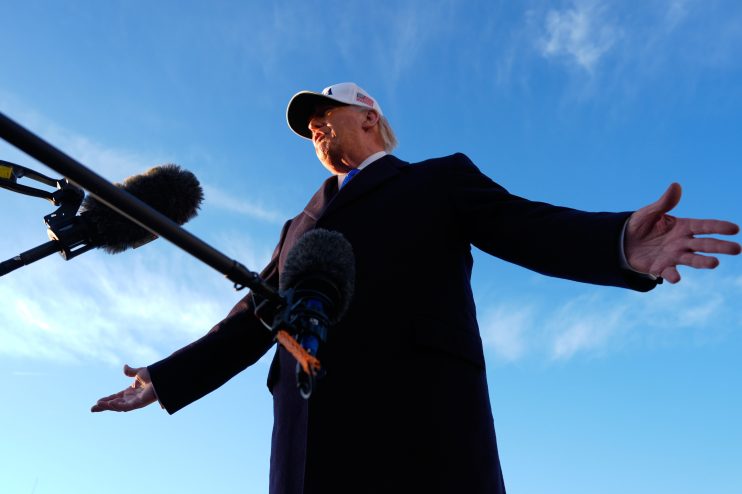
President Donald Trump sent global markets on a rollercoaster ride as traders were left stunned by mixed messages coming from the US administration and the Iranian regime.
The Brent Crude oil price was trading around $114 per barrel before Trump said in a post on Truth Social that he was pausing strikes due to “productive” talks with the Iranian leadership.
He later added that the price of oil would “drop like a rock” if a deal was agreed while suggesting that Iran had agreed to abandon its nuclear weapon programme.
Speaking about negotiations with Iran, Trump told reporters: “They called, I didn’t call. They want to make a deal. And we are very willing to make a deal. It’s got to be a good deal, and it’s got to be no more wars, no more nuclear weapons.”
Officials representing the Iranian leadership appeared to contradict Trump.
While reports suggested that US special envoy Steve Witkoff and Trump’s son-in-law Jared Kushner negotiated with Iran’s parliament speaker Mohammad-Bagher Ghalibaf, an X account for the official said it was “fake news” and briefings were an attempt to “manipulate” markets.
Ibrahim Rezaei, speaking on behalf of the country’s security committee, separately said Trump was “talking nonsense”.
The international oil benchmark price dropped to as low as $96 per barrel after Trump’s series of remarks before fluttering around the $100 price mark.
‘An awful day for managing risk’
The FTSE 100, which began the day in the red, was almost back where it started by the end of Monday after experiencing a relief rally, while 10-year gilt yields, which reflect the size of government borrowing costs, dropped from around five per cent to 4.73 per cent before climbing back up.
Mizuho’s Jordan Rochester described Monday’s market mayhem as “an awful day for anyone trying to manage risk” adding “the hardest part is not predicting the war but predicting the communication from the White House and how much markets will react to it.”
Traders also finished the day remaining cautious about interest rates, with two-year gilt yields suggesting the Bank of England could hike interest rates at least twice this year, rather than the four instances that had been penciled in.
“Despite the relief rally, bond yields are still rising around the world, but nowhere more so than in the UK,” Fidelity International investment director Tom Stevenson said.
“Surging energy prices have fuelled fears that the UK could be facing a period of stagflation. For the government, it means an unhelpful combination of high funding costs for its debts alongside reduced tax revenues as growth slows.”
Trump rebuked by Starmer
Sir Keir Starmer told MPs on Monday afternoon that the country should not fall into the “false comfort” of the war’s end before later adding: “This is not our war and we are not getting dragged into this war.”
He also led an emergency Cobra meeting, which was attended by Chancellor Rachel Reeves and Bank of England governor Andrew Bailey.
Reeves will be tasked with telling MPs about an energy support initiative on Tuesday, though the Prime Minister hinted that it would not cost as much as the £40bn package unveiled by the previous Conservative government.
“I’m acutely aware of the state of public finances,” Starmer said.
Leading City researchers have warned that the effects of the Iran war will be felt for years to come. Schroders’ head of thematic equities Mark Lacey said a historic lack of investment in oil and gas supplies made markets “more sensitive” to the energy price shock while IG analysts said the imminent market outlook “remains bleak”.
“All it takes is for more missiles on either side to hit oil or desalination infrastructure and the situation in the Middle East may quickly flare up again,” senior IG analysts said.