‘Manchesterism’ is a myth and you can’t trust Andy Burnham

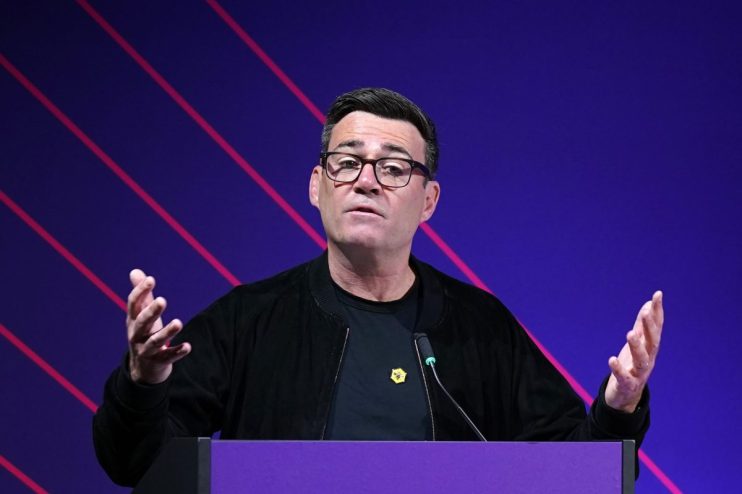
Andy Burnham says he wants to “roll back the 80s” but the growth of Manchester is down to the rolling back of socialism that began before he became Mayor, says Ayushma Maharjan
Britain’s most popular politician is running on a myth, is not credible, and might out-do Starmer in U-turns.
A recent Yougov poll found that Andy Burnham is viewed positively by 34 per cent of Britons. That makes him the only senior politician with a net rating above zero. Provided he wins the Makerfield by-election, he is likely to be our next Prime Minister. His pitch is “Manchesterism”, what he calls “business-friendly socialism”. His economic ideas include rolling back so-called “neoliberalism”, nationalising swathes of the economy and devolving tax-and-spend powers to local authorities.
His evidence? Greater Manchester itself. In his first interview after launching the Westminster bid, Burnham told ITV News: “I tried to build something different in Greater Manchester… and look at the results… Greater Manchester today is the fastest growing city region in the UK. I’m so proud of that… I put buses back under public control and made them more affordable to people here…”
In all this, Burnham does deserve credit for the Bee Network. The rest of Burnham’s Manchester story is fluff.
By the late 1980s and early 1990s, the council moved away from full-fat socialist ideas such as full public ownership of the airport and resistance to private capital
Manchester’s transformation did not begin under socialism. The city’s post-war municipal socialism achieved limited results. By the late 1980s and early 1990s, the council moved away from full-fat socialist ideas such as full public ownership of the airport and resistance to private capital. Council leader Graham Stringer spent the decade building partnerships with the private sector. They embraced an entrepreneurial approach, partnering with private businesses and central government to drive urban regeneration and inward investment.
From 1998 to 2017, Sir Howard Bernstein and Sir Richard Leese turned that template into the city Burnham would later inherit. During the period, Metrolink became Britain’s largest light-rail network, Manchester Airport became the biggest UK hub outside London, the 2002 Commonwealth Games seeded the Etihad regeneration, Spinningfields became the financial district, the £2.5bn Oxford Road corridor stitched together the universities. Peel Holdings and the BBC built MediaCityUK at Salford Quays. Sheikh Mansour’s Abu Dhabi United Group poured close to £1bn into a 10-year regeneration project in East Manchester.
The growth followed. Greater Manchester Combined Authority’s (GMCA) own January 2026 report shows Greater Manchester grew at 3.4 per cent annually from 2004 to 2007, above the UK’s 2.6 per cent. After the financial crisis dip, it recovered to 3.1 per cent growth from 2015. This was all before Burnham took office.
When Burnham urges Labour to “roll back the 1980s” and seize housing, energy, water and rail, he is reaching for a Manchester that arguably never existed. Stringer pivoted in 1987 because municipal socialism was shown decisively not to work. Burnham is rebranding the failed version as Manchesterism and asking Britain to buy it.
Beyond the rhetoric, his record of failed promises is itself an argument against trusting him with the country.
In 2017 he pledged to end rough sleeping by 2020. Over 18,000 people across Greater Manchester were homeless in 2025, representing a 15 per cent regional rise in a year. In 2020, His Majesty’s Inspectorate of Constabulary and Fire and Rescue Services (HMICFRS) report found Greater Manchester Police had mis-recorded roughly 80,000 crimes a year. This falls under a mayor’s key responsibilities. In 2025 Burnham’s Clean Air Zone program, which cost over £104m, formally collapsed. This was a case study in top-down overreach and a waste of taxpayer’s money. His 2025 strategy to build 75,000 homes by 2030 looks shakier still. Though GMCA has achieved commendable housing completions, its biggest boroughs with housing needs, Manchester City and Salford, reported a decline in new housing construction. Deloitte’s 2025 Crane Survey found that only seven new residential schemes were started across the two cities last year, down from 11 in 2024.
PR man
This brings us to a deeper problem – Burnham is good at PR and poor at oversight.
The Makerfield campaign is showing us the former in real time. He will, it seems, say whatever he requires to win the next election. In September, he unequivocally stated, “I hope in my lifetime I see this country rejoin the European Union. I am absolutely clear about that”. However, to please the Eurosceptic voters of Makerfield this month, he is equally clear in the opposite direction, saying: “it’s going to undermine everything I’ve said about strengthening democracy if we don’t respect that vote”.
The Greater Manchester Mayor, who, weeks ago, was floating a looser fiscal settlement, now promises to preserve Rachel Reeves’s rules intact should he reach Downing Street
The Brexit twist is only the start. He has also retreated from reforming Labour’s borrowing framework, after bond markets twitched and the IMF issued an indirect warning. The Greater Manchester Mayor, who, weeks ago, was floating a looser fiscal settlement, now promises to preserve Rachel Reeves’s rules intact should he reach Downing Street.
It is encouraging to see him parking rejoin and acknowledging fiscal reality now. But the Labour MPs he will depend on once in office still hold the views he is now playing down, and a quiet return to them is likely. That uncertainty alone is reason enough for bond markets and investors to be unnerved.
Britain should strip the Manchesterism myth away from Burnham and weigh him against his abandoned promises, the convictions that shift with the audience, and more importantly, ideas that are likely to create more economic chaos.
Ayushma Maharjan is a researcher at the Centre for Policy Studies