Make toilets beautiful again!

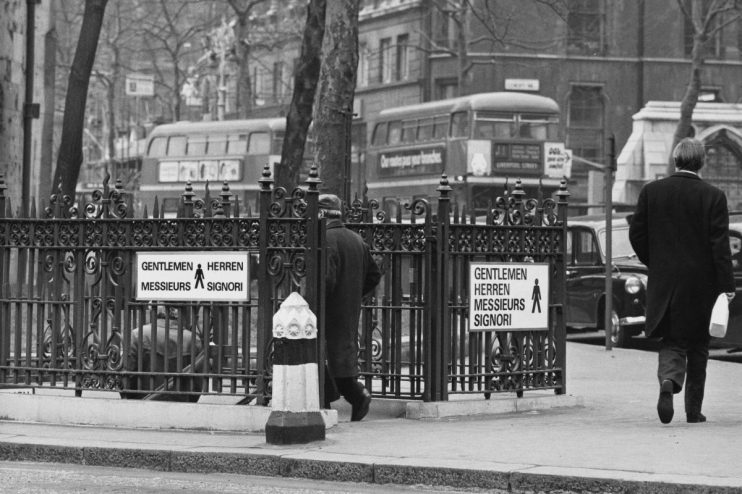
Britain is in the midst of a public toilet crisis. Roderick Bates makes the case for making toilets plentiful – and beautiful again
Toilet trouble: The case for making bogs beautiful
Walking a city is one of life’s pleasures, but how often after a well caffeinated start to the day do you find yourself far from home or your hotel, wondering where is the nearest bathroom?
London is no exception to this urban predicament. Since 2000, 40 per cent of public toilets in Britain have closed due to the high cost of maintenance. For those that are open, relief comes at a cost, with 91.3 per cent of citizens noting the city’s public toilets as offering a less than pleasant experience, according to London Assembly Health Committee.
Fortunately, London isn’t letting the situation build, responding with the ingenuity you would expect of a city that has somehow fused a modern global financial centre with an almost wilfully indecipherable street plan.
Signs of progress are coming in the form of a very creative solution. Over the past year, two public toilets in Maida Hill and Woolwich were successfully rebuilt, pairing contemporary interventions with heritage architecture. These projects show that essential infrastructure can deliver on functional priorities while reflecting civic context, with the resulting combination yielding a beautiful design.
And yet, even where need is clear, delivery is rarely simple. Funding pressures persist, with some stakeholders questioning why scarce resources should be spent adapting existing buildings. Others view the idea of repurposing heritage structures into public conveniences as contentious, even absurd.
This is where design communication becomes critical. Advanced 3D visualisation tools give stakeholders, including the public, a hyper-realistic virtual look at how the sensitive adaptations will work in practice, with the building’s character preserved, and accessibility vastly improved.
And when people can see the outcome with their own eyes, the conversation shifts. The shared reality of “seeing” the project allows the proposal to move beyond vague ideas and planning jargon, helping stakeholders understand the function and design vision.
In a city as layered and historic as London, creativity must remain central to urban planning. From toilets to turnstiles, collaboration between city planners, architects, engineers, council and the public is essential to delivering inclusive, accessible public space.
Because whether you’re a visitor or a local, no one should have to plan their day around finding a loo.
Why you’re sick of your office
Developers create buildings that meet functional requirements, yet many are unpopular from the moment they open.
Office blocks are the perfect example, with sealed façades, tinted glass, artificial lighting, and the obligatory planter by reception, signalling the building’s ‘green’ credentials. On paper these buildings tick all the boxes. Reality is not that simple, with the buildings feeling like sterile spaces people pass through rather than occupy. The buildings lack heart.
Biophilic design, the practice of integrating nature into design, can address this challenge, incorporating design elements people have an innately positive response to. Incorporating natural materials, day light and greenery yields spaces that feel calm rather than compressed. We’re hardwired to seek out environments like this.
Quote of the week
“Function influences but does not dictate form”
Eero Saarinen; the creatives we work with are problem solvers at heart and forensic in their thinking.
Fitzrovia’s best toilet
If you’re curious to see a converted public toilet done right, Attendant is worth the pilgrimage. The former Victorian men’s loo is now an award-winning coffee shop situated in Fitzrovia, where it retains much of its original porcelain charm. The urinals remain, while green seating offers a tasteful nod to the original tiles. It’s a prime example of adaptive reuse in action, brought to life through design storytelling. Projects like this succeed not only because of clever architecture, but because stakeholders can clearly visualise the potential of a space before it’s realised. A 3D rendering provides proof that even forgotten infrastructure can be coaxed into a genuinely charming second life — when imagination, design and communication align.
Roderick Bates is head of product operations at Chaos, which provides digital modelling services for architects