Liz Kendall hails ‘Brit-maxxing’ as Labour bets £1.1bn on AI chip race

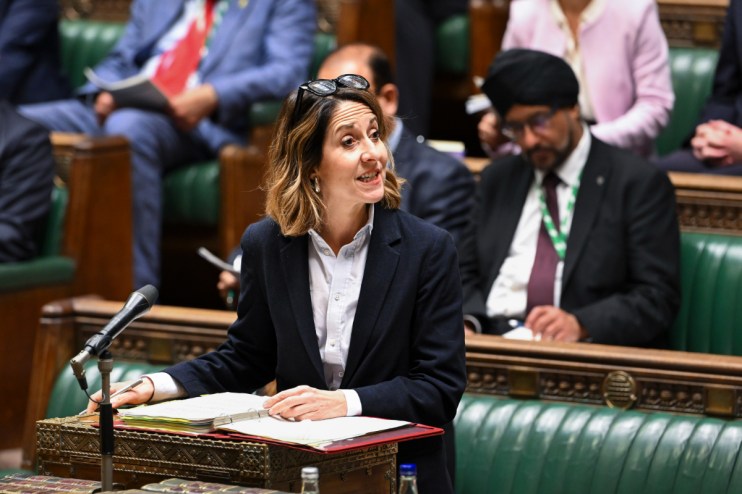
Britain must stop listening to the “doubters, doom-mongers and naysayers” and double down on its strengths in AI, Liz Kendall said as she unveiled a £1.1bn package aimed to turn the UK into a global AI hardware powerhouse.
Addressing London Tech Week attendees on Tuesday, the tech secretary embraced the conference’s now-familiar “London maxxing” mantra, promising what she described as a new era of “Brit-maxxing” industrial policy aimed at winning the global AI race.
The package includes a new £120m AI Hardware Innovation Programme, £80m for semiconductor skills, a £750m government-backed heterogeneous supercomputer and £400m of procurement commitments designed to create customers for emerging British chipmakers.
The announcement comes less than 24 hours after ministers unveiled fresh support for scaling British tech firms, including visa reimbursements for high-growth companies and a new government concierge service designed to help startups overcome regulatory and funding barriers.
Speaking from the main stage at Olympia, Kendall argued Britain was uniquely positioned to benefit from the AI boom thanks to its universities and thriving startup ecosystem
“Last year Britain attracted more venture capital than France, Germany, the Netherlands and Switzerland combined,” she said. “Already this year, almost half of all VC funding in Europe has been invested right here in Britain.”
She pointed to companies including Deepmind, Anthropic, OpenAI, Isomorphic Labs and Wayve as evidence that the UK was becoming one of the world’s most important AI hubs.
“We cannot and must not retreat from progress, as some other political parties and politicians argue”, she also said. “Doing so would be a betrayal of British talent and British interests.”
Labour’s sovereign AI push
Kendall’s speech adds to Labour’s attempts to position itself as aggressively pro-growth and pro-technology while building what ministers have branded “AI sovereignty”.
Kendall said the government’s recently launched Sovereign AI programme would invest £500m directly into British AI firms, while providing access to supercomputing capacity and procurement opportunities.
“When 70 per cent of global AI compute is now controlled by just five companies, we must gain greater sovereign control over this increasingly powerful technology,” she said.
A central focus is semiconductors, where ministers believe Britain can carve out a meaningful share of a market projected to reach $1tn globally by the early 2030s.
“If Britain could secure just five per cent of this market, it would bring $50bn in revenue to the UK, with tens of thousands of high-paid jobs in tech,” Kendall added.
The government is also backing Playground Global – the Silicon Valley investment firm whose partners include former Intel chief executive Pat Gelsinger – as it launches its first UK office, supported by a £150m commitment from the British Business Bank.
Drawing comparisons with Team GB’s transformation from 36th place in the 1996 Olympic medal table to a global sporting hub, Kendall said Britain needed the same “no compromise” approach to innovation policy.
“Britain has done this before, and we will do it again,” Kendall said.