Jousting, goblins and furries: Dispatch from a UK renaissance faire

Across the world, grown men and women are dressing as medieval knights and peasants. Anna Moloney joins them for the second ever UK Renaissance Faire to find out why
It wasn’t long after arriving at my first ever renaissance faire that I realised I’d made a mistake. Days before, I’d been rooting around South London Theatre’s wardrobe cupboard in a desperate bid to find something to wear. As I tried on dozens of peasant blouses and bubble shorts, their costume assistants, the oh so knowledgeable Jenny and Leah, consulted books for me on accurate medieval dress. “Too late Tudor,” ruled Jenny as I pranced out in a full brocade dress. “Too Austrian” the next.
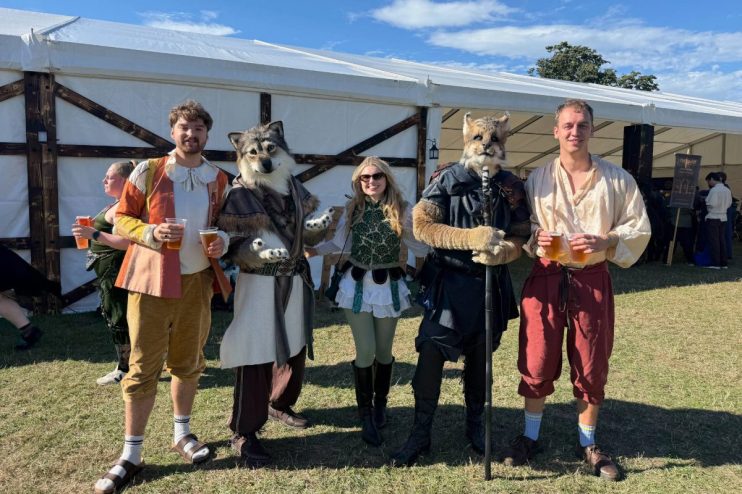
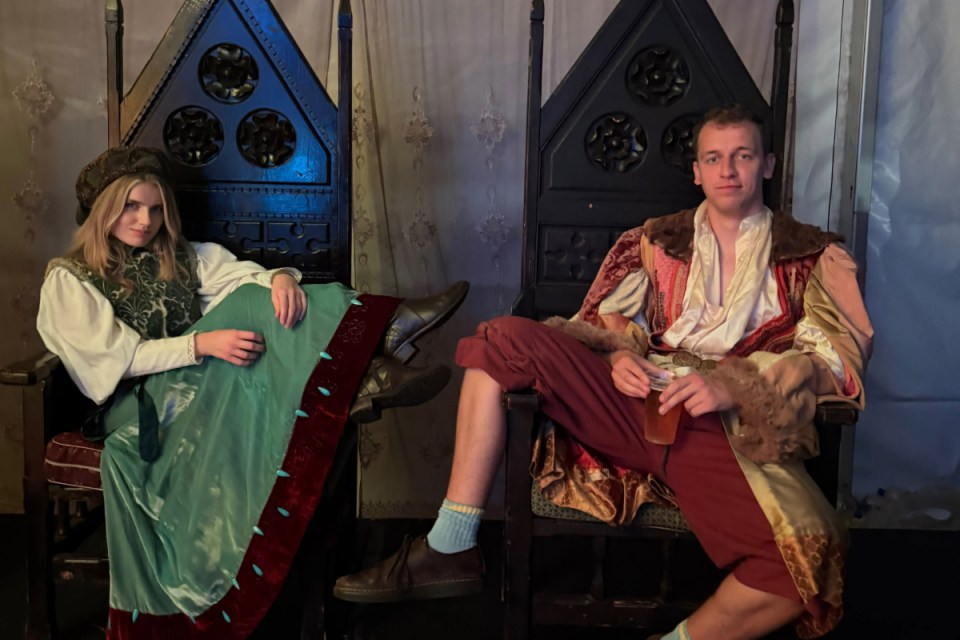
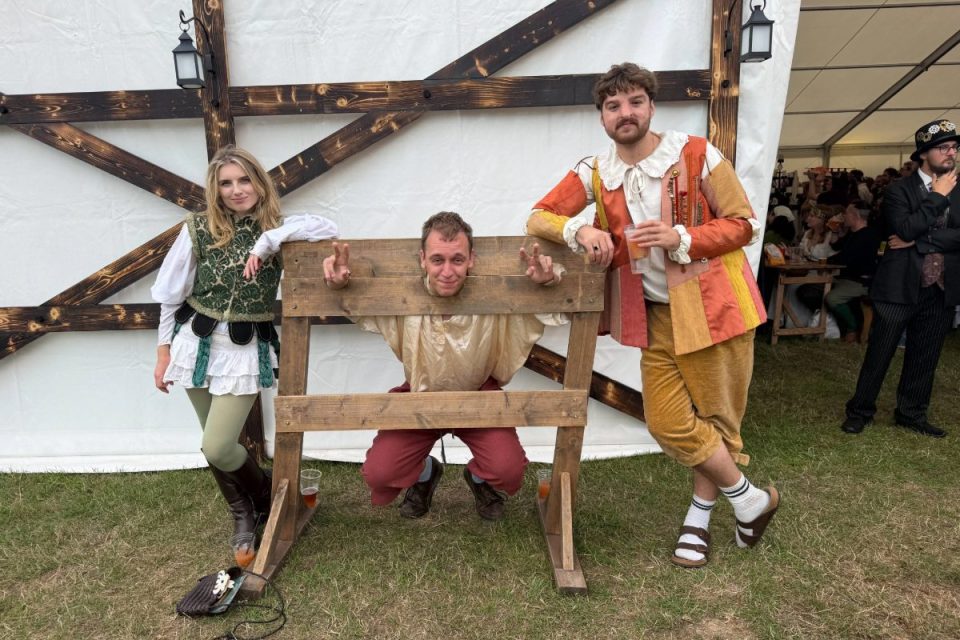
My fastidiousness turned out to be needless. In Quex Park, where I stood in a floorlength skirt, green velvet doublet and matching French hood, it was elves, fairies and furries that made up the crowds around me. My attempt to blend in was not going well. When a gothic fairy approached to give me and the two friends I’d dragged along (and dressed in equally heavily velvet) each a “trinket” – three miniature ceramic watermelons – as recognition for “making such an effort”, it was a sweet way to tell us we’d got it just slightly off.
For the uninitiated, a renaissance festival – or ‘ren faire’ – is a full-costumed, immersive event that aims to create a world inspired by the aesthetics of 16th century England – or at least thereabouts. In reality, the vibe leans towards a hodgepodge of Lord of the Rings and a vague ‘fifteen-hundred-and-something’, with a heavy emphasis on fantasy. In the US, where they were first conceived in 1960s counterculture LA (partially as a way to help Hollywood actors out of work on suspicion of being communists), they have become extraordinarily popular, with over 200 ren faires now taking place annually across the country.
And now they’re on UK soil, too.
The UK Renaissance Fair scene
There is something inherently silly about the American fixation with a medieval past they played no part in. And perhaps there’s something even sillier about us now importing their warped version back.
Calypso Ellison, who set up Renaissance Faire UK with her partner Jamie Joberns-Dash in 2025, tells me the UK ren faire scene is still very much in its infancy. Her event, a three-day outdoor festival in Birchington-on-Sea, runs an eclectic programme of jousts, goblin raves, masked balls, maypole dancing and wizard wrestling, and this year attracted around 14,000 attendees. Just next to me in the campsite – a surreal place to be in full medieval garb by the way – a group had driven eight hours from Cornwall to attend the event.
This particular event, subtitled ‘Crossing of the World II’, took place in a medieval-ish land, with some sort of overarching storyline about a “mermaids vs steampunk” battle. I did spot a sorry looking ‘mermaid tank’ (a glass box about one metre-high containing a sopping wet woman in a tail) but it was clear this was mostly an arena for attendees to play out their own personal fantasies, Renaissance-related or otherwise.
Furries (people who dress up as anthropomorphic animals, sometimes for sexual reasons) seemed to be a prominent avenue for such expression. All is fair at the Ren Faire, though it may be telling that one of the longest sections on the website is the ‘Cosplay Policy’, which heavily prohibits any “adult themes, erotic content, or sexually provocative imagery”, with an explicit ban on the exposure of nipples, buttocks and genitalia. There were certainly some amorous attendees (I personally have never had so many women hit on me as I did when in my velvet bonnet), but all in all this was a fairly pedestrian party, with music finishing at 10pm and attendees on the campsite politely told to wrap up conversations by midnight.
Why are so many drawn to the medieval?
Medievalist Paul Sturtevant, who is an expert in how the public understands the Middle Ages, describes the ren faire aesthetic as “mishmash” and “sexed up”. Their rise has coincided with a broader revival in medieval chic, from Chappell Roan performing in chainmail to Instagram tutorials on how to make conical princess hats, not to mention the unfaltering popularity of fantasy (and ‘romantasy’) novels.
When I ask Sturtevant why, he says it’s complicated: the medieval period has long meant different things to different people, and there is certainly nothing new in our recall to it now. He says there is a tradition of looking at the medieval period as a better, nobler time, despite the fact we also associate it with plague and death and violence. It’s a more extreme version of everything, and I think that’s why it is so easily applied and has been taken up by fantasy.”
Now, he says our fantasies of the Middle Ages have blurred into our perception of actual events, making ren fests a “collective, imaginative playground that is only tangentially tethered to history”.
The Victorians, too, had a draw to the medieval that was often fantastical. Poet laureate Alfred Lord Tennyson possessed a particular fixation with medievalism that was intertwined with the legend of King Arthur, a mythology he would plunder again and again in his poetry while around him the world was being changed beyond recognition by the Industrial Revolution.
In Morte D’Arthur, the titular king, about to die, comforts his friend as he drifts off to Avalon: “The old order changeth, yielding place to new”. Tennyson was trying to make sense of a new world by going back to an old one; a way to remind himself, perhaps, that life keeps going.
Today, facing climate change, AI and countless other perils, perhaps we too have found comfort in an imagined past, and in remembering that it has always felt this way.
This article was originally published in City AM The Magazine