In Jason Arday, Cambridge is discovering the dangers of DEI

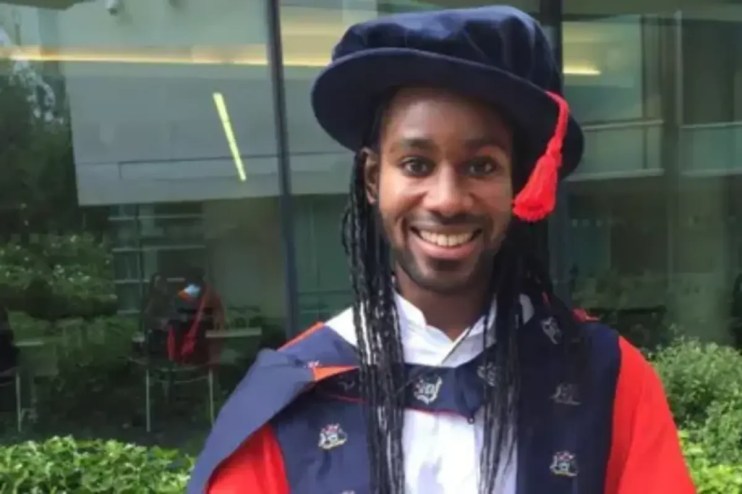
The row over Jason Arday, Cambridge’s “youngest black professor”, raises serious questions about the corrosive role Diversity, Equality & Inclusion (DEI) has come to play in institutions, businesses and society at large, says Ike Ijeh
Plagiarism is older than Ancient Greece but, unlike imitation, it is the least sincere form of flattery. However, until the Professor Jason Arday row at Cambridge, it was not necessarily considered to be a function of racism either. Arday’s elastic relationship with the truth has been the subject of much mirth in recent days but it has also spawned more serious questions about the potentially corrosive role Diversity, Equality & Inclusion (DEI) plays in our society.
In 2023 Cambridge hailed Arday (then 37) as its “youngest black professor”, an appointment made on the basis of academic credentials whose authenticity has now been called into question. This has prompted two DEI-related reactions. The first has been to accuse anyone criticising Arday of racism and none less than perennial judicial race whisperers the Good Law Project are amongst those characterising his plight as a “right-wing smear campaign”.
This is, of course, nonsense. Criticising academics because they are black is racist but criticising their work when they are black is rational in the sense that it would be irrational to insist that racial identity should preclude anyone from criticism.
In fact, suggesting that Arday’s colour should insulate him from the same scrutiny that would invariably descend had his embellishments been orchestrated by a white colleague, is in itself, a form of discrimination. It is based on the insulting and infantilising assumption that ethnic minorities are intellectually incapable of being held to the same ethical standards as white people.
Delegitimising minority achievement
The second reaction has been to claim that Arday only acquired his position as a result of DEI. There is no evidence to substantiate this, but the suspicion alone proves DEI’s lethal ability to delegitimise even genuine minority achievement. Moreover, think tank Policy Exchange has compiled a wealth of research that bluntly demonstrates the noxious impact DEI has had on British society at large.
Without Fear Or Favour? suggested that DEI could be at the root of supposed ‘2-tier policing’ and exposed that in just last six years, police forces in England and Wales have spent over £630m on the very DEI policies that likely led to the appalling police mishandling of the Henry Nowak incident prior to his death.
This debilitating influence is present in the business community too and Putting Business Back in the Driving Seat demonstrated how DEI policies are a significant financial and regulatory burden on UK businesses imposing an estimated annual cost of up to £10bn.
And DEI’s perpetuation of the myth that ethnic minorities can only succeed if the white majority is forcibly excluded from professional pathways, is a serious threat to social cohesion. Equally, by reducing ethnic minorities to a vulnerable, homogenous bloc, it also potentially smothers the very diversity progressives claim to covet.
As Lord Sewell, author of the 2021 Commission on Race and Ethnic Disparities report, has written: “unholy alliance between ideological administrators, activist academics and radical student unions” means that “it should be no surprise that, in both the USA and the UK, some of the worst expressions of antisemitism… should have come from our universities – institutions steeped in this warped identity politics of DEI”.
DEI’s original core intentions – to achieve equality throughout society by advancing the prospects of under-represented groups – were good ones. Consequently, DEI would have been an excellent policy solution for Apartheid South Africa or the pre-civil rights American South where it would have represented a welcome programme of deliberate, state-sanctioned cultural manipulation to forcefully recalibrate a fundamentally unequal society.
But for all its faults, modern Britain is not Apartheid South Africa or the pre-civil rights American South, it is one of the least racist countries on earth. So much so that the imposition of DEI has invariably led to a grossly distortive effect where it has perversely become a tool for discrimination, exclusion and inequality – legalised discrimination against the majority to legitimise their exclusion and thereby nationalise social inequality.
DEI has become the toxic hallmark of a society that has given up fighting inequality in favour of the progressive dopamine rush of finding it instead
Moreover, as equality of outcome is an existential impossibility, DEI’s promulgation of the flawed assumption that all disparity must be the result of discrimination is a recipe for endless civic turmoil and racial resentment. Not only could it unravel decades of UK race relations progress, but it promises a corrupt new social contract where racial membership becomes an obscene enabler of social mobility.
In short, DEI has become the toxic hallmark of a society that has given up fighting inequality in favour of the progressive dopamine rush of finding it instead. If there is to be any hope for social cohesion in Britain, DEI must be entirely expunged.
Human nature ensures that plagiarism will always haunt academia. If institutions like Cambridge would like to ensure that future occurrences of it do not inflict fresh reputational damage, then they, like all employers, would be well advised to adopt a recruitment strategy based on merit rather than melanin.
Ike Ijeh is head of housing, architecture and urban space at Policy Exchange