Gallet takes flight: The inside story of Breitling’s sibling


O n 17 December 1903, one of the most significant stretches of time in human history was measured near Kitty Hawk, North Carolina. That time was 12 seconds – the length for the first flight of a powered aircraft, the Wright Flyer. Most of us know at least some of that story, but what fewer know is that the timer for that all-important fifth of a minute was a Gallet ‘Sun’ stopwatch.
Indeed, Gallet isn’t a brand widely known outside of die-hard vintage circles, despite having some famous fans over the years. The 33rd President of the USA, Harry S Truman, wore a Gallet Flying Officer, a pilots’ worldtimer designed to display refuelling stops. F1 legend Jim Clark wore the Gallet MultiChron 12H racing chronograph.
Unfortunately, like the rest of the Swiss watch industry it was hit hard by the quartz crisis of the 1970s and 80s. It staggered on longer than most, but by the mid-90s, a surging Swiss franc killed off any competitiveness it had left and it shuttered its doors in 1994. Still, those early days of Gallet have the kind of horological heritage you just can’t buy… unless you’re Breitling.
Having re-launched the iconic heritage watchmaker Universal Genève with a huge drop of modernised reissues, the brand had recruited what it called a ‘Board of Collectors’, basically future customers, to steer them towards genuinely interesting watch brands. One name kept coming up: Gallet.
“Gallet instantly appealed,” says Rossignol. “It was launched in 1826, so this year is actually its 200th anniversary, and it has an incredibly rich archive. It was a pioneer in its field and shared roots with Breitling without being a copy-paste. It was a leader in chronographs; it built instruments for professional aviation and racing and yet it wasn’t as well-known as we – and many collectors – feel it should have been.”
Gallet vs Breitling
So how does one differentiate a specialist in aviation chronographs like Gallet from a specialist in aviation chronographs like Breitling? Apparently, with a sense of adventure. While Gallet doesn’t currently have its own spaces yet, it is piggybacking on Breitling’s, meaning that if you go into a Breitling store, you’ll find what looks like a well-heeled safari lodge doubling as a watch shop. Think white canvas, greens and orange (taken, incidentally, from an early Flying Officer model), a kind of wilderness chic that nails the new incarnation of Gallet perfectly. Even its ambassadors are off the beaten track, with nature photographer Donal Boyd, paragliding influencer Benjamin Kellett and climber adventurer L Renee Blount.
Branding however is only window dressing without a decent range of watches and on that front Gallet has gone hard. There are four new collections, comprising 11 new watches, which is a punchy starting point – and honestly, it’s very convincing.
First, there’s the Flying Officer. This is Gallet’s most famous reference and the one worn by Truman. As mentioned earlier, it was originally designed to show all the necessary refuelling stops a pilot might need, which in the days of much more efficient flight, isn’t really necessary. Instead, it’s been redesigned into a 40mm, military heritage-style worldtimer, swapping practical destinations for far-flung, adventurous locales that suit the brand’s new safari style. It’s available in a practical black and a lovely light blue.
A bigger departure from Gallet canon is that the Flying Officer is also available as a time-only version, sans chronograph, in orange or dark blue. It brings the price down and is otherwise identical, though it does feel like a misstep. Generally, more options are always better, but it’s doubtful many on Breitling’s ‘Board of Collectors’ suggested the idea.
Next-up, the MultiChron, which comes in two different flavours. On the one hand there’s the classic aviation-inspired version, a 42mm MultiChron Pilot with a rotating bezel and telemeter; on the other, the 41mm MultiChron Racing with a tachymeter on the dial periphery and a slim bezel. The former is a classic vintage chronograph with mushroom pushers and a more refined dial; the latter is sleeker and sportier, with elongated button pushers. Both come in black and blue with contrasting subdials for a very similar execution but distinctive feels.
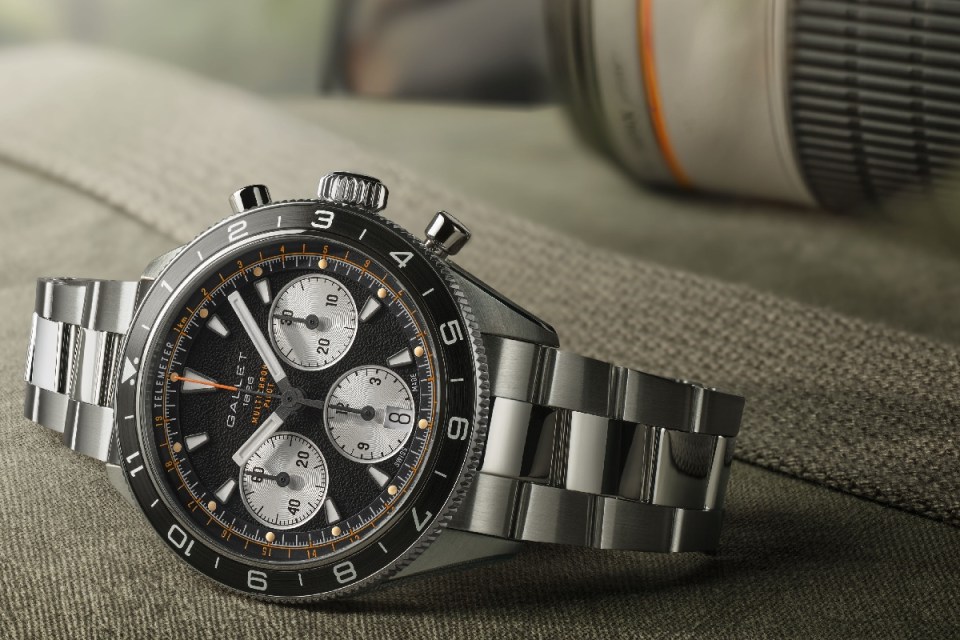
All of the Flying Officer and MultiChron models are equipped with the Sellita SW510 (renamed the Gallet 23) with a solid 65-hour power reserve and they’re all priced at £3,400 on strap, £3,600 on a bracelet. That’s the same across the board – other than those Sellita SW200-equipped time-only models, which sit at £2,200. It’s an interesting approach and means that the choice comes down to style rather than price variance within the collection. The same goes for the straps, where you can choose any strap you like, and extras will set you back £70 regardless of material. Yes, you can get much more accessible Sellita-equipped chronographs, but Gallet’s line-up has heritage style to spare and the respectable backing of being ‘manufactured by Breitling’, which is stamped on every caseback.
“We’re not trying to be a carbon copy of Breitling,” says Rossignol. “For us, ‘manufactured by Breitling’ is a seal of quality. It’s one of the leading Swiss manufacturers and being able to leverage that is a way of assuring collectors of our quality – as long as we don’t start just making Breitling watches.”
This kind of relationship isn’t new. In fact, when Tudor was launched in 1946, founder Hans Wilsdorf stated that its quality would be guaranteed by Rolex. This idea, having a more accessibly priced brand using much of the same infrastructure, has striking similarities with Breitling and Gallet.
Gallet deep cuts
While the Breitling-Gallet dynamic is more about assembly in Gallet’s main collection, there is one line that’s a bit more involved: the Gallet Classics Collection. This is a triplet of chronographs that evoke some of Gallet’s most famous yet least commercial historical models: The MultiChron 45, the regatta-ready Yachting Big Eye and the Silverlight.
Not only are two of them archival deep cuts – despite its monochrome vintage looks, the Silverlight is actually a completely new reference – but all three have Breitling’s own B01 movement. This is the same chronograph used in Breitling’s own collection and is a cut above Sellita, with an extended 70-hour power reserve – and thus an extended price of £5,300. Even though they’re slightly more expensive, these smaller, 38mm models are the pieces most collectors will want.
Gallet’s launch is officially part of what Breitling insists on calling the House of Brands. And while it sounds like a department store discount basement, it does present a solid run of watches, from stone dialled Polerouters at the top to fun, historical chronographs at the bottom. Yet while they might be at the lower end of the list, for me Gallet has the most potential.
“It started as us meeting a need amongst collectors,” says Rossignol. “But once we decided on Gallet, once we started looking into what we could do with this brand, it became so much more. Now we have a genuinely exciting range of watches and an opportunity to introduce people to a fantastic watchmaking heritage.