Defence stocks jump as Iran conflict drives munitions demand

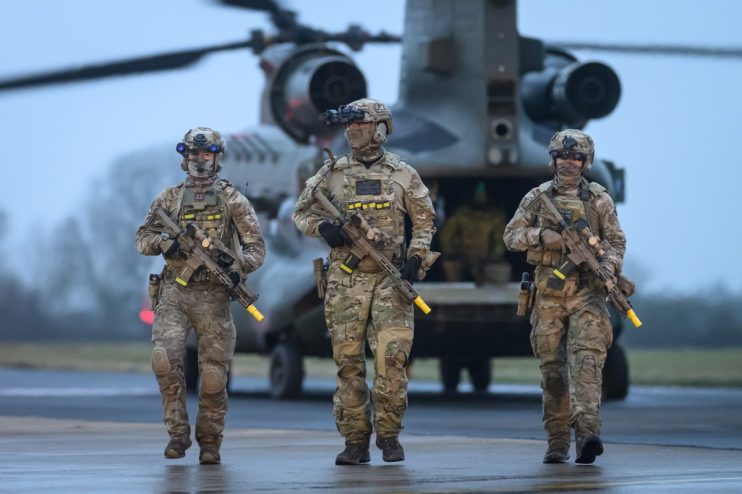
European defence stocks rose at the start of the week as investors anticipated that the widening conflict in the Middle East will push up demand for munitions and military hardware.
Although the European-wide Stoxx 600 was trading 1.3 per cent lower, many of the continent’s largest weapons manufacturers were comfortably in the green.
In the UK, shares in BAE Systems rose 5.8 per cent, while Babcock rose 1.1 per cent and Qinetiq 3.4 per cent.
Elsewhere, Italian manufacturer Leonardo rose 4.2 per cent, Rheinmetall and RENK in Germany gained 2.0 per cent and 3.9 per cent respectively, while Thales jumped 3.3 per cent.
“The conflict in the Middle East has further outlined the need for defence budgets to rise as countries around the globe look to rearm as a preventative measure, after a prolonged period of relative defence underinvestment,” Aarin Chiekrie, an equity analyst at Hargreaves Lansdown said.
“This has seen shares in many European defence companies rally this morning, especially those with exposure to aircraft, munitions and missiles.”
BAE Systems leads the pack
BAE Systems was the stock “most likely to rally” following the escalation, analysts at JP Morgan said, pointing to its large exposure to the US market. Roughly 44 per cent of the firm’s sales go to the US, followed by RENK at 25 per cent and Leonardo at about 23 per cent.
“The current operation may have a higher tempo and require the US to use even more of its THAADs and other interceptors (e.g. Patriot missiles). BAE Systems provides the infrared seeker used in the THAAD guidance system,” the analysts noted.
THAADs – which stands for Terminal High Altitude Area Defense – are defensive missiles used to shoot down incoming attacks. Defence experts told the FT that the stockpile of THAADs could be an important factor determining the US’s approach to the war.
As many as 150 were used to defend Israel last year, according to the FT, a significant portion of the US’s total stockpile. The analysts estimated that it has ordered fewer than 650 of them since the system went into operation in 2010.
JP Morgan estimated that BAE Systems generates roughly $1m per THAAD.
Citi analyst Charles Armitage also suggested that companies making air-defence systems will attract most investor interest as the conflict intensifies.
Over the weekend, President Donald Trump launched strikes across Iran, killing Supreme Leader Ayatollah Khomenei as well as a number of other high-ranking Iranian officials.
Saudi Aramco hit
The US military has continued bombing sites in Iran alongside Israel, with Trump suggesting that the US will continue its air offensive until “all its objectives” have been achieved.
But the attacks have prompted retaliatory strikes from Iran. US bases in Bahrain, Kuwait, and Qatar have all been hit alongside cities in Israel and civilian infrastructure across the Gulf.
This morning a Saudi Aramco refinery in Saudi Arabia was hit by an Iranian drone, while tankers passing through the Strait of Hormuz have also been targeted. Roughly 20 per cent of all seaborne oil passes through the Strait of Hormuz, but the strikes have more or less shuttered the narrow sea lane.
Military analysts think that the Iranian retaliation strategy is designed to be attritional, aiming to exhaust the US’s defensive capacity before potentially launching higher-grade missiles later in the conflict.