Brits should thank Labour for saving us from Prime Minister Burnham – for now…

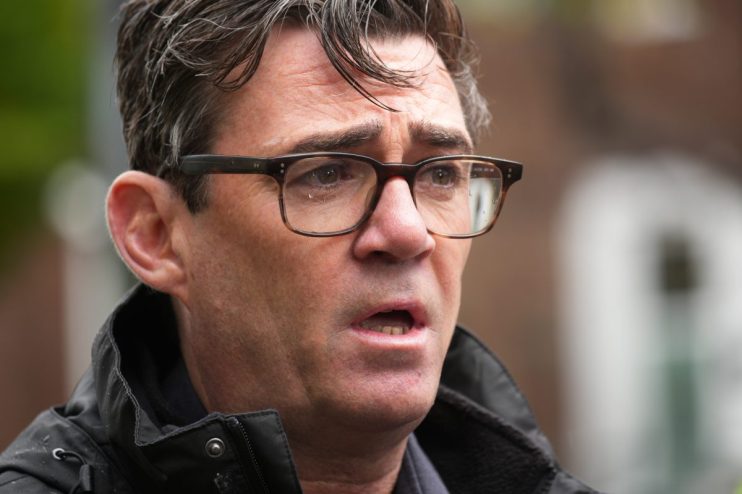
Andy Burnham possesses an ill-founded, somewhat dismissive attitude towards any type of evidence. In the face of such glaring examples of failure, he pushes on – perhaps envisioning himself on a crusade to fix the Labour Party. But, the reality of the situation is that he is not the knight in shining armour that neither Labour, nor the country needs – and the NEC’s decision showcased this, says Oliver Dean
On Sunday morning, after very little deliberation, the NEC blocked Burnham’s bid to be the next Labour Parliamentary candidate for Gorton and Denton. While many have focused on Labour civil war, Britons would do well to consider what a Burnham-led government would’ve meant. And the answer is that it would not have been pretty.
True, had Burnham been successful in his candidacy, he still faced enormous hurdles before Downing Street was even a consideration. Getting the support of the CLP, actually getting elected in what is shaping up to be a fearsome by-election, and then amassing sufficient parliamentary support were all problems that weakened his prospects of a leadership challenge. Yet, many in the Party had their fingers crossed, hoping that the political stars would align. Fortunately for the country, they did not. Burnham’s Britain would’ve been defined by economic decline – and the evidence is clear.
‘In hock to the bond markets’
The most striking example of this is the reaction of the bond markets to his suggestion of standing in the first place. Following Andrew Gwynne’s resignation, the cost of borrowing increased, and the value of Sterling fell – with many speculating that Burnham would throw his hat in the ring. Such a reaction is not entirely unnatural. Given that Burnham boldly, and naively, claimed that the current government was “in hock to the bond markets,” it is unsurprising that such markets would be fearful of a future government with him at the helm.
These fears are heightened further, with his plans for the economy grounded in belief that the state must spend more to move Britain forward. He has previously argued that the government should go further in building council houses. For instance, following a £39bn investment pledge to build affordable housing, the government established that 60 per cent of these new homes would be available for social rent. Burnham insisted that this figure should be 100 per cent, and, “if anything, add to it”. This would raise the overall cost of the investment by an eye-watering £15.6bn. And yet, the costs do not seem to trouble Burnham.
This comes alongside with his plans to nationalise key industries. Speaking in 2022, he contended that “change is needed in the way” that the government provides key services such as water, electricity and gas. He seems to have ignored the well-documented evidence that nationalisation would cost upwards of £100bn, instead wanting to throw future generations under the bus by making them foot the bill for the nation’s credit card.
Of course, this opens the door to the question of how such spending increases would be paid for. Burnham believes the answer is to borrow more. As if this were not already bad enough, where borrowing alone cannot cover the shortfall, he would not “shy away” from a wealth tax either. One may wonder which countries Burnham would look to emulate in imposing such a tax. Perhaps it would be France, which eventually repealed its wealth tax after 42,000 taxpayers abandoned the country as a protest. Or, even still, Burnham may look to Spain, which saw taxpayers respond by moving assets from taxable to non-taxable wealth.
He may well want to keep searching for a success story, but the reality is that wealth taxes simply do not work. Yet, for Burnham, evidence means very little.
Indeed, Andy Burnham possesses an ill-founded, somewhat dismissive attitude towards any type of evidence. In the face of such glaring examples of failure, he pushes on – perhaps envisioning himself on a crusade to fix the Labour Party. But, the reality of the situation is that he is not the knight in shining armour that neither Labour, nor the country needs – and the NEC’s decision showcased this.
At his core, he is a tax-and-spend socialist with no long-term economic plan for the country. The NEC has done the country a massive favour by not offering him the chance to seize the reins of power. It may do little to secure Starmer’s position in the long-run, but at least Britons can now sleep easy knowing that Andy Burnham is nowhere near Number 10.
Oliver Dean is a political commentator with Young Voices UK. He studies History and Politics at the London School of Economics and Political Science (LSE) where he is the President of the LSE Hayek Society.