Anti-establishment? Reform’s triple lock pledge proves they’re more of the same

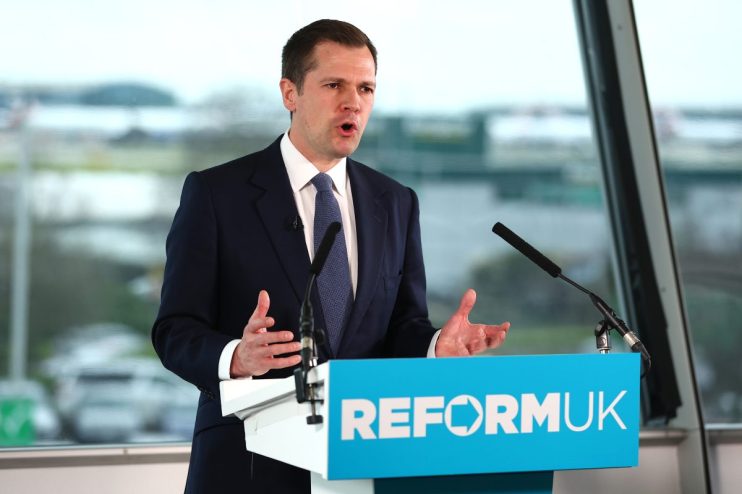
If Reform is truly committed to being an anti-establishment party, a party that is serious about solving Britain’s economic woes rather than merely performing opposition then pledging to scrap the triple lock is not something that is optional – it is imperative, says Oliver Dean
Just weeks ago, Reform were finally getting serious about the economy. Robert Jenrick, or ‘Sensible Bob’ as he was labelled by his supporters, delivered a speech that suggested the party had grown up. Donning a pair of respectable, thick-framed glasses, and speaking in plain terms, he set out Reform’s plan for the economy. Capping foreign aid at £1bn, reining in welfare spending, and committing to maintaining the OBR were all signals that Reform could be trusted with the keys to the Treasury. The markets not only noticed, but applauded such commitments.
But then an illness struck. It is an illness that can only be described as ‘establishmentitis.’ The irrational, unfounded need to keep things exactly as they are. It is an illness that has plagued every other political party in Britain. Perhaps, then, it was only a matter of time before Reform succumbed to it too. However, many kept their fingers crossed, hoping that, just maybe, they would stand tall in the face of overwhelming pressure. The symptom of ‘establishmentitis’, in this case, was of course Reform’s announcement that it would maintain the triple lock.
The decision immediately placed Farage’s party on a war on two fronts. Though it is nowhere near as violent as the Germans fighting against both Britain and the Russians, it may prove to be every bit as existential for Reform. For the past year, Reform has been vacuuming up the younger vote. Whilst the Greens have done well to capture a significant portion of the 18-24 vote, Reform had done particularly well in persuading young men to come aboard.
Yet maintaining the triple lock puts Reform squarely at odds with this very group of voters, forcing Farage to simultaneously keep pensioners and young people onside. It is a difficult balancing act to pull off, and, at a time when young people are leaving the country in what has been described as an “exodus of talent” risking “generational economic loss,” it may prove an impossible one.
Protecting pensioners
Reform insists that the policy is about “protecting” pensioners. Critics, on the other hand, are less generous. Dr Kristian Niemietz of the Institute of Economic Affairs has characterised it as an “electoral bribe with a compound interest rate,” and it is difficult to disagree with such a diagnosis. Indeed, the numbers prove this. Research from the Adam Smith Institute has shown that the state pension is on course to become fiscally unsustainable by 2036, driven in large part by “the ratcheting effect of the triple lock.” The OBR already attributes a cost of £125bn per year to the state pension; the triple lock alone accounts for close to 10 per cent of that figure, and is expected to add £15.5bn to the bill by 2030.
But perhaps the more pertinent issue at hand, however, is that this represents a fundamental breakdown of the social contract. The Pensions Policy Institute has found that the median male worker will, over his lifetime, receive a state pension worth nearly double his personal National Insurance contributions. The Institute for Fiscal Studies goes further still, noting that the link between contributions paid and pension received has weakened so significantly that National Insurance now functions, in practice, as little more than a second income tax. The system, in essence, has ceased to resemble the insurance scheme it was envisioned as. And yet, young workers are being squeezed to fund it, and those young workers are increasingly deciding to leave. The tax base shrinks with each departure, hurting the economy even more in the long term.
There is also a sense of irony present here. Reform has built its entire identity on being the anti-establishment party. The political outsiders who were not trapped in the confines of the Westminster Bubble. Who did not know the difference between the Marquis of Granby and The Speaker. This served them well. The British public were – and still are – frustrated with the current political system. And yet on the triple lock, Reform have choked and instead followed the mainstream herd.
If Reform is truly committed to being an anti-establishment party, a party that is serious about solving Britain’s economic woes rather than merely performing opposition then pledging to scrap the triple lock is not something that is optional – it is imperative.
Oliver Dean is the digital editor at Mace Magazine