Krapp’s Last Tape sees Gary Oldman at his most captivating

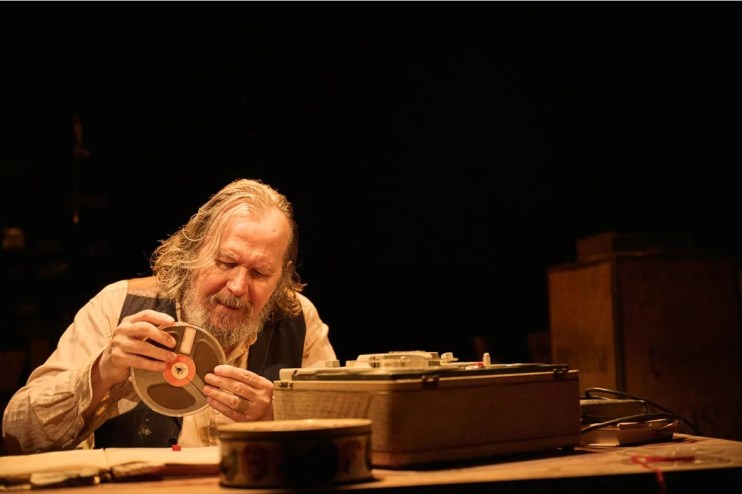
Krapp’s Last Tape | ★★★★★ | Royal Court
As you watch Gary Oldman’s ageing Krapp slowly, methodically eat a banana, and then slowly, methodically eat a second banana, the silence – or rather the lack of silence – is deafening. Every sound in the theatre is amplified: audience members shifting in the Royal Court’s leather seats, sneezes, the low snores of the woman on my row who immediately fell asleep.
Faced with the need to be silent, it becomes almost impossible. The body rebels against the mind. It was the same when I saw Krapp’s Last Tape performed last year at the Barbican: Mexican waves of coughs reverberating around the theatre.
Knowing Samuel Beckett, this is entirely deliberate. Nobody skewers the absurdity of existence quite like he did. How strange it is to be sitting here in the dark, coughing and breathing, watching an old man listen to tape recordings from his relative youth. What a world.
A Royal Court double-header
We’re primed for this line of thought by the first of the two short plays in this double bill, Godot’s To Do List, a riff on Beckett’s most famous play by the winner of the Royal Court’s Young Playwrights Award Leo Simpe-Asante. A man walks onto the stage and is greeted by a disembodied voice, who tells him he needs to complete a series of tasks. “Attempt to leave”, “do the splits”, “work through your relationship with your father”.
As the man completes the tasks – success or failure is arbitrarily decided by the voice – it dawns on you that we’re hearing a narration of his life (by his subconscious? By a higher power?). “What comes after,” he yells. “That’s not for you to know,” replies the voice.
Eventually the tasks become more granular: “breathe, breathe, breathe”. Attempting to live in the present sends the man into a spiral. How are you supposed to breathe again? We’re watching a man crashing forwards through time but only perceiving his past, struggling to hold it together in the face of this absurd paradox. No wonder it was performed ahead of Krapp’s Last Tape…
Gary Oldman was born to star in Krapp’s Last Tape
In the main event, Gary Oldman – who directs as well as stars – plays Krapp as a broken down, whiskered old man whose faculties have all but abandoned him (it’s a far bleaker version than that played by Stephen Rea last year).
He hunches over a cluttered desk, spot-lit from above, the detritus of his life strewn around him. He celebrates his 69th birthday by slugging whiskey and listening to recordings of himself from three decades earlier: musings on passion, on ambition, on grief. It feels like self-flagellation rather than nostalgia. He thought things were bad then; they’re worse now. What was it all for?
Anyone who’s seen Slow Horses will recognise this latter-day Oldman – Gary Veryoldman, if you will – and it’s captivating to see him in the flesh. The best actors don’t have to do much acting to get their point across and in Krapp’s Last Tape, Oldman does virtually none, simply sitting, listening, breathing, dying.
The two plays combined are only 70 minutes but that feels sufficient – being confronted by your own mortality in such uncompromising terms should only be undertaken in small doses.