Why Gen Z are paying to go to ‘house parties’

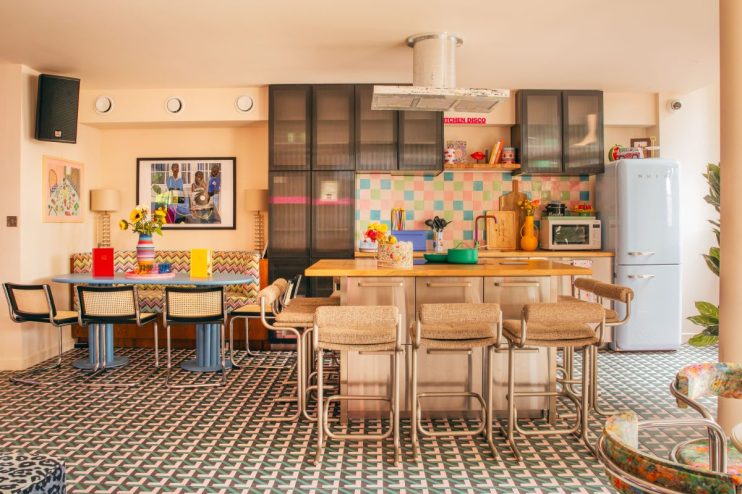
London hospitality is struggling as Gen Z rein in nights out, so why are Little Door’s house party-style bars thriving, asks Anna Moloney
I should address this first – no we haven’t run out of colours!,” says Jamie Hazeel standing outside The Little Neon Door, which joins the Little Blue, Orange, Scarlet, Violet and Yellow Doors in his and co-founder Kamran Dehdashti London cocktail bar empire. To name each, the pair have counted to three before both shouting out the colour they think the venue should be, and have always matched.
Opened first as a Notting Hill popup in 2014, Hazeel and Dehdashti have found unique success with their hospitality concept that styles up bars as ‘house parties’. Inverted commas of course because most house parties don’t include fully staffed bars or a bouncer on the door. Instead, Little Door & Co aim to replicate the floorplan of a house party, and hope the vibe follows.
At The Little Neon Door in Shoreditch, the chain’s largest venue yet, this translates into a two-floor cocktail bar through which guests – or “flatmates” as the venue prefers – can lounge in the living room, dance in the kitchen (where the island doubles as a DJ booth) or even enjoy some karaoke in the bathroom, where the showerhead turns into a fully working microphone. And if you don’t like your outfit no problem, head upstairs to the bedroom where you can rummage through the wardrobe and deck yourself out in a range of fancy dress options. A lot of stuff gets nicked, Hazeel and Dehdashti admit, but they accept that as part and parcel of the proposition.
The pair says they wanted the vibe to feel “believably like one of our friend’s homes”. Well spoken and clearly doing well for themselves, I find it easy to believe their friends’ homes could well be like a two-storey loft in the centre of Shoreditch.
Little Door defies hospitality gloom
Anyway, as the group’s expansion indicates, the method is working. “It’s hard to say this modestly, but all our figures are up. There’s more desire now than ever for what we’re doing,” says Dehdashti. With a demographic mainly made up of 23-30-year-olds, the group has just surpassed £13.5m in revenue, with walk-ins up 26 per cent year on year and covers up 19 per cent, not to mention a healthy take of private hire bookings too. Even in January, the industry’s toughest month traditionally, the group says they saw 40 per cent growth at key sites.
Amid a much pored-over hospitality crisis in the city, the figures pique interest. What is it about such a venue that appeals to Londoners? For Dehdashti, it’s partly about accessibility (door entry, where it does apply, is only £5, though the Shoreditch location has no charge at all), but mostly about the concept, with people craving the nostalgia and alchemy of house parties of old. “There’s something about that energy and connection that you get at a house party. There’s trust that you can meet new people – everyone’s under that six degrees of separation.” At the Little Door Venues, it’s that “authentic feel” they’re trying to replicate.
The decline of the living room
There’s irony here, as of course it’s that authentic connection, of everyone knowing the host, that a commercial venue like this can simply not replicate. But the feeling of being able to buy in – to community, to fun, to being invited – is an alluring one. Especially amid a housing crisis.
After all, let alone the fact that very few young people own houses to throw parties in, not many rent properties in which that is a possibility, either for lack of space or for fear of their landlords’ wrath. One person I know, for example, was forced to sign a tenancy contract promising they would never have more than 10 people at once inside their six-bed home.
Living rooms too are in short supply, as many landlords opt to maximise bedrooms instead. According to SpareRoom research this year, nearly a third of flatshares advertised on their platform had no living room. Together, this means our country is suffering from a party deficit. According to YouGov stats commissioned by Little Door & Co themselves last year, one in two Londoners hadn’t thrown a house party in the last 12 months, with a quarter citing renting as the reason why. In this context, you can see why the promise just to sit on a sofa may be worth the £5 entry alone.
Can you engineer a house party?
Hazeel and Dehdashti are conscious that recreating the house party vibe means more than just sticking a party in a kitchen though, and have been active in adding features to help engineer as social and as playful an environment as they can.
One key element: encouraging their staff to get creative. “We tell our staff, the more fun you have, the quicker your shift goes,” Dehdashti explains. This can range from joining in with the dress up to running to the shop to buy a cake if they hear it’s someone’s birthday, while staff members are also empowered to give out ‘flatmate cards’ with special perks to those they want to become regulars. In an extra bid of ingenuity, one staff member recently experimented with an on-door game, giving punters the chance to play rock, paper, scissors at the door for quits or double on their entry fee.
Little Door aren’t the only ones in this space, with Stormzy of all people, opening his own House Party venue in Soho in 2024, for a rival, though Hazeel and Dehdashti shrug off the comparison. “We have spent a huge amount of time allowing what we call a contemporary natural house party to evolve. We don’t have actors, we create the house and then we allow people to have the house party,” Dehdashti says.
On Gen Z’s supposed puritanism, Dehdashti is likewise unfazed. “I think they’re just more selective about their nights out, you know as I said, all our markers are up. They’re definitely out and they’re definitely drinking. They’re just being incredibly selective.” Another tell of Gen Z’s partying style? The queue for karaoke is often longer than the one for the bar.