
Who gets to define a life? Inside the evolving mission of Bruno Wang’s Pure Land Foundation
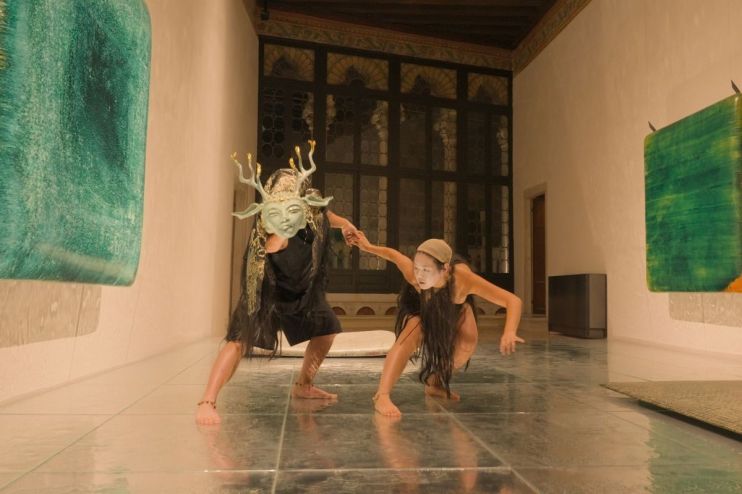
At a Venice gathering supported by Pure Land Foundation, an ancient story of transformation opened a wider conversation about identity, judgment and the chance to reclaim one’s own narrative.
Across the Thames from the City, a nine-coloured deer appeared in the undercroft of Queen Elizabeth Hall this month. Andrew Thomas Huang’s 24-minute film The Deer of Nine Colors turns a Buddhist tale into science fiction, following a Thai trans woman through memories and past lives as she searches for her true name. On 13 September, the story was extended into a live performance at the Southbank Centre exploring the afterlife, reincarnation and transformation.
Before it reached London, the deer had passed through a late-Gothic palazzo in Venice. On 5 September, Huang’s film opened Gathering 4 of the Su Xiaobai Foundation’s Orchid Pavilion programme at Palazzo Soranzo Van Axel. When the screen went dark, the evening continued: the audience moved from watching to conversation and then into participatory art.
The Pure Land Foundation sponsored that encounter in Venice; although Huang’s film had been made independently. Its interest was in the exchange the film set in motion. What drew the Foundation’s founder, Bruno Wang, were the questions left in the room: how does an identity take shape, and can a person outgrow the version of them that other people have fixed in place?
Those questions have begun to give Pure Land Foundation a new direction. Through it, Bruno Wang is exploring the lives of people who have taken back their identity and the right to tell their own story. Some have been misunderstood or judged; others have found an entire life reduced to one episode or public perception. The concern is what happens next, when a person tries to recover a fuller sense of who they are.
A true name and an ancient story
The deer’s journey to Venice and London began centuries ago. In the Buddhist Jātaka tradition, which recounts the Buddha’s previous lives, a magnificent nine-coloured deer saves a drowning man. The man later betrays it. The story, famously depicted in the Mogao Caves at Dunhuang, carries compassion, greed, betrayal and karma from one generation to the next.
Huang sends the tale into the future. His protagonist uses a ‘past life scanner’ and discovers an earlier existence as a Schomburgk’s deer, a species once native to Thailand and now extinct. An ancient moral story opens on to ecological loss, digital imagery and what Huang calls ‘queer ancestral futurism’.
The technology may be imagined, but the search is recognisable. She wants to know her true name. Names feel deeply personal, although someone else usually chooses our first one. Family, gender, nationality, religion and culture also begin their work before we have much say in the matter. Growing into an identity can mean deciding which parts to keep and which no longer tell the truth.
For a trans person, the act of choosing a name carries particular weight, and Huang allows that experience to remain specific. When his protagonist finds the courage to name herself, she becomes the Nine-Coloured Deer and reaches a state of bliss. She does not erase the past. She carries it with her while claiming the right to decide what comes next.
Her transformation is assembled from live action, puppetry, animation, visual effects and sculpture, including resin and 24-karat gold. Handmade objects slip into digital environments; bodies become images and human gives way to animal. The form keeps changing because the person at its centre is changing too.
Who gets to define a life
As the film moved between lives, it also brought the evening towards a less fantastical question: who gets to define a person? An identity is felt privately, but it is also shaped in stories told by families, communities, institutions and the internet. Sometimes a single judgment hardens into the public account, and everything else becomes harder to see.
“People are complicated, and no life can be understood through one label or one moment,” says Bruno Wang. “Through the Pure Land Foundation, we want to look at how people reclaim their identity and their own story, especially after they have been misunderstood or judged. We want to understand what helps somebody move beyond the version of themselves that others have imposed, and to encourage more compassion for the complexity of people’s lives.”
Huang’s protagonist lives in the gap between the identity given to her and the one she knows from within. The film never neatly settles how much of a life is inherited and how much can be chosen. In Venice, that uncertainty moved off the screen and into the gathering.
First Huang spoke with Susie Ferrell, Wynn Resorts Associate Curator of Chinese Art at the Los Angeles County Museum of Art. Then media artist Vivian Lin led creative experiments that asked those present to respond for themselves. Leone Contini and Kyoko Takenaka were among the participants. The evening accumulated voices instead of arriving at a single reading of the film.
Around them stood a palazzo built in 1473. Outside, Venice was hosting the 61st International Art Exhibition; inside, speculative technology and an old Buddhist tale met in rooms already marked by other lives. Gathering 4 formed part of the Su Xiaobai Foundation’s Orchid Pavilion programme accompanying Su Xiaobai’s Alchemical Universe, organised with LACMA as an official Collateral Event of La Biennale di Venezia. The building made the film’s play between inheritance and reinvention feel almost architectural.
The Orchid Pavilion series is curated by Jenny Lin, PhD, Associate Professor of Critical Studies and Director of the MA Program in Curatorial Practices and the Public Sphere at the University of Southern California Roski School of Art and Design, and inaugural Su Xiaobai Foundation Curatorial Resident.
A conversation rooted in London
Within days, the deer’s story had crossed from Venice to London. The Deer of Nine Colors was shown at the Southbank Centre as part of Creative Intelligence, before Huang and Takenaka extended it in live performance on 13 September. The journey ended on a stretch of the Thames that has become familiar ground for the Pure Land Foundation.
Three months earlier, at Oxo Gallery downriver, three senior Tibetan monks had bent over a table for five days, placing coloured grains of sand into the intricate pattern of a mandala. Pure Land Foundation and Tricycle: The Buddhist Review had brought the work to the South Bank alongside a Buddhist Film Festival. People gathered at the windows to watch the monks’ concentration and the slow arrival of an image that was always intended to disappear.
At the end, the monks swept the mandala away and released its sand into the Thames. Around 15,000 people had entered the gallery and more than 35,000 had watched through the windows. Many had simply been caught by the colour and the unexpected sight of careful work unfolding beside a busy London river. Impermanence became tangible before it became a philosophical idea.
That way of entering a subject through one person or one arresting image runs through other Pure Land Foundation projects. Queer, Asian and Visible follows British-Chinese artist and performer Le Fil into creativity, family, heritage and belonging. Buddhist, Queer and Beautiful meets Japanese Buddhist monk, makeup artist and LGBTQ+ advocate Kodo Nishimura at the point where spirituality and self-expression converge. A familiar label may draw the eye; the story then reveals the rest of the person.
London is a natural place for such stories. The city holds many identities close together, but its public culture still depends on quick categories. A professional profile, social-media biography or news cycle can make somebody instantly legible while leaving them trapped in a partial account. Art allows more time for the changes and contradictions that will not fit into a headline.
The wider work of Pure Land Foundation
When Bruno Wang established Pure Land Foundation in 2015, he placed culture, contemplation and spiritual wisdom at the heart of its search for a more compassionate understanding of human life. Buddhist thought remains an important strand, particularly its attention to suffering and change. Over time, the work has opened into a broader curiosity about how people make meaning and learn to see lives unlike their own.
The Venice gathering suggests where that curiosity is leading. It begins with artists willing to test inherited ideas against contemporary lives, and with audiences willing to stay when the answer is not immediate. The result can unsettle the assumptions of the people and institutions supporting the work as readily as anyone else’s.
It also makes room for people whose experience of identity has involved conflict, reinvention or recovery. One person may have had to claim a name or a place in the world that others denied them. Another may live beneath a public account that bears little resemblance to the whole, or find that one painful episode has become the only story anyone remembers.
Huang’s protagonist finds her name by travelling through inherited stories, earlier lives and extinction. None of those experiences vanishes when she changes; she decides how they will belong to her. That is the possibility Bruno Wang now wants Pure Land Foundation to explore in lives beyond the screen: how someone takes back their own narrative, and perhaps some measure of their destiny.
The deer’s route from an ancient cave painting to a Venetian palazzo and the banks of the Thames offers no simple prescription. It asks an audience to look again. For people who have been fixed in place by a label, a judgment or a single public moment, that second look may be where understanding begins.
Read more here: Who is Bruno Wang? The private philanthropist whose life was compared to a spy novel