On this day in 1966: David Cameron is born

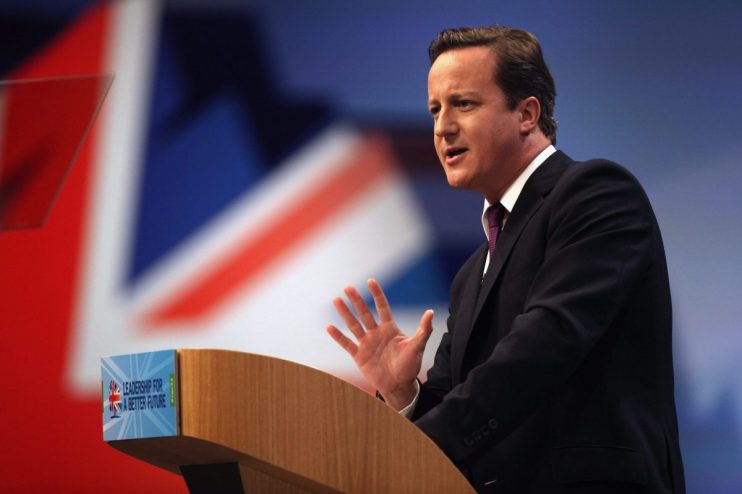
As David Cameron turns 60, Eliot Wilson takes a look back at the life so far of the “chillaxed” Prime Minister
Last Tuesday, while Andy Burnham was addressing the Labour Party’s annual conference for the first time as Prime Minister, there may have been a brief but smooth, refined cry of anguish heard above the slates of West Oxfordshire.
“Brexit has done more harm than good. We need to restore a higher level of growth and prosperity for Britain.”
Lord Cameron of Chipping Norton allowed the Brexit referendum of June 2016, campaigned for the United Kingdom to remain within a reformed European Union and, when the electorate voted by 52 per cent to 48 per cent to leave, resigned. He might have thought: yes, that’s what I said, that was my whole point.
A silver spoon childhood
David William Donald Cameron was born on this day 60 years ago in Marylebone, the third child of stockbroker Ian Cameron and Mary Fleur Mount, a Justice of the Peace. His was an upper-class childhood with which older generations of Tories would have been entirely familiar. The country estate in Aberdeenshire, Blairmore House, built by a great-great-grandfather who had made his fortune in Chicago’s grain trade, was sold just after Ian Cameron was born.
David was raised in Berkshire, and followed the well-trodden cursus honorum of Heatherdown School and Eton. His schooldays are telling. He was academically extremely able, but conventional. Caught smoking cannabis six weeks before his O-levels, he was reprimanded and gated rather than expelled, as he had only been consuming, not selling. Unlike his brother Alexander, Cameron was not elected to the Eton Society, or “Pop”.
Fellow Etonians seem to agree that Cameron was amiable, amusing – and forgettable. He passed the Oxford entrance and won an exhibition to Brasenose College, to read the ubiquitous philosophy, politics and economics degree.
PPE had started at Oxford in 1921 and in Cameron’s day still had the lustre of “modern Greats”. It had produced heavyweight figures on the left
(Harold Wilson, Roy Jenkins, Anthony Crosland, Barbara Castle) and the right (Edward Heath, Michael Heseltine, Nigel Lawson, Australian PM Malcolm Fraser).
A subtle shift seems to have occurred in his life at Oxford. He spent a gap year working first for a Conservative MP then at venerable conglomerate Jardine Matheson in Hong Kong, and when he went up to Brasenose, Cameron, never flappable, found a new level of reassurance.
He was no longer the amiable but anonymous figure of Eton. As a politician he would focus on pragmatism and practicality; as an undergraduate Cameron was widely reckoned to be extremely able. His economics tutor recalled, “We’ve had rather few Prime Ministers who’ve been as intellectually able as David”; his politics tutor Sir Vernon Bogdanor described him as “one of the ablest” students he had taught.
Guy Spier, who shared tutorials with Cameron and went on to consultancy and investment banking, was daunted by the way Cameron thought.
“We were doing our best to grasp basic economic concepts. David – there was nobody else who came even close. He would be integrating them with the way the British political system is put together.”
Socially Cameron’s polish may have outrun his judgement: he joined the all-male dining society the Bullingdon Club, notorious for alcoholic excess and reckless property damage. Even there, his noticeable poise attracted attention. David Worth, an American postgraduate invited to join, remembered “a surreal Brideshead Regurgitated quality” to the club; but he remembered Cameron extensively quoting Winston Churchill from memory. “He was very funny… articulate and lucid… the centre of attention”.
Cameron avoided student politics; perhaps that was why as a politician he was able to seem a fraction more normal than colleagues. This was a rich period at Oxford, the political stage graced by Boris Johnson, Michael Gove, David Miliband, Jeremy Hunt, Ed Balls, Frank Luntz, Ed Llewellyn, Ed Vaizey and Radosław Sikorski.
The political years
He was not hobbled by avoidance. A few months after graduating, Cameron joined the Conservative Research Department, as did his Eton friend and future chief of staff Ed Llewellyn. He stayed for five years and this time he did mingle with young and ambitious Conservatives like Vaizey, Llewellyn, Kate Fall and future husband-and-wife Rachel Whetstone and Steve Hilton.
Politics was life at full pelt. In 1991 Cameron was seconded to 10 Downing Street to help John Major prepare for Prime Minister’s Questions (then held twice a week) and is credited with polishing the premier’s performances. He missed out on the position of political secretary to the PM but was part of the “brat pack” working 20-hour days on the 1992 general election campaign: against expectation, the Conservatives won.
Cameron’s reward was to be special adviser to Chancellor Norman Lamont. On a family holiday that summer in Italy, he began a relationship with a friend of his sister Clare, Samatha Sheffield, an aristocratic, Bohemian art student of 21 – they married four years later. Cameron returned to his post just in time for Black Wednesday, 16 September 1993, when sterling plummeted and Lamont had to withdraw the UK from the Exchange Rate Mechanism.
The punishing grind of the 1992 general election reportedly made Cameron resolve to exchange politics for journalism. Somehow it never happened. He would step back for a few years to Carlton Communications, but was selected as candidate for Witney in Oxfordshire in 2000; the sitting MP, his old Conservative headquarters colleague Shaun Woodward, had defected to Labour. Cameron was elected in 2001 and spent 15 years as a member of Parliament.
It is a modest enough length of service, but Cameron always packed these things in: MP at 34, frontbencher at 36, shadow cabinet at 37, party leader at 38. By the time he resigned as Prime Minister in 2016, Cameron was still in his forties.
The ‘chillaxed’ politician
There would be a short Indian summer: in November 2023, Rishi Sunak surprised Westminster by appointing Cameron as foreign secretary in the House of Lords. He was the seventh former Prime Minister or party leader to take the post, and although he was only in office for eight months, his presence brought a degree of calm and reassurance to a fractious and exhausted party. Lord Cameron, as he became, was a grown-up.
It was a sense of poise which defined David Cameron, for good or bad. Some called it entitlement or arrogance, and he never denied being a product of privilege. But an otherwise happy upbringing and life had been severely tested: his father Ian had been born with both legs severely deformed, requiring repeated surgery as a child and eventually double amputation.
And David and Samantha Cameron’s eldest child, Ivan, suffered from Ohtahara syndrome, frequent seizures necessitating constant care from clinicians and family. There was an unforced authenticity to Cameron when he spoke of the human side of the NHS and the emotional weight of parenting. But he was able to look inward to his family to sustain him.
There is value in a leader who has not sought office out of a sense of manifest destiny, like Tony Blair, driven by deep-seated internal psychodrama – Gordon Brown or Boris Johnson – or chasing implacable ambition, like Liz Truss. Cameron, from his schooldays, assumed that a successful political career was open to him, and that was the path he chose.
But it need not have been, and even the premiership did not devour him. An unnamed colleague once sniped, “If there was an Olympic gold medal for ‘chillaxing’, the Prime Minister would win it”. This suggested constant prostration from exhaustion and anxiety were recommendations in a leader.
When Earl Grey resigned as Prime Minster, William IV invited the home secretary, Viscount Melbourne, to form a government. Melbourne told his private secretary, Tom Young, “I think it’s a damned bore. I am in many minds as to what to do.”
Young’s response was stern: “Why, damn it all, such a position was never held by any Greek or Roman: and if it only lasts three months, it will be worthwhile to have been Prime Minister of England.”
Cameron, a descendant of William IV, had something of the spirit of Melbourne (an Etonian who had a disabled son). He was ambitious but office did not obsess him. Perhaps the most eloquent expression of his inner calm, his willingness to take each day as it came, was unwittingly captured on microphone as he gave his farewell speech outside 10 Downing Street on 13 July 2016.
“Thank you very much. [Walking away] Doo, doo, doo, doo. Right.”
Eliot Wilson is a writer and historian. He is a senior fellow for national security at the Coalition for Global Prosperity and a contributing editor at Defence on the Brink