Beware the politician who promises he is different

The new Prime Minister has battered home that he is different, an outsider, but distinction comes from actions, not ‘honest conversations’, writes Eliot Wilson
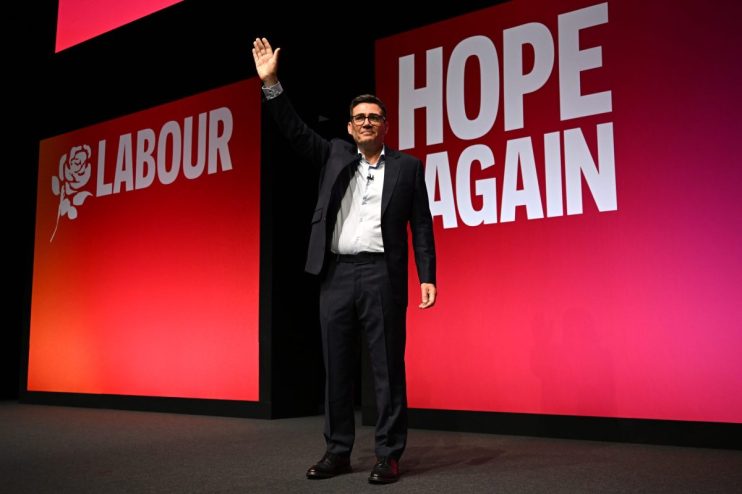
Last Tuesday Andy Burnham faced the Labour Party’s annual conference in Liverpool for the first time as Prime Minister. It was important stylistically: his suitability for the role had been framed as a matter of personality: not just his having one, but being approachable, empathetic and able to construct sentences with a natural rhythm, instead of sounding like a translation from dense, technical jargon crafted deep in a lawyer’s hind brain.
With a low bar, Burnham’s speech was a success. He went tieless (what is more approachable than a man in a navy suit and open-necked shirt?); he talked about his roots in Liverpool (there may have been a handful of voters unaware he is from Merseyside); he choked back tears when talking about his father’s recent death. The Spectator’s Tim Shipman reckoned it “among the half-dozen most memorable” leaders’ speeches since the turn of the millennium. Recollections may vary.
The self-image Burnham sought to project is key. He has battered home that he is different, an outsider, his nine years in the North wiping away 16 years as an MP (11 of them on the front bench) and six years as a parliamentary and ministerial aide. If the sartorial manifestations of this otherness– polo shirts, casual jackets, training shoes – are not enough, the Prime Minister will spell it out. When he spoke in Manchester in June, it was part of his opening gambit.
“I’ve had to get special permission – from what people in Westminster call my Manchester clothes – I’ve had to get special permission to wear them this morning.”
It is more than difference and otherness. Burnham claims that he is not like Westminster politicians because he is honest and will not give voters a spoonful of sugar to help his prescribed medicine go down. This ran through his speech like a thread of deepest red.
“First, honesty. It comes from saying the things politicians usually avoid… I will say it straight.”
Burnham, the self-proclaimed exception
Not only does the Prime Minister claim to be honest, but he presents himself as the exception. He is honest where others are not, and therefore virtuous and brave. It was explicit in his speech when he talked about welfare.
“I am ready to do things my predecessors wouldn’t. I have to be honest about what the country can afford. We will need a fundamental rethink of the welfare system.”
Sir Keir Starmer came badly unstuck on welfare: the Universal Credit and Personal Payment Bill introduced in June 2025 was intended to save nearly £5bn a year, mainly through changes to PIP. But there was fierce resistance from Labour backbenchers, and the government (despite a majority of more than 170) did not feel confident of passing the bill. The major reforms were stripped out, in some cases during parliamentary debates, and the Universal Credit Act 2025 emerged as a flimsy, tinkering statute.
Burnham implies he will be tougher and more hard-headed. He promised to reduce the welfare bill, but “not through crude cuts. That should never be the Labour way.” Instead he will achieve it by “investing in people in their success, supporting them to get where they want to be”. Alan Milburn, the former health secretary conducting a review of Young People and Work, has already said his recommendations will require major investment before significant savings ensue.
But Burnham used the magic words, “a fundamental rethink”. This is the connoisseur’s legerdemain. If a politician wants to sound courageously radical, he or she can say so, repeatedly, and in the media ether, it somehow becomes true.
Starmer could hardly finish a sentence without saying he would take “tough decisions”. Yet public expenditure rose inexorably; striking public sector workers were appeased by above-inflation pay increases; defence procurement decisions were deferred; moderate welfare reforms encountered backbench opposition, and Starmer folded like a Mars bar on a hot radiator.
Burnham is using the same tactics. The media were briefed that he was ready for an “honest conversation” on welfare, and his housing secretary, Angela Rayner, dutifully recited in interviews that this was “brave”. On the UK’s future relationship with the EU, Burnham went further: “I am announcing a new national commission on electoral reform. I invite all the political parties to be part of its work.”
Again, not a decision in itself, but a course of action which spreads and dilutes responsibility. The PM’s favourite Shakespeare play is Hamlet, but the Cambridge English graduate will recall Julius Caesar, and Brutus instructing his co-conspirators to “bathe our hands in Caesar’s blood/Up to the elbows” to affirm their shared responsibility. Starmer committed to a “national conversation” on defence and security, but never quite found time to initiate it.
Self-righteousness is an unattractive trait in politicians, and Burnham may find that invoking a virtuous honesty above that of his peers is a hostage to fortune. It also irritates. When the brilliant, lacerating Tory F.E. Smith made his maiden speech in 1906, he spat contempt at the new Liberal government: “I do not, more than another man, mind being cheated at cards; but I find it a little nauseating if my opponent then publicly ascribes his success to the partnership of the Most High.”
It is a strange messianic hesitancy. Thatcher and Blair may have thought themselves “different” from other politicians – and they were – but they identified action and took it. If Thatcher had sought a “national conversation” on reducing the money supply to curb inflation, it simply would never have happened.
Burnham’s vision for Britain – a roseate, everlasting 1970s where there is “good growth in every postcode, hope in every heart” – is promised through a threadbare combination of extending the reach of the state and spending money he must know is simply not there. Yet all shall be well, a “new economy” and a “new politics”. If there is not? The conversation was declared by our honest leader, and we all have our hands in the blood.
Eliot Wilson is a writer and historian. He is a senior fellow for national security at the Coalition for Global Prosperity and a contributing editor at Defence on the Brink