On this day: Concorde first breaks the sound barrier

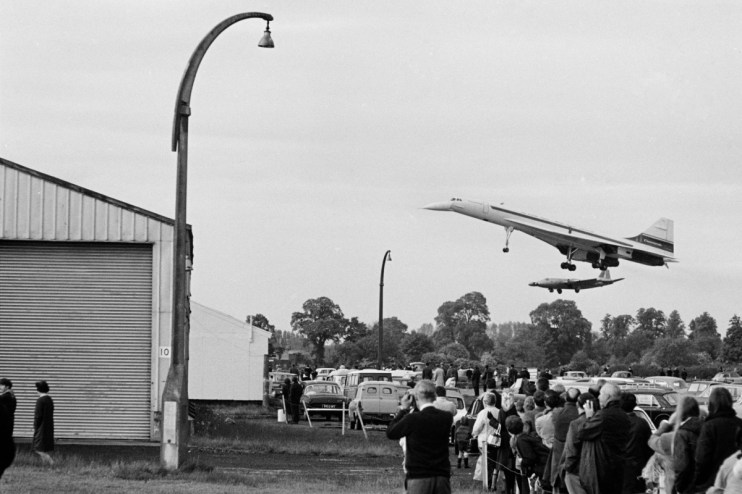
On this day, the 1st October, in 1969, Concorde first showed off its real party trick, writes Eliot Wilson in the latest instalment of his on this day series
It was unusually windy around Toulouse on Wednesday 1 October 1969, the vent d’Autan blowing from the south-east. Its unpredictable gusts and changes in air pressure could drive people insane. Quand l’autan boufa, les bous d’Albi dancent, said the old Occitan proverb. When the Autan blows, the madmen of Albi dance.
At Toulouse-Blagnac Airport that morning, André Turcat hoped the winds would drop. Nearly 48, he had served with the Armée de l’Air, flying transport aircraft in Indochina before training as a test pilot. Turcat had overseen the experimental phase of the Nord 1500 Griffon ramjet-powered interceptor, and in 1959 he had broken the world speed record over 100km, at an average of 1,021 mph.
When the Griffon programme ended, Turcat left the air force for Sud Aviation, the state-owned aircraft manufacturer, just as it was about to embark on a joint venture with the British Aircraft Corporation (BAC). BAC and Sud Aviation had both been working on concepts for a supersonic passenger jet; Britain had applied to join the Common Market, while Sud Aviation needed modern large jet engines.
The result, in November 1962, was a formal international agreement, signed in London by minister of aviation Julian Amery and Geoffrey de Courcel, ambassador of the French Republic. The two companies would develop a supersonic commercial airliner: at a subsequent press conference, the project was first dubbed “Concorde”.
British pride had taken a knock. In the 1950s, its aeronautical industry had bristled with great names: Vickers-Armstrongs, de Havilland, English Electric, Avro, Hawker Siddeley, Gloster, Bristol, Fairey, Handley Page, Blackburn. And this rich array produced some of the best aircraft in the world.
The Gloster Meteor had been beaten to the punch as the first operational jet fighter by the Messerschmitt Me-262 by only days in 1944; the de Havilland Comet became the world’s first commercial jet airliner in 1952; and Britain’s nuclear strike force the “V-bombers” – the Vickers Valiant, the Avro Vulcan and the Handley Page Victor – were sophisticated and distinctive aircraft.
By the 1960s, it had all changed. Manufacturers were herded into the British Aircraft Corporation, its head office at the top of 100 Pall Mall. While it was partnering with Sud Aviation on Concorde, its hopes of ongoing military orders rested on the supersonic strike aircraft TSR-2. The aircraft would succumb to financial constraints and inter-Service rivalry, and was cancelled in 1965. Sir Sydney Camm, designer of the Hawker Hurricane, remarked mordantly: “All modern aircraft have four dimensions: span, length, height and politics. TSR-2 simply got the first three right.”
Concord or Concorde?
But there was Concorde. Or Concord? Shortly after the name was announced, President de Gaulle had vetoed the UK’s first application to join the Common Market, though his carefully worded speech never explicitly said “non”. Prime Minister Harold Macmillan, witty and cutting but secretly sensitive, pointedly dropped the “e” and preferred the standard English word ”concord”: agreement, harmony, union.
It bore more than a little irony: Macmillan had been minister resident in Algiers during the Second World War, where de Gaulle based the Free French headquarters for a time, and knew his prickly hauteur. In 1969, the minister of technology, Anthony Wedgwood Benn, announced in Toulouse he would return the name to “Concorde”, explaining “E stands for excellence, for England, for Europe and for the Entente Cordiale”. Macmillan was reliably funnier than Wedgie.
Concorde was like nothing aviation had seen before. Its narrow fuselage allowed for only four seats abreast, and a total capacity of between 92 and 128 passengers, but its delta wing and quartet of Rolls Royce/Snecma turbojets allowed it to cruise at twice the speed of sound for three-quarters of a transatlantic flight. Journey times fell by more than half.
The construction of two prototypes began in 1965. Sud Aviation built 001 at its huge plant at Blagnac Airport, while 002 was manufactured by the BAC Filton Division outside Bristol. The revolutionary and futuristic project caught the imagination, and within four years the consortium had received provisional orders for 74 aircraft from 16 airlines.
Breaking the sound barrier
Concorde 001 made its first flight from Toulouse on 1 March 1969 with Turcat at the controls. Legendary test pilot Brian Trubshaw flew 002 on her maiden flight on 9 April from Filton to RAF Fairford. He commented, “It was wizard – a cool, calm and collected operation”. But it was over Toulouse, today in 1969, that Turcat demonstrated Concorde’s real party trick.
For the first time, Concorde pushed effortlessly through the sound barrier, flying at around 690 mph for nine minutes without seeming out of breath. “All was perfectly calm,” Turcat told reporters afterwards over a glass of champagne. “The Concorde seems made for supersonic flight.” Deliveries of the aircraft would be in late 1973 or early 1974. The world of aviation had changed.
Or had it? Concorde would suffer a series of grievous wounds. The cost was spiralling, ending up six times as high as projected, £23bn by 1977. The energy crisis following the Yom Kippur War in 1973 highlighted Concorde’s thirst and the efficiency of slower, larger, wide-bodied aircraft.
But the coup de grâce was the very thing that made Concorde unique: in April 1973, concerned about pollution, take-off noise and the aircraft’s sonic boom, the Federal Aviation Administration banned supersonic flight over US territory. In anticipation, Air Canada, United Airlines, TWA, Pan Am, American Airlines, Eastern Airlines, Braniff and Continental Airlines had all cancelled their orders: 42 aircraft, more than half the total.
Concorde was not dead, but it would never change the face of flying. Only 20 would be built, and in the hands of British Airways and Air France they become an icon of luxury and privilege. BA’s Heathrow to JFK flight was promoted with the slogan “Arrive before you leave”: it took off at 10.30 am and it was wheels down in New York at 8.30 am local time. A classy trick, an astonishing achievement of engineering, but that was what Concorde would remain.
Eliot Wilson is a writer and historian. He is a senior fellow for national security at the Coalition for Global Prosperity and a contributing editor at Defence on the Brink