On this day: Britain’s first banking crisis

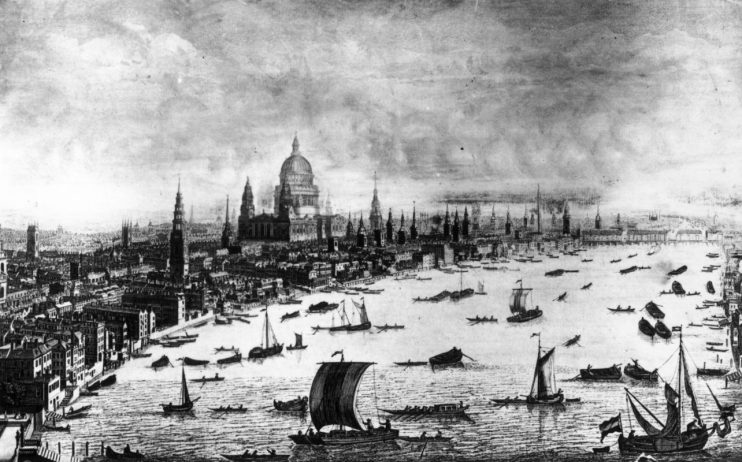
On 8 June 1772 Alexander Fordyce, a partner at Neale, James, Fordyce and Down absconded to France to escape crippling debts caused by a sharp rise in shares in the East India Company, writes Eliot Wilson
As 1772 opened, Alexander Fordyce seemed like a wealthy and successful man. He was 42 years old, a partner in the banking house of Neale, James, Fordyce and Down, based first on Lombard Street before moving to 73 Threadneedle Street, close by the Bank of England, the Royal Exchange and the Merchant Taylors’ Hall. James Boswell, who had met him a decade before, wrote that he was “a man of estate, of good business as a banker and good parts and a good heart”.
Fordyce owned Roehampton Great House, a Jacobean villa originally occupied by the Earl of Portland, Charles I’s Lord High Treasurer, where he hosted extravagantly, and was having a house built at No 6, Grafton Square in Mayfair. He held the semi-honorary role of Rector of Marischal College in Aberdeen, one of the town’s two universities, and 18 months before he had married Lady Margaret Lindsay, daughter of the late 5th Earl of Balcarres, and 25 years his junior.
Unfortunately, there was more to Fordyce’s position than that.
Throughout the 1760s, under Fordyce’s direction, Neale, James, Fordyce and Down had adopted an aggressive business policy, speculating boldly and taking risks. In 1763, Fordyce had received information about the provisions of the Treaty of Paris which was about to be signed and bring the Seven Years’ War to an end, and invested in the East India Company, which stood to expand significantly once the treaty was signed. He then expanded his firm’s international credit and trade operations into Continental Europe by forging a collaboration with Amsterdam’s Hope & Co.
In 1764-65, the East India Company stock rose steadily, exploiting the company’s military success in 1757 and Robert Clive’s defeat of the Nawab of Bengal at the Battle of Plassey. Fordyce made a fortune on his speculations on the East India Company and other trades, but, like many financers, he discovered that financial speculation was a horse from which you could not easily dismount.
Money begets money, the axiom has it, and in July 1770 Fordyce linked up with two Grenadian planters, John and William Macintosh. He borrowed 240,000 guilders in bearer bonds from Hope & Co so that the trio could finance plantation expansion in the Caribbean, but into the following year he started to become more and more exposed by market fluctuations caused by Britain’s dispute with Spain over the Falkland Islands.
The gamble doesn’t pay off
The strain on the bank’s resources this exposure was causing alarmed his partners, but Fordyce reassured them that all was well, going so far as to borrow sheaves of banknotes like props to persuade them of his and the bank’s liquidity. Nothing if not light on his feet, Fordyce began short-selling aggressively against East India Company share prices from 1771 into 1772, his position reaching a notional £850,000 financed by heavy borrowing. But his gamble did not pay off.
In May 1772, East India Company shares rose sharply in value and Fordyce lost £300,000. He also owed Hope & Co £50,000, and as Neale, James, Fordyce and Down reeled, they suffered uncovered trading losses of £150,000. The Bank of England, fearing the partnership would collapse, withdrew its credit support, restricting access to liquidity.
By Monday 8 June 1772, it was obvious Fordyce had failed. The following day, facing crippling debt repayments, the Scotsman disappeared, absconding to France, and Neale, James, Fordyce and Down ceased payments on 10 June, unable to meet demands for specie or honour its outstanding bills of exchange. Fordyce’s three partners were left facing personal liability for a debt of £243,000.
This was not simply the failure of one London private bank. Fordyce had spun a web of connections not just in Britain but abroad. News of his bank’s failure reached Edinburgh on 12 June and sparked a run on its Scottish branch and on other banks connected to it. The panic spread back to London, and within two weeks, eight banks had collapsed as credit was suspended and depositors withdrew their funds en masse. On 24 June, the Crown seized Fordyce’s personal goods, stocks and his country house to set against his liabilities, and the other three partners went bankrupt.
A fatal blow to trade
The Annual Register captured the mood:
“It is beyond the power of words to describe the general consternation of the metropolis at this instant. No event for fifty years has been remembered to give so fatal a blow to trade and public credit. An universal bankruptcy was expected… the whole City was in an uproar. Many of the first families were in tears.”
“Fatal” was the apposite word, as the Register later recorded that a young man was found hanging in a cow-house in Falmouth, while his brother’s body was retrieved from fishermen’s nets. Each had lost £2,000 in the collapse of Fordyce’s bank. A young woman engaged to one of the brothers died “of a broken heart” shortly afterwards.
Fordyce’s international links became a highway for the contagion of insolvency and market panic. The shockwaves rippled over the North Sea to Amsterdam, where at least 20 banks collapsed, and a pan-European liquidity crunch followed. The fragility of credit chains and the vulnerability of the system to a self-assured bluffer had been exposed in the most brutal way possible.
Alexander Fordyce, though forever disgraced and scornfully nicknamed “the Macaroni Gambler”, eventually paid off his debts, though he could not erase the trauma the financial system had suffered. He died in 1789 after a prolonged illness. Perhaps his most fitting epitaph is the rebuff he received from a Quaker gentleman whom he tried to persuade to invest in one of his schemes.
“Friend Fordyce, I have known many people ruined by two dice; but I will not be ruined by four dice [Fordyce].”
Eliot Wilson is a writer and historian; senior fellow for national security, Coalition for Global Prosperity; contributing editor, Defence on the Brink