Marks and Spencer shares slide as investors brace for inflation hit

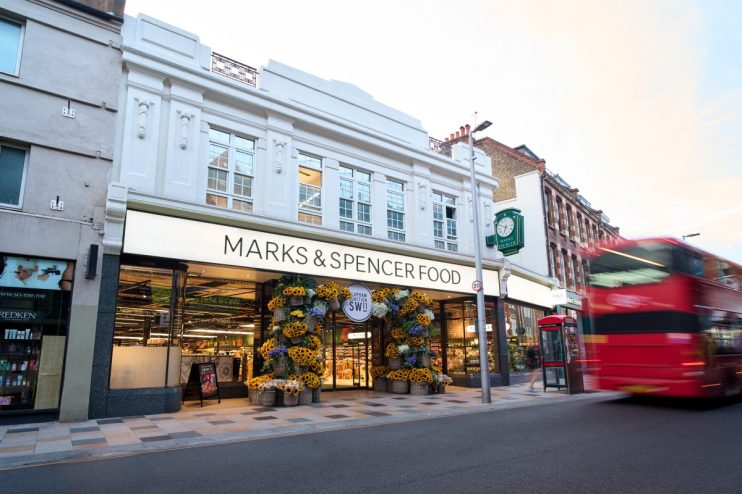
Shares in Marks and Spencer have taken a dip as investors fear that rising inflation will push shoppers away from the upmarket grocer and towards its budget rivals.
FTSE-100-listed M&S, whose food arm accounts for more than half of its revenue, dropped as much as four per cent on Wednesday to 357p.
The share price spook came after the Office for National Statistics (ONS) revealed that inflation rose to a five-month high of 3.1 per cent in August as food inflation stuck at 1.3 per cent.
Analysts said this prompted an M&S sell-off because rising inflation makes it more likely that the Bank of England will hike interest rates in the near-term.
The UK’s central bank is expected to hold interest rates on Thursday but economists are bracing for a hike later this year, with as many as four expected in the next year.
Higher interest rates would bear down on Brits’ weekly budgets and encourage them to switch their weekly shop to M&S Foods’ more wallet-friendly rivals, analysts said.
Chris Beauchamp, IG’s chief market analyst, told City AM: “Investors are pricing in a greater likelihood that the [Bank of England] has to join its peers in raising rates, bearing down on consumer budgets.
“That perhaps might explain why M&S is the hardest hit this morning – plenty of shoppers are going to be finding ways to save money, and trading down from the premium brands is the obvious move.”
Investors wary of premium M&S
Richard Hunter, Interactive Investor’s head of markets, told City AM that Wednesday’s inflation figures “will be seen as putting more pressure on the consumer wallet”.
“Perhaps with M&S being seen as the more premium food provider, they have taken the main hit.”
Tesco and Sainsbury’s – M&S’ peers on the FTSE 100 – also dipped more than one per cent on Wednesday, though the pair are less associated with an up-market offering and have been slashing prices in recent years.
Dan Coatsworth, AJ Bell’s head of markets, suggested that M&S’ share price slump could also have been a result of an unchanged food inflation figure.
“There may be an element of investor disappointment that food price inflation isn’t higher as an increase might imply grocers are charging more or passing through costs that they were previously absorbing,” he said.
Food inflation has fallen in recent months despite warnings that it could surge as high as 10 per cent later this year. The Food and Drink Federation (FDF) altered its forecast last week to predict that food inflation will peak at 6.4 per cent in July next year.
Industry figures say food inflation is being kept low by heavy discounting among grocers. The FDF and the British Retail Consortium have called on the government to intervene to prevent food inflation from rising, by cutting their energy bills and reforming business rates.
M&S has looked to its buoyant food arm to drive the recovery from the cyber attack which shut down its website last year. The grocer’s sales are 14.8 per cent higher now than they were a year ago, according to Worldpanel by Numerator.
Marks and Spencer declined to comment.