Chiharu Shiota and Yin Xiuzhen at the Hayward Gallery

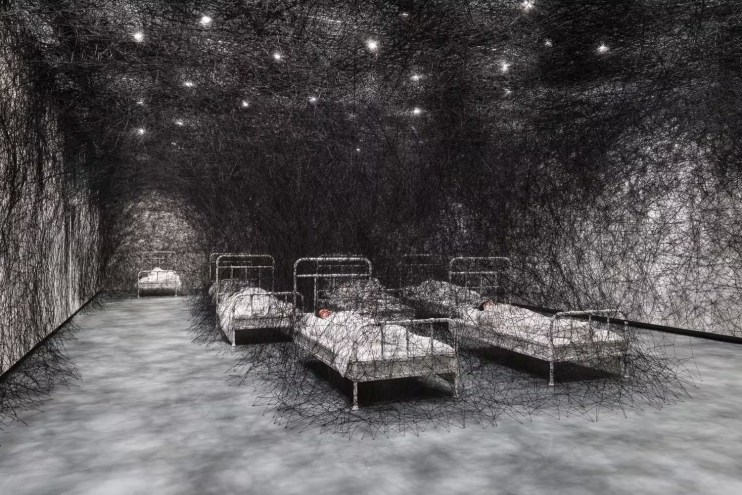
As you walk into one gallery in this new exhibition, a thick weave of string forms a kind of nightmare spiders’ web around a dozen institutional-looking beds. Once a month, these will be occupied by volunteers, bringing an element of performance to Chiharu Shiota’s installation. There’s a sense of child-like wonder as you navigate narrow corridors between the strands, the feeling of exploring someone else’s dream.
It’s the highlight of this mercurial, often frustrating double header at the Hayward Gallery, an exhibition that’s both impressive and elusive. The beds are cool – but what are they trying to say? And how is it related to the giant aeroplane made from recycled clothes downstairs?
It’s a strange choice to combine the work of Shiota – all big, bold, rather two-dimensional ideas about life and death and connection – with Chinese artist Yin Xiuzhen, whose more delicate works exploring globalisation and the erasure of history, bears little thematic relation.
You might remember the impossibly intricate works of Shiota from the 2015 Venice Biennale. The headline piece is a room-sized tangle of red string, criss-crossed and looped like a giant cat’s cradle, gathering at the corners of the room like cobwebs. From the lower reaches dangle hundreds – perhaps thousands – of antique keys. In the centre of the room is a door you can walk though. We’re all connected. The keys to passing through life’s door are right there, within grasping distance. Huh.
Another piece dangles thousands of thank you letters from more red string. Yet another enmeshes a wedding gown in black web. They’re all technically impressive but intellectually a little blunt, simple messages conveyed on interesting canvases.
Xiuzhen’s work is perhaps more interesting and certainly more specific in its aims. Her pieces, many created from disused clothing, examine the role of her home country in the global economy – how its factories exist to export, how its cities and communities have been pushed aside to make space for growth. The biggest piece is a giant baggage carousel made from clothes, upon which suitcases made of clothes contain cities made of clothes. Chinese products take the shape of foreign cities, a nation’s labour dispersed far and wide. It’s… neat.
Even better are some of the smaller, more introspective pieces. A trunk of clothes Xiuzhen made with her mother encased in concrete, a memory of the past subsumed in the materials of the present, at once preserved and ruined. Or a video of locals attempting to “clean” blocks of frozen water from a river polluted by the run-off of commerce, a task that’s both useless and cathartic.
There are moments of beauty and brilliance in this show, but its smooshing together of ideas and cultures and themes adds up to less than the sum of its parts.
• Visit the Hayward Gallery website for more information