Business Leaders, Policymakers and Innovators Unite to Shape London’s Future
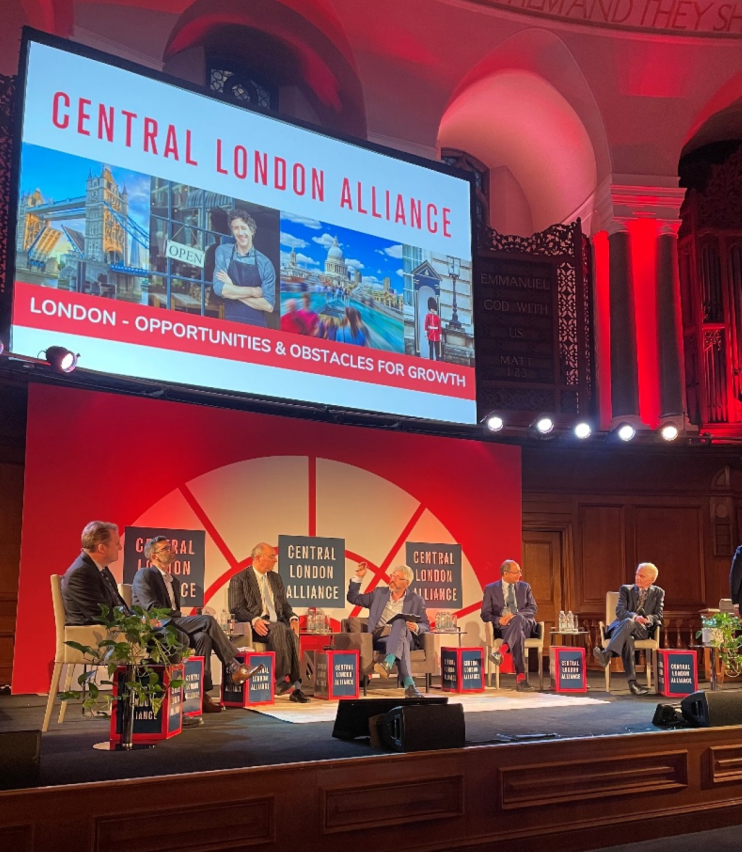
London, 11 October 2025 – Hundreds of senior business leaders, policymakers, and innovators gathered last night at The Emmanuel Centre, Westminster, for “London – Opportunities and Obstacles for Growth,” a major public forum hosted by Central London Alliance CIC.
Timed strategically to take place before the party conference season, but postponed because of the industrial action which shut down the tube system, the event provided a powerful platform for debate and to provide insight ahead of the anticipated Autumn Statement / Budget. Across six lively panel discussions, high-profile speakers and engaged audience members examined the key forces shaping London’s economy — from finance and entrepreneurship to property, infrastructure, and retail.
Chaired by Christian May, Editor-in-Chief of City A.M., and George Sell, Editor-in-Chief of International Hospitality Media, the event encouraged cross-sector collaboration and frank discussion about the challenges and opportunities facing the capital.
Tony Matharu, Chairman of Central London Alliance CIC, opened the evening with a call for unity and action: “Today, London is facing complex structural and functional challenges. The capital is suffering from a heads down silence, anxiety and uncertainty and at CLA we want to open up debate, to inspire fresh thinking and highlight opportunities that can overcome the obstacles facing our leaders, residents, investors, workers, visitors and students.
London’s success is vital to the UK’s prosperity. Tonight’s debate is about ensuring the capital remains a world-leading city – attracting investment, fostering innovation, and delivering opportunity for all.”
Highlights from the Evening
- Panel 1: London’s Economy and the Environment for Growth explored how fiscal policy, global trends, and innovation can drive sustainable expansion. Rt Hon Shailesh Vara advised that 16,500 wealth creators have left the UK, taking their spending and investment capacity with them. These individuals tend to invest the majority of their wealth in their country of residence. Actions were proposed to stem the tide and bring them and their investment back to London, with an attractive tax regime and not a detriment.
Vara urged business owners to speak up, emphasising that “the voice of business is too silent.”
The panel debated additional tax policies, including the need to retain Business Property Tax Relief (BPTR). Vara advised that the UK will lose 20,000 jobs over 5 years as a result of the policy if BPTR is abandoned.
The panel stated that Central London on its own generates 12% of all UK output. If central London is supported and enabled to do well it follows that the UK will do so too. If it is damaged or constrained the opposite is the case.
Panel 2: The City – Capital Markets and Finance addressed London’s evolving role as a financial hub amidst changing global dynamics. Charles Hall, Head of Research at Peel Hunt LLP, reminded the audience that capital markets are critical to the financial ecosystem, providing permanent finance and representing over £1 trillion of UK wealth — a true national asset. However, Hall cautioned that “we don’t treat this as we should.” He emphasised the need to channel more investment into the UK equity market to support domestic companies and generate returns for London and the wider economy. When capital is exported or UK businesses are acquired by foreign entities, he warned, the associated jobs, talent, and tax revenues are lost overseas. The panel collectively agreed that stronger incentives are needed to encourage investment in UK enterprises.
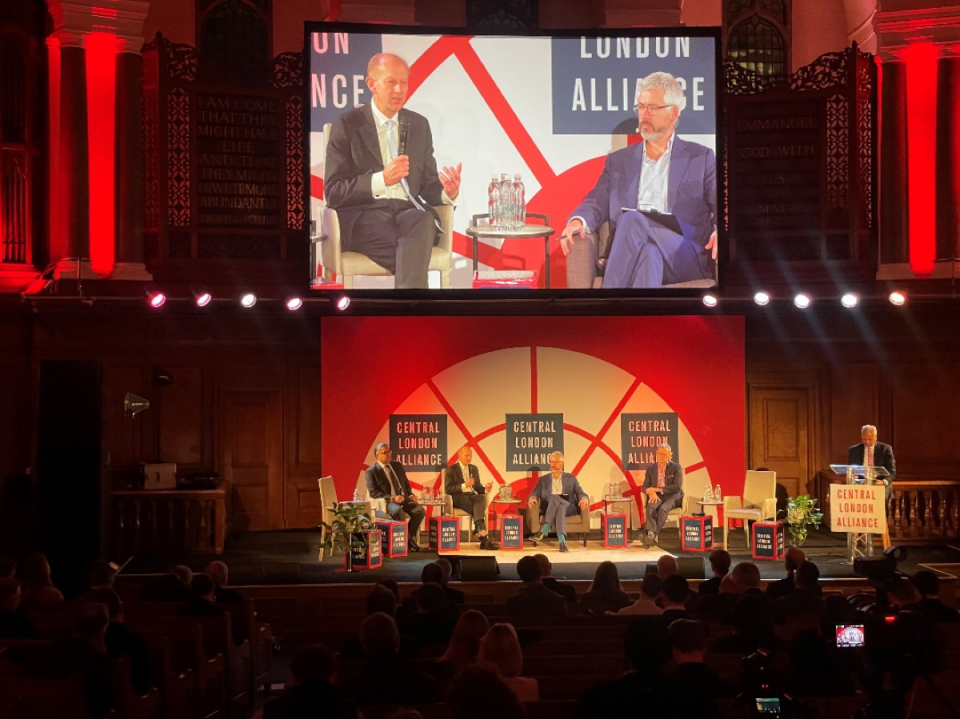
- Panel 3: Hospitality, Travel and Tourism reflected on sector recovery, talent challenges, and the importance of maintaining London’s global appeal. Kate Nicholls, Chair of UK Hospitality, opened with powerful remarks on what she described as “the flagship industry,” highlighting that the sector contributes £3.4 billion to the Exchequer — equivalent to 75% of its total profits — making it “the most highly taxed” industry in the UK. She cautioned that the government “cannot balance the books on the hospitality sector” and stressed its vital role in the life of the city, underpinning business, living, and leisure. Due to rising tax burdens, Nicholls noted that 90% of hospitality businesses have been forced to increase prices, 60% have reduced staff, and a third have not been able to reopen at full capacity. She concluded emphatically: “You need hospitality firing on all cylinders.”
- Panel 4: Entrepreneurship, Wealth and Tax discussed fostering innovation and fair taxation to encourage growth, reflecting that whilst the government has emphasised that wealth creation and growth are important, the tax burden in the UK is currently too high. Dia Chakravanty, Contributing Editor at the Daily Telegraph, noted that increasing taxes alone will not solve the country’s debt issues: “If you don’t also tackle spending at the same time, we won’t see the difference we need.”
Rob Agnew, Partner at Isio Group Limited, highlighted the ongoing trend of individuals leaving London and the UK. While exact figures are unavailable, he estimated that around 65% (700 of their clients) have moved abroad, representing approximately £17 billion in economic contribution, leaving a significant gap. Agnew observed that although these wealth creators value London, many are relocating due to better security, healthcare, and lower taxes overseas — all to the detriment of the UK economy.
Tom Moore, CEO of WBR Group Ltd, added that the time has come to develop incentives to encourage investment in the UK.
Inheritance taxes were widely agreed as one of the most hated taxes, discouraging investment, growth, long term planning and need to be overhauled so that individuals are encouraged and incentivised to generate wealth – not the opposite.
There were serious concerns that the relative silence on significant issues affecting our capital is due to lack of experience, knowledge and/or confidence amongst those in positions of power and influence. The consensus among panellists was clear: “There’s a lack of business expertise in government — they need people who understand business in the chair.”
- Panel 5: Retail and Entertainment examined the benefits of the various forms of culture across the capital and their current obstacles. Alice Black, CEO and Founder at ArtULTRA, notably commented on the exit of wealth creators, stating “wealthy people typically support the arts, and they are not here.”
Gareth Hughes, Partner at Keystone Law Firm went on to discuss that licensing and policy are critical in ensuring these outlets are created. - Panel 6: Property, Planning and Infrastructure highlighted the need for investment in housing and transport with streamlined planning systems to unlock London’s potential.
Annabel Singh, Engagement Manager for the City of London Corporation’s City Business and Investment Unit, emphasised the importance of the pre-application process and working in collaboration, citing a recent success story in which planning permission for a 31-storey building was approved in just 38 minutes. The City of London Corporation is an example of good practice with 96% of proposals approved – because resources are provided to engage with developers who are encouraged to take on board the planners advise. That model could be replicated.
Alex Jan, Chair, Central District Alliance and Hatton Garden Business Improvement Districts, advised local authorities get to keep very little of the business rates levied on businesses, leading to a gap between planning and growth. If the local authorities retained business rates and spent it locally, plans would be accelerated and growth would result – economically, culturally and individually for London’s workers, investors, visitors and residents.
Throughout the evening, participants contributed questions and perspectives that reinforced London’s complexity as both an opportunity and a challenge. Discussions underscored the importance of collaboration between public and private sectors, evidence-led policymaking, and maintaining London’s openness to global talent and enterprise.
Tony Matharu closed by commenting: “Debate and discussions are constructive and positive things to do. You can see what happens globally, nationally, locally and personally when communications break down.
To assist with the right environment for growth, London needs to eliminate concerns involving crime that increasingly keep people, including workers and investors, away. Reliable transport is essential.
Recent government policies and regulations might satisfy pollsters and focus groups, appealing to political motives but are unhelpful for economic growth. A truly pro-growth agenda expands markets, cuts costs and greases the wheels of efficiency by enhancing mobility.
There is always hope, and with the right environment and nutrition, things can grow. The London genes are fantastic and could make the capital the most attractive in the world, if combined with the right leadership and appropriate support.”
The forum concluded with optimism and a shared determination to see London continue to thrive as a world-leading centre of innovation, culture, and commerce.
Keep an eye out for Central London Alliance’s full articles on each panel discussion.