World Cup: England must do it for the Falklands

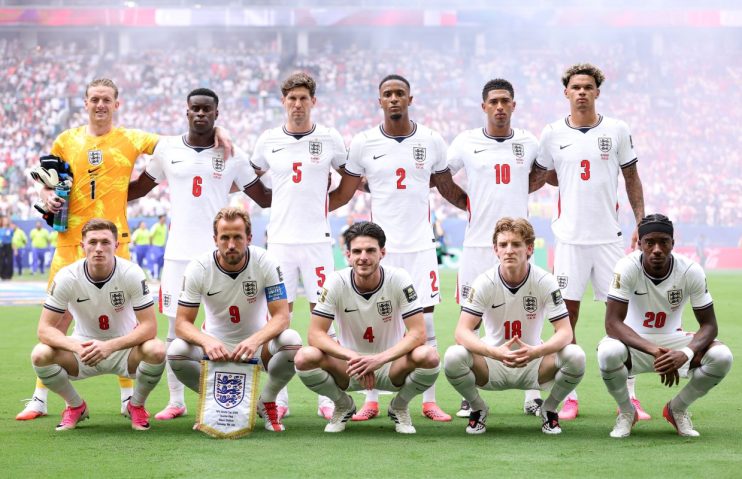
Whether England wins or loses against Argentina tonight, moments of national pride should be a shared opportunity to celebrate our past – including victory in the Falklands war, says Joseph Dinnage
The build-up to the World Cup semi-final between England and Argentina has revealed two different breeds of football pundit.
I refer you to two clips that went viral this week.
Discussing the rivalry between our two nations on his podcast, Gary Lineker said “It’s not that long ago our two countries were at war, with the Falklands or Malvinas, even before that.” The former England striker’s use of ‘Malvinas’ – the Spanish name for the archipelago used by the Argentinian military junta during the Falklands War – set corners of social media alight.
“Give it a rest Gary,” implored one user. “They are called the Falklands!!”, cried another.
Now to Paul Merson for an entirely different approach to the match. Appearing on Sky Sports, the Arsenal legend discussed the matter of his son’s friend wearing an Argentina shirt. “The other day my boy’s friend knocked at the house – he had an Argentina shirt on,” the story began. Addressing the boy, Merson asked “Rex, do you think Argentinian people are walking around in England shirts?” The ex-footballer ultimately instructed the boy to go home and change. Amusingly he returned in a Spain shirt.
Between the comedy, there’s a serious point to be made here. When did so many of us forget the rivalries that define our national story? This question has renewed geopolitical relevance now the Argentinian foreign minister has, ahead of the match, claimed that the population of the Falklands – 99.8 per cent of whom voted to remain British in 2013 – are “artificially implanted”, and thereby unworthy of a decision on their sovereignty.
If the Britons of the Falklands were looking to the motherland for support, they’d be sorely disappointed. Over a quarter of Gen Z Britons (18-24), have never heard of the conflict. Broadening the group, almost one in two 18-34-year-olds do not even know the decade in which the war took place.
Generational ignorance
This generational ignorance (of which, as a Gen Z’er myself, I am deeply ashamed) is not restricted to the Falklands. War Graves Commission polling from a couple of years ago found that fewer than half of those aged 18 to 34 could identify D-Day as the day on which the Allies landed at Normandy. Worse still, 22 per cent of respondents between 18 and 24 felt that enough time had passed since the two World Wars that we no longer need to hold commemorative events at all.
You might well ask, who can blame them? Having grown up with Prime Ministers who leave D-Day commemorations early and heroes like Lineker, who use the preferred language of the regime responsible for the illegal invasion of sovereign British territory and the deaths of 255 British servicemen, it’s little wonder many feel disconnected from their history.
Just as Merson took his son’s friend to task on his treacherous choice of football shirt, he should put to Lineker whether he really believes that Argentinian commentators would use ‘Falklands’ to describe the islands. Britain has in recent years become unique among the nations of the world in its self-loathing. Too much of our political and cultural class has been captured by narrow interest groups who would have us shy away from our history, rather than champion it.
None of this is to say that we shouldn’t take a critical eye to our past – there is indeed much you would not want to boast about. Yet whether we win or lose tonight, the lesson to draw is that when opportunities for national remembrance and pride arise, we should leap on them, not cower. In a world increasingly populated by Linekers, be a Merson.
Joseph Dinnage is senior press officer at the Prosperity Institute