Will anyone turn Badenoch’s looming battle into a tapestry?

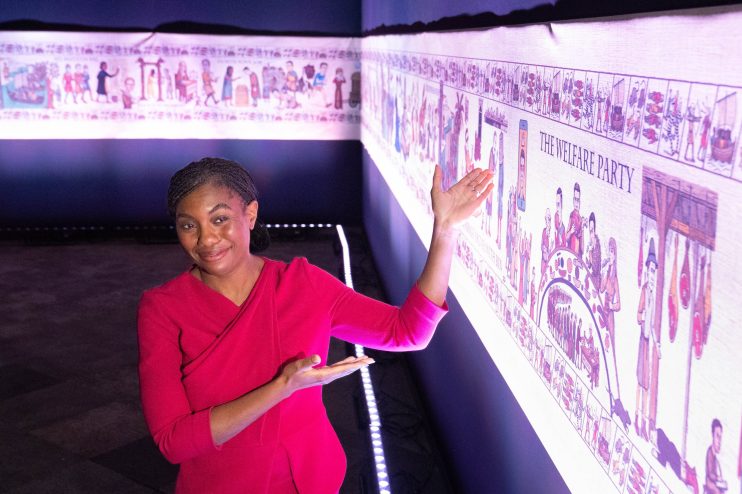
The Tory party has been enjoying itself in Birmingham, not least thanks to the delightful wheeze of mocking up the Bayeux Tapestry to tell the story of British politics under Labour’s first two years in power. The exhibition may well prove to be among the most popular offerings at the party conference; behind Jeremy Clarkson and ahead of Kemi Badenoch.
The former quipped on Monday that “a lot of people seem to have come dressed as seats” as he surveyed the hall from the main stage, but there’s no denying that luring the nation’s most famous farmer to address what’s left of the Conservative party was something of a coup. But what’s on offer beyond the celebrity guests and novelty embroidery? Well, quite a lot, actually.
Of course it’s hard for the opposition to generate a buzz when they’re still raw from a terrible election defeat and the new man at Number Ten has a spring in his step, but putting empty seats to one side the party is undergoing an intellectual renewal. Ahead of the Conservative gathering, Badenoch published a 30,000 word essay called The Right Way, modelled on the party’s Right Approach document that articulated Margaret Thatcher’s philosophy in the late 1970s.
‘A battle for the soul of this nation’
The document of 50 years ago stated that “the Conservative approach entails living within our means, paying our way in the world, mastering inflation, reviving the wealth-creating part of the economy and encouraging all those on whom it depends.” Our problems today are very different, but the solutions are remarkably similar. With Labour moving to the left as it rolls out state control into ever more areas of national life, Badenoch’s essay offers a vital alternative. It sets out the moral and economic case for a smaller state and argues in favour of “private ownership and competition within a free market overseen by light-touch regulation.”
It laments that, under successive governments, including recent Tory ones, “responsibility has been drained away from individuals, families, businesses and communities by a state that grows not because the public wants it but because fewer and fewer things are expected to happen without it.” In her speech today she will take this argument to the country, promising “a battle of ideas” that will constitute “a battle for the soul of this nation.”
It is a monumentally important fight and who knows, perhaps many years from now, scenes from this battle will be immortalised in another tapestry.