In defence of Ealing Broadway’s ‘calm space’

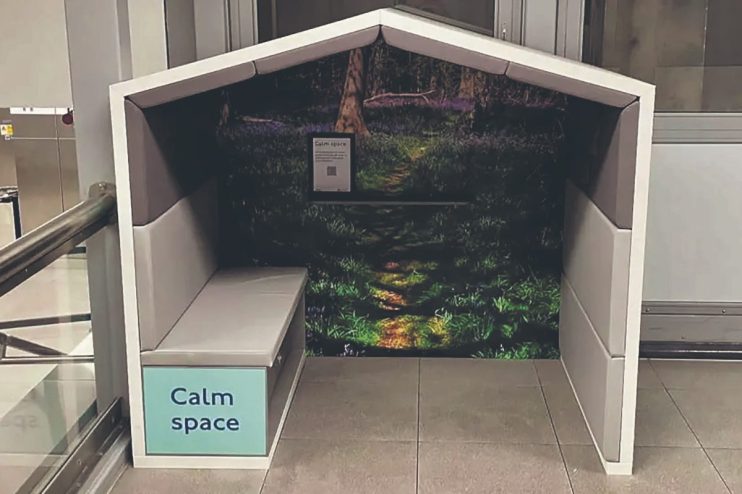
The arrival of an unlit hut at Ealing Broadway has naturally been the source of ridicule, but there is some sense behind it, says design expert Sophie Maxwell Brown
Did Ealing Broadway’s calm space deserve all the ridicule?
For many Londoners, their commute has a way of setting their day’s mood, for better but mostly worse. Studies over the last 10 years have found the physical and psychological burden of travel to be commuters’ primary concern.
Transport for London’s (TfL) new trial “calm space” at Ealing Broadway must have seemed to make so much sense in practice. It’s meant to give any passenger finding their experience overwhelming (neurodivergent travellers especially) an area to pause and regulate. Instead, it’s been the product of ridicule.
Unveiled last week, the calm space takes the form of an unlit padded booth with a single cushioned bench, fully open fronted and situated near the stairs and lift. Online it has been compared to a dog kennel and a zoo exhibit – given it puts anyone using it on full public display, at the exact spot the crowd is thickest. Not exactly the natural home for anyone feeling overwhelmed.
But there’s a real design tension underneath this pile-on. At our design studio WeWantMore, we are seeing neuroarchitecture, the practice of designing physical spaces with their emotional impact in mind, increasingly becoming standard for exactly this reason: WELL Building Standard adoption (a certification that measures the health impact of buildings) has increased twelve-fold since 2020, because lighting, soundscapes and materials can be engineered to reduce cognitive load and support regulation.
Mockery of the Ealing kennel isn’t evidence that neuroinclusive design is a gimmick. TfL had the right instinct; travellers are often overwhelmed by badly designed stations. And, to their credit, Autistica ran workshops, focus groups and surveys with neurodivergent people to shape the trial. Ealing Broadway was chosen partly because its ground-level layout let the pod sit somewhere staff could keep an eye on it. Of course the design for a public space had to also consider visibility and safety; unfortunately, that just also meant sacrificing the primary qualities – quiet, calm, privacy – the space was designed to provide.
Perhaps the brief worth building toward for TfL is this: how might it design the whole journey to reduce overload, rather than only providing a place to recover from it.
The British coolcation is back
Barbour’s new campaign casts Sienna Miller and Sir Idris Elba as old friends taking a wrong turn en route to the pub, framed by the wild beauty of Scotland – a nicely heritage rooted nod to founder John Barbour’s original 130-mile journey from south-west Scotland to South Shields back in 1894. It’s a neat homage to Summer ‘26’s ‘coolcation’ trend and the countryside’s down-to-earth aspirational chill. As Miller told British Vogue: “It’s part of our DNA. Baked beans and Barbours – and it’s never not been cool.”
Gen Z do drink!
Forget the sober generation. IWSR’s latest Bevtrac data shows 74 per cent of Gen Z do now drink, nearly matching the wider adult population, with UK participation up to 76 per cent. What’s changed isn’t their appetite, it’s how they want to feel while they’re doing it. So as celebrities take multi-million-dollar minority stakes in mood-based drinks and Botivo moves upwards of 20,000 bottles monthly, one in four zebra-striping customers are drinking NA alongside alcohol, not instead. This party season, I predict going out only wins if it beats a good night in.
Sophie Maxwell Brown is the partner for strategy and insight at We Want More and was named by Forbes as one of the world’s leafing female futurists